AI Humanizer Tools Tested: HumanizeAI.pro vs MyDetector vs SuperHumanizer for English Academic Writing

AI-generated English essays are everywhere now. Students, researchers, and professionals use tools like ChatGPT and Claude to draft content every day. At the same time, AI detectors such as GPTZero, Originality.ai, and Turnitin have become standard in universities and publishing workflows.
AI humanizer tools claim to rewrite AI-generated text so it sounds more natural and passes AI detection. But do they actually work? And does the "humanized" text remain readable, accurate, and academically appropriate?
In this review, we tested three popular English AI humanizer tools — HumanizeAI.pro, MyDetector AI Humanizer, and SuperHumanizer — using two real academic essays. We checked every output against seven different AI detectors and commissioned an independent writing quality evaluation for each rewritten text. Every result below comes from actual testing, not marketing claims.
Quick Summary of This AI Humanizer Test
| Test Item | Details |
|---|---|
| Tested Language | English only |
| Content Type | Academic essay / research-style writing |
| AI Humanizer Tools | HumanizeAI.pro, MyDetector, SuperHumanizer |
| AI Detectors | GPTZero, ZeroGPT, Originality.ai, Winston AI, QuillBot, Copyleaks |
| Writing Quality Evaluator | GPT-5.5 (independent, prompt-controlled) |
| Quality Dimensions | Meaning Preservation, Academic Tone, Grammar & Fluency, Formatting Consistency |
| Total Humanized Outputs Tested | 6 (3 tools x 2 essays) |
| Main Goal | Compare real AI detection results and writing quality across tools |
Why We Tested English AI Humanizer Tools
Most AI humanizer reviews online make claims without showing evidence. They say a tool "bypasses all detectors" or "produces 100% human-like text," but they rarely back it up with side-by-side test data.
This review is different. We:
- Used the same two source texts across all three tools
- Tested every output against the same seven detectors
- Had each rewrite independently evaluated for writing quality
- Published the full original texts, humanized outputs, and evaluation reports in the appendix
The goal is not just to see whether AI scores drop. It is to answer a harder question: can a humanizer produce text that is simultaneously detector-resistant, academically sound, and well-written?
AI Humanizer Tools Included in This Review
HumanizeAI.pro
Website: https://www.humanizeai.pro/
HumanizeAI.pro is a dedicated AI text humanizer that offers multiple rewriting modes. For this test, we used:
- Essay 1: Academic mode
- Essay 2: Standard mode with Ultra Run enabled
Both outputs were then tested across all seven detectors.
MyDetector AI Humanizer
Website: https://mydetector.ai/ai-humanizer/
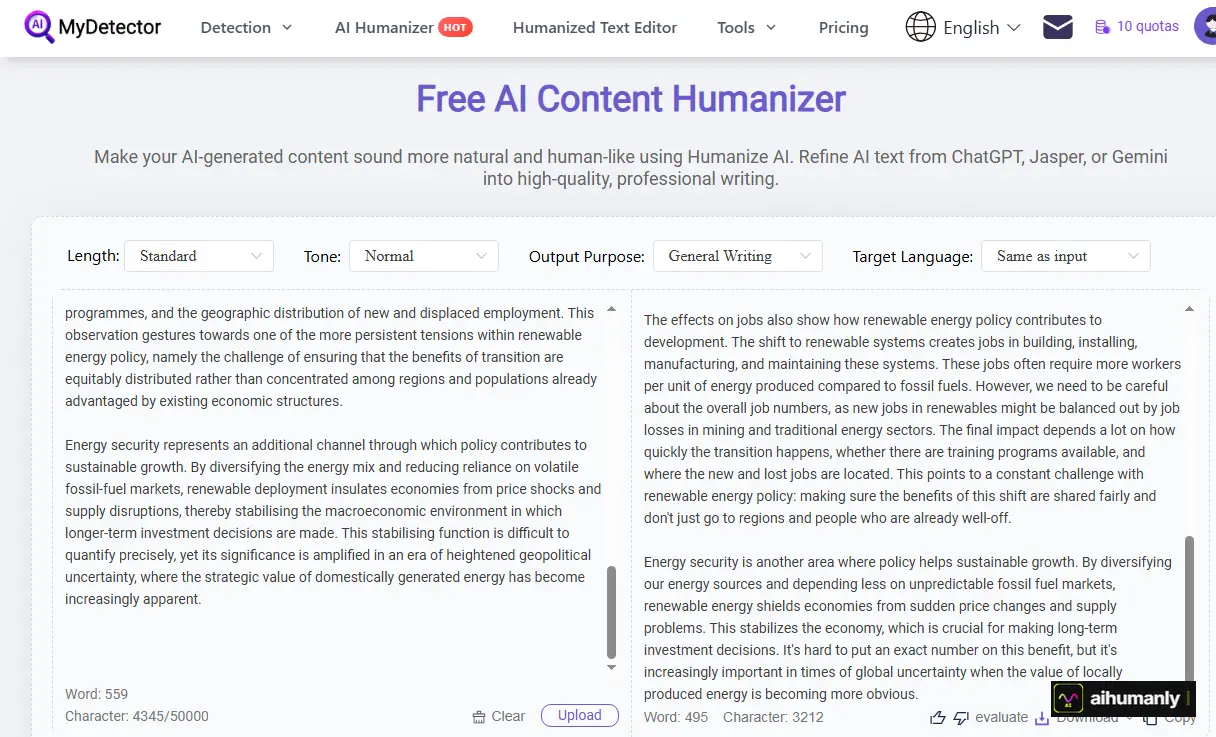
MyDetector is primarily known as an AI detection platform, but it also includes a built-in AI humanizer. For this test, we used:
- Essay 1: Academic purpose with Pro Model
- Essay 2: General Writing purpose with Base Model
SuperHumanizer
Website: https://superhumanizer.ai/
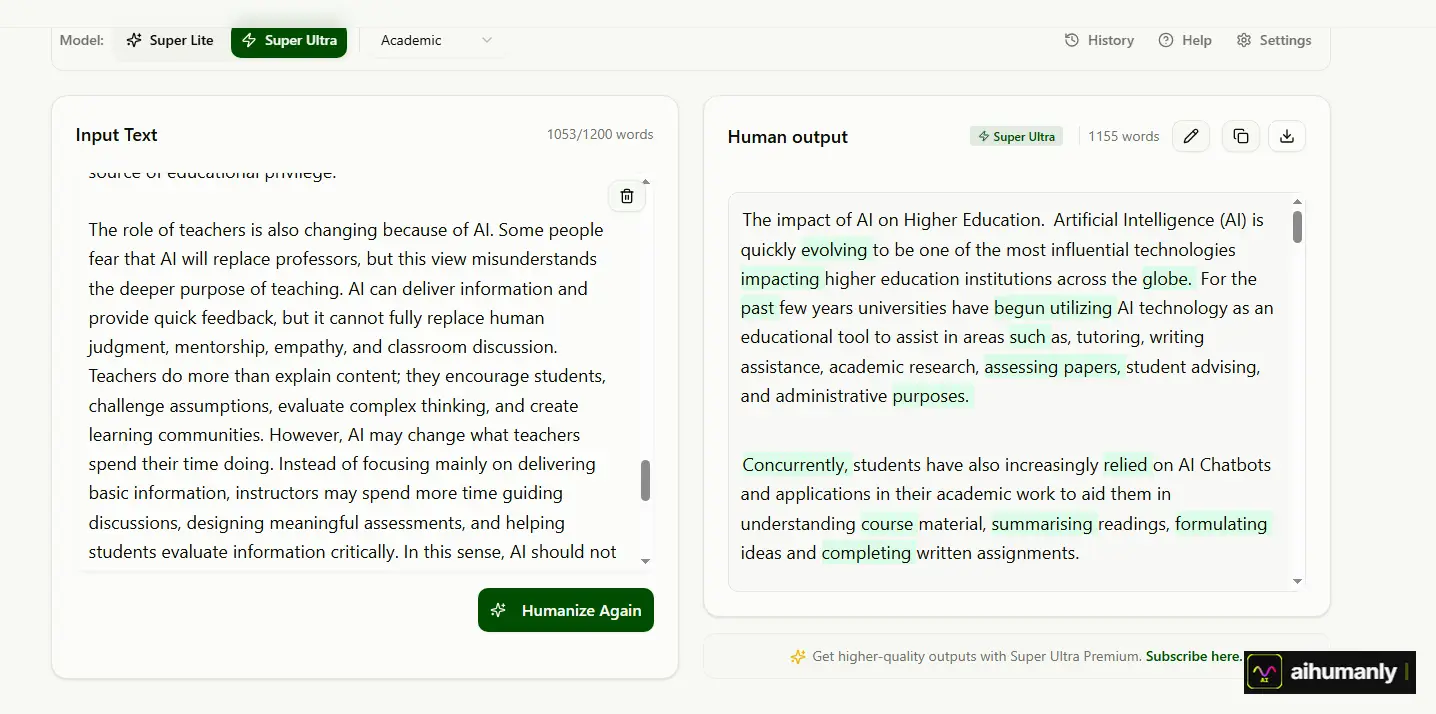
SuperHumanizer markets itself as an advanced AI humanizer capable of producing undetectable text. For this test, we used:
- Essay 1: Academic purpose with Super Ultra Model
- Essay 2: General purpose with Super Ultra Model
AI Detection Tools Used in the Test
We ran every piece of text — original and humanized — through the following seven detectors:
1. GPTZero — One of the most widely recognized AI detectors in education
2. ZeroGPT — A free detector popular among students
3. Originality.ai — A paid detector widely used by publishers and content agencies
4. Winston AI — A detector marketed for academic and professional use
5. QuillBot AI Detector — From the makers of the popular paraphrasing tool
6. Copyleaks AI Detector — An enterprise-grade detection platform
Different detectors use different algorithms, and results can vary dramatically for the same text. Some provide percentage scores; others give a binary or categorical label. We recorded both the numeric score and the final verdict (AI / Human) wherever available.
Testing Methodology
Step 1 — Generate Original English AI Texts
We generated two original English academic texts using different AI models:
1. Essay 1 — Undergraduate Argumentative Essay
- Topic: The Impact of Artificial Intelligence on Higher Education
- Generated by: GPT-5.5
- Style: Undergraduate-level, balanced argument, clear structure
2. Essay 2 — Graduate-Level Research Discussion
- Topic: The Role of Renewable Energy Policy in Accelerating Sustainable Economic Development
- Generated by: Claude Opus 4.8
- Style: Graduate-level, analytical, complex sentence structures
Using two different source models adds an extra layer of realism: in practice, people humanize text from various AI models, not just one.
Step 2 — Humanize Each Essay with Each Tool
Each original essay was processed through all three tools, producing six humanized outputs:
| Essay | Humanizer Tool | Mode / Settings |
|---|---|---|
| Essay 1 (Undergraduate) | HumanizeAI.pro | Academic |
| Essay 1 (Undergraduate) | MyDetector | Academic, Pro Model |
| Essay 1 (Undergraduate) | SuperHumanizer | Academic, Super Ultra Model |
| Essay 2 (Graduate) | HumanizeAI.pro | Standard, Ultra Run |
| Essay 2 (Graduate) | MyDetector | General Writing, Base Model |
| Essay 2 (Graduate) | SuperHumanizer | General, Super Ultra Model |
Step 3 — Test Each Output with All AI Detectors
Every humanized output was run through all seven AI detectors. Screenshots were captured for every result.
Step 4 — Independent Writing Quality Evaluation
AI detection is only half the story. A humanizer could produce text that passes detectors but reads terribly. To assess writing quality, we commissioned GPT-5.5 to evaluate each humanized output against the original across four dimensions:
| Dimension | What It Measures |
|---|---|
| Meaning Preservation | Does the rewrite keep the original argument, key points, and logical relationships? |
| Academic Tone | Is the tone appropriately formal, objective, and precise? |
| Grammar & Fluency | Is the text grammatically correct, natural, and readable? |
| Formatting Consistency | Does the rewrite preserve the original paragraph structure and formatting? |
Each dimension was scored on a 1–10 scale. The full evaluation prompt and methodology are documented in the appendix.
Test Texts Used for the Review
Test Essay 1 — Undergraduate Argumentative Essay
Topic: The Impact of Artificial Intelligence on Higher Education
This topic was chosen because it is a common academic essay subject relevant to AI, education, and student writing. It allows balanced discussion of both benefits and concerns, and it reflects the type of assignment frequently given in undergraduate courses.
The original GPT-5.5 text is 8 paragraphs, approximately 700 words, with a clear thesis statement, body paragraphs covering personalized learning, academic support, academic integrity, dependency, equal access, and the changing role of teachers, and a concluding paragraph.
The full original text is included in Appendix B.
Test Essay 2 — Graduate-Level Research Discussion
Topic: The Role of Renewable Energy Policy in Accelerating Sustainable Economic Development
This topic was chosen to test whether AI humanizers can handle complex analytical writing with formal academic tone, policy analysis, economic reasoning, and research-style argumentation. It represents a realistic graduate-level writing scenario.
The original Claude Opus 4.8 text is 6 paragraphs, approximately 800 words, covering private investment mobilization, technological innovation, labor market effects, energy security, and policy limitations including inconsistency, infrastructure costs, regional inequality, and implementation challenges.
The full original text is included in Appendix D.
Results for Essay 1: Undergraduate Argumentative Essay
Topic: The Impact of Artificial Intelligence on Higher Education
Source: GPT-5.5
HumanizeAI.pro — Essay 1 Results
Mode: Academic
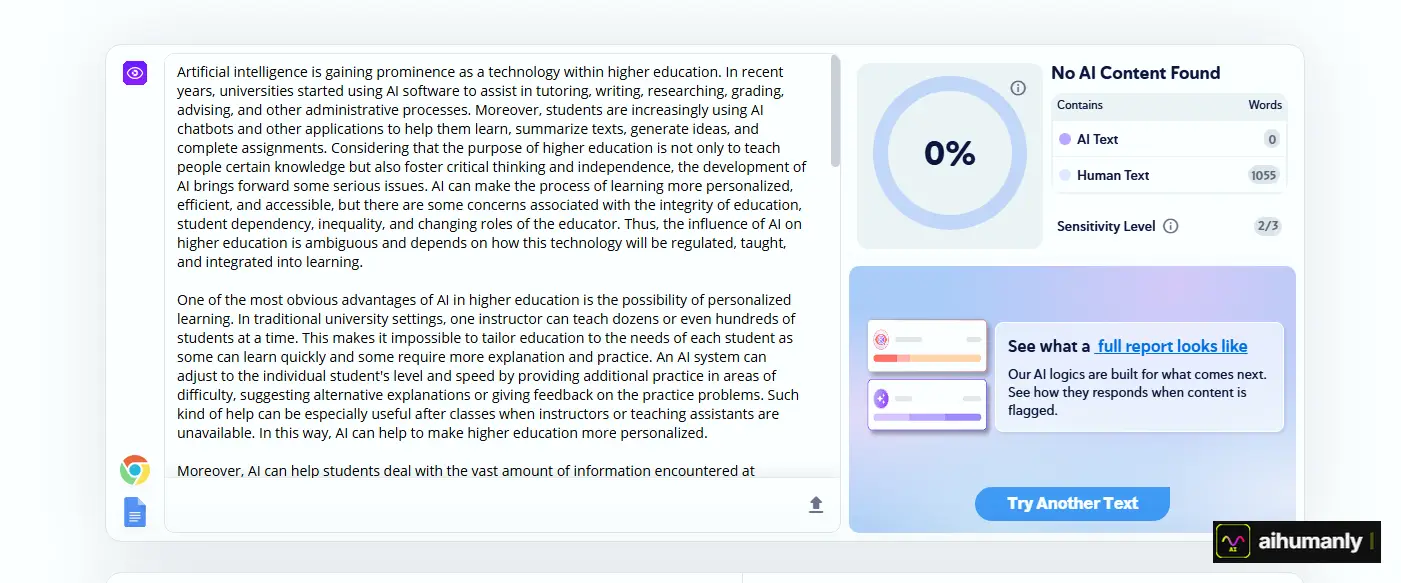
| Detector | AI Score | Verdict |
|---|---|---|
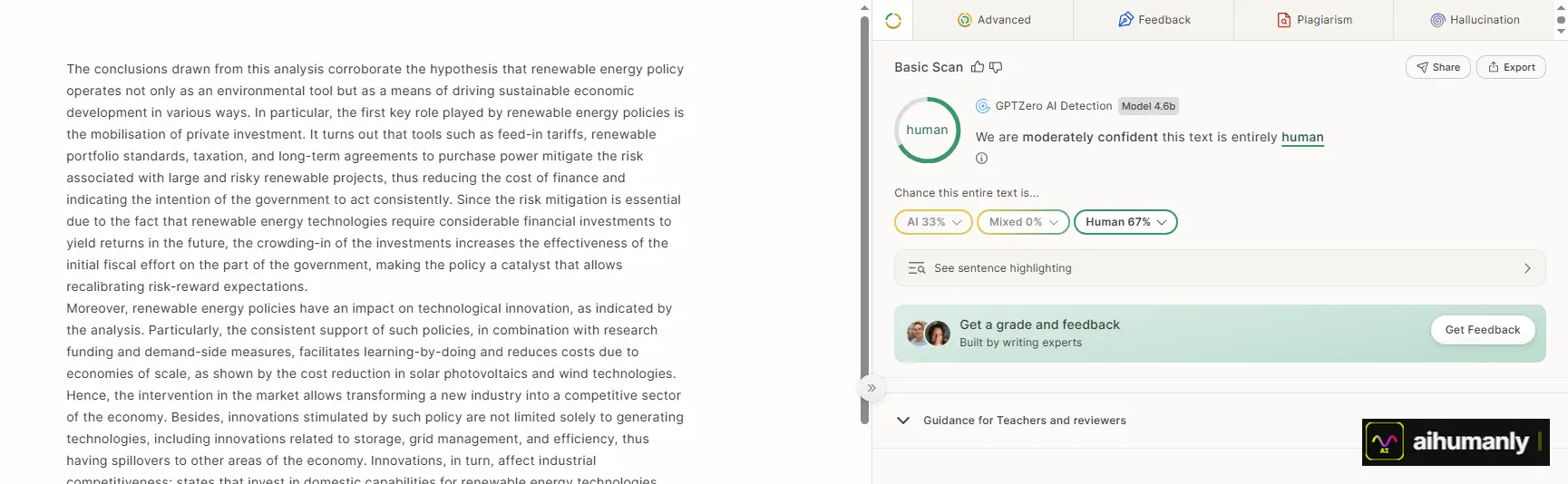
| GPTZero | 33% | Human |
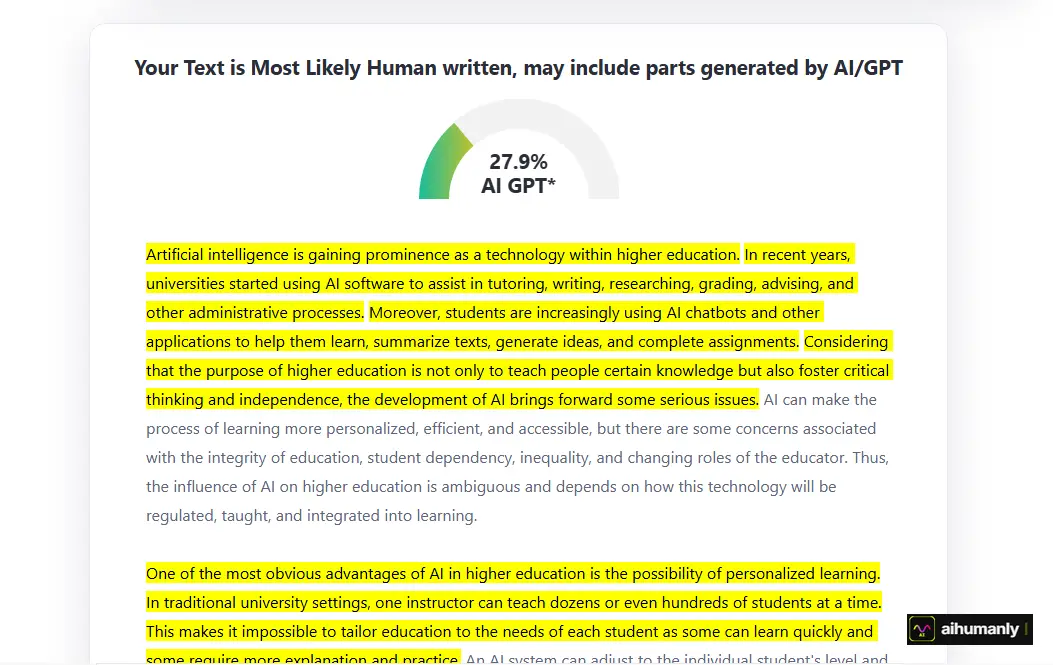
| ZeroGPT | 27.9% | Human |
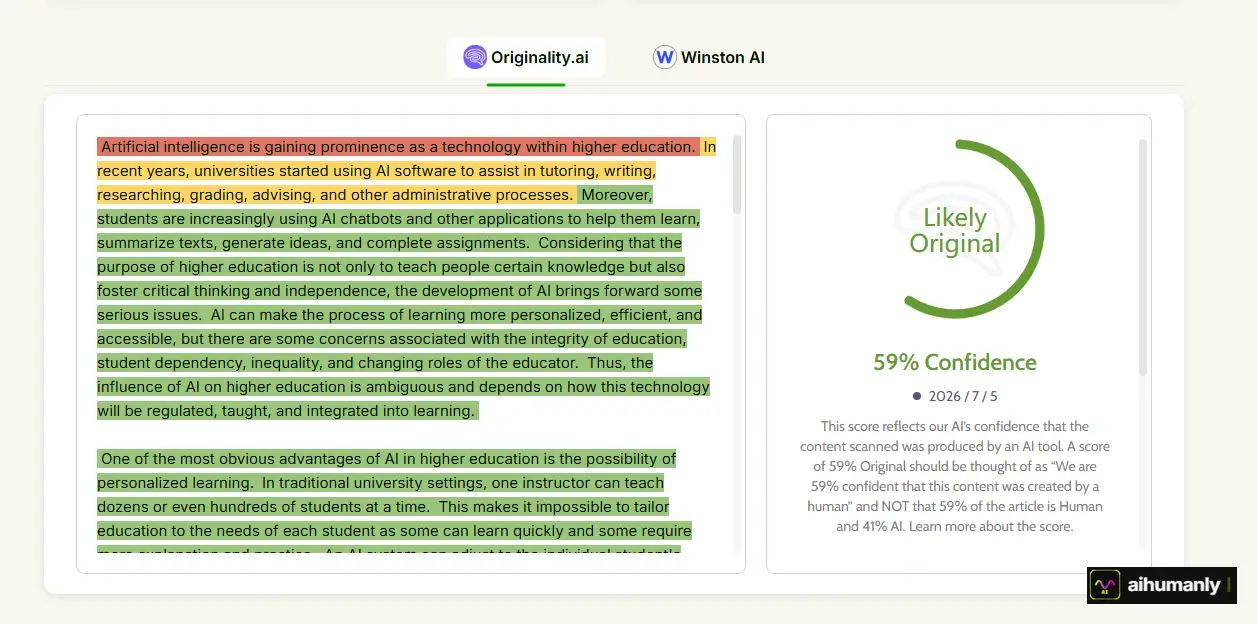
| Originality.ai | 41% | Human |
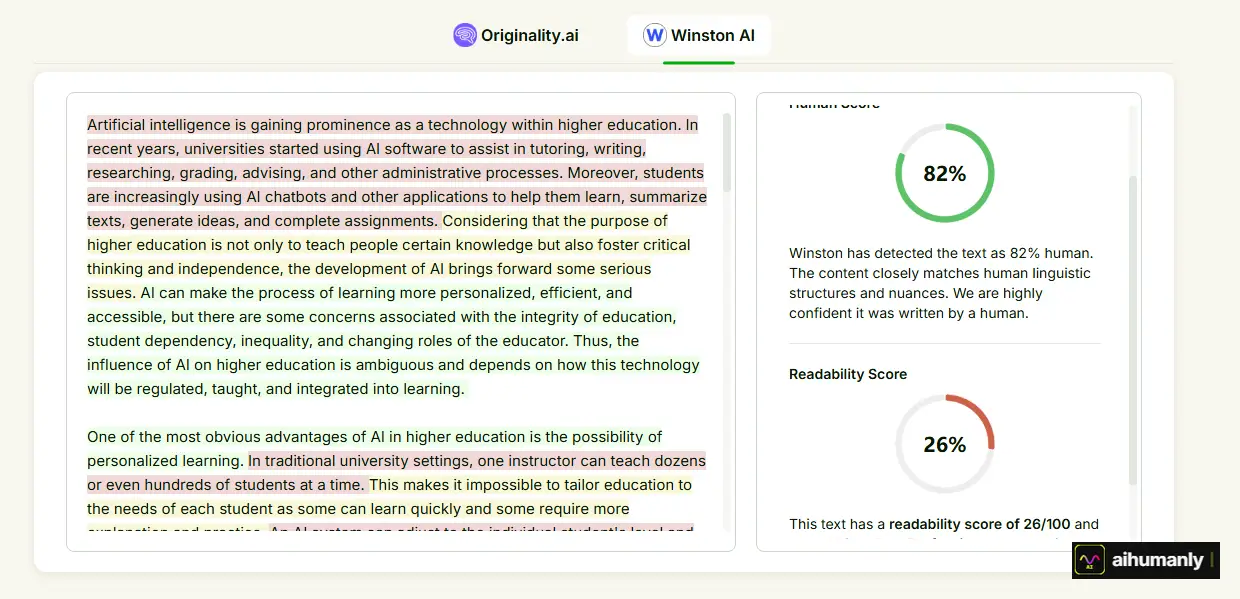
| Winston AI | 26% | Human |
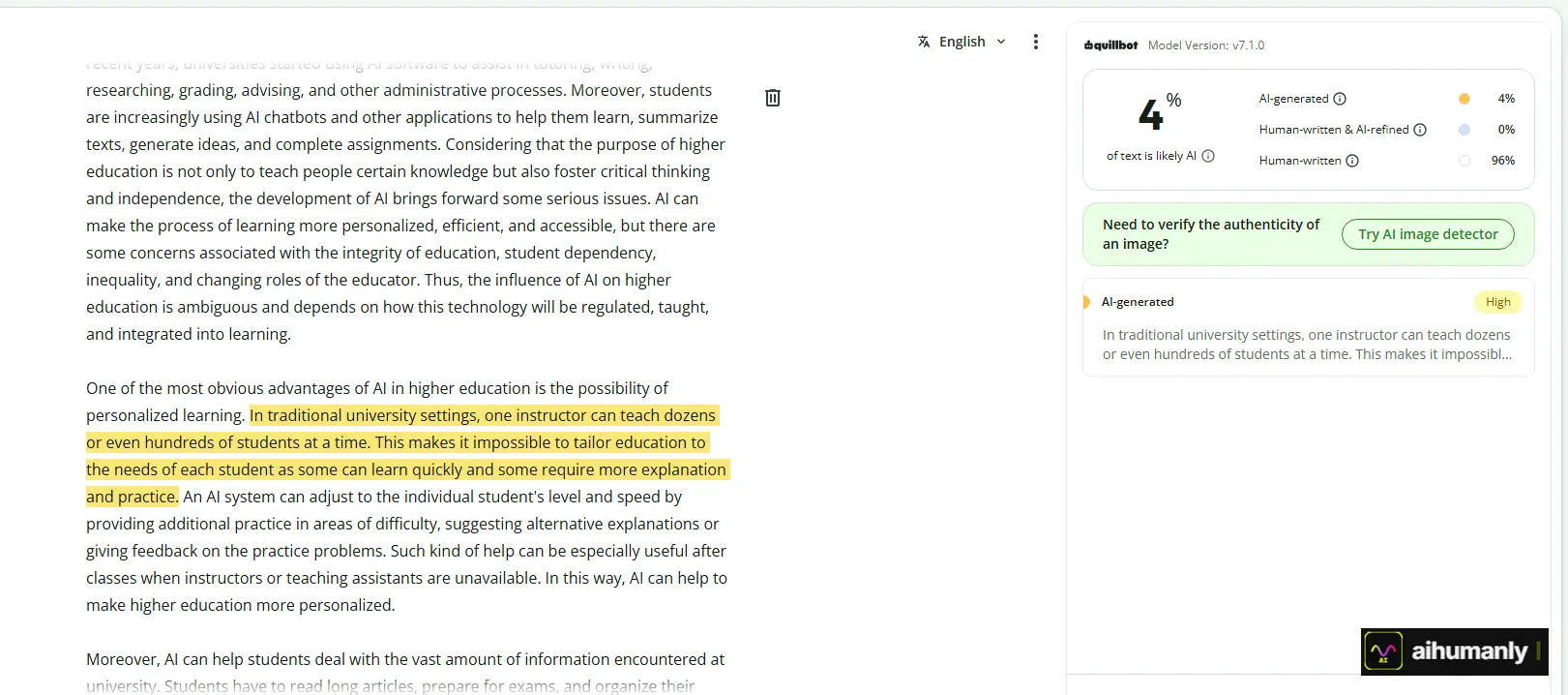
| QuillBot | 4% | Human |
| Copyleaks | 0% | Human |
Result: 6/6 detectors classified the output as human. This was the strongest overall detection performance for Essay 1.
Writing Quality Evaluation
| Dimension | Score / 10 |
|---|---|
| Meaning Preservation | 8 |
| Academic Tone | 7 |
| Grammar & Fluency | 7 |
| Formatting Consistency | 10 |
| Average | 8.0 |
Summary: HumanizeAI.pro preserved the main argument and structure very well (Formatting: 10/10). Meaning Preservation was strong at 8/10, with only minor omissions. The main weaknesses were in Academic Tone and Grammar & Fluency (both 7/10), with some awkward phrasing, article issues, and unnatural collocations. The evaluator noted that expressions like "teach people certain knowledge" and "spoil the skills and values preserved in education" sound unnatural in academic English.
MyDetector — Essay 1 Results
Mode: Academic, Pro Model
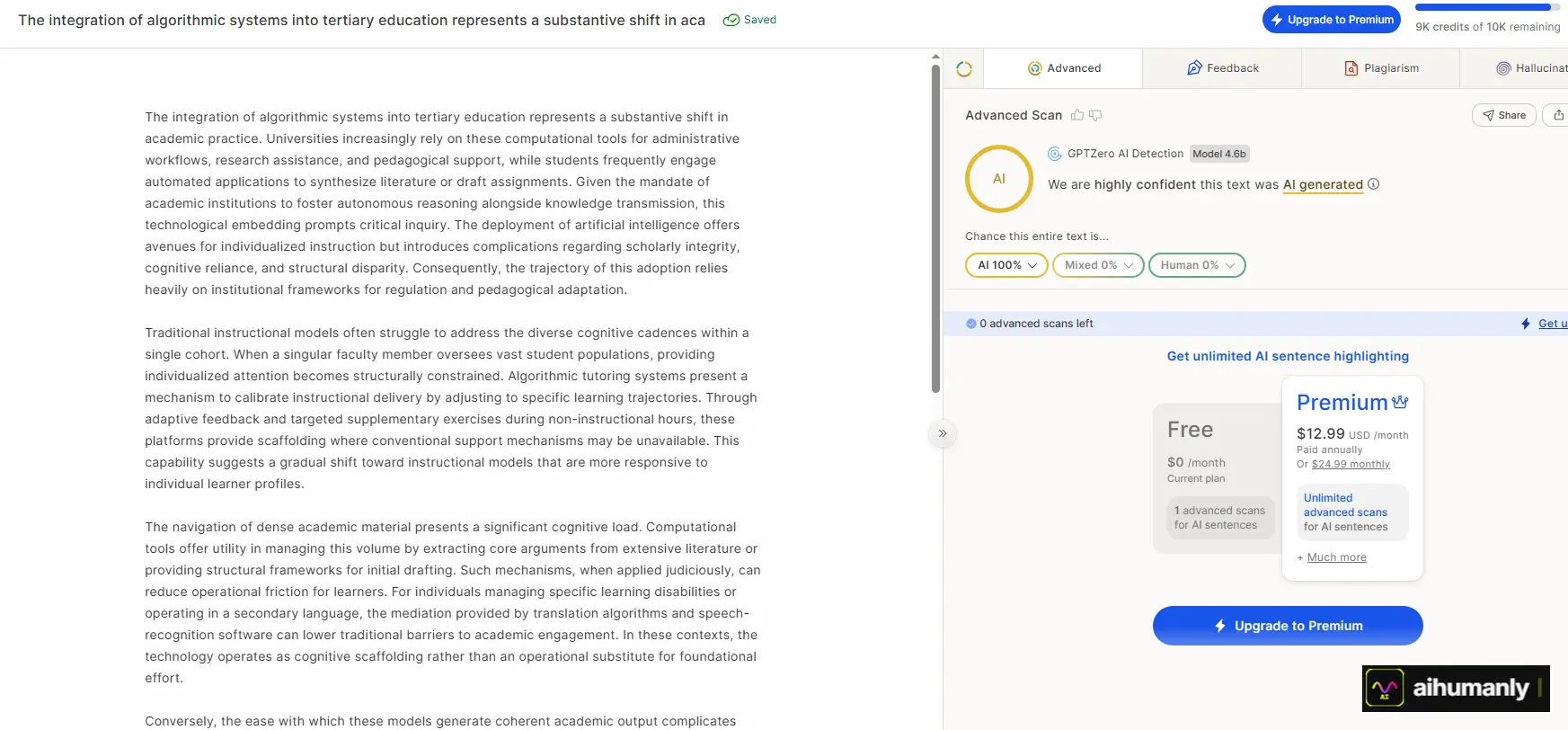
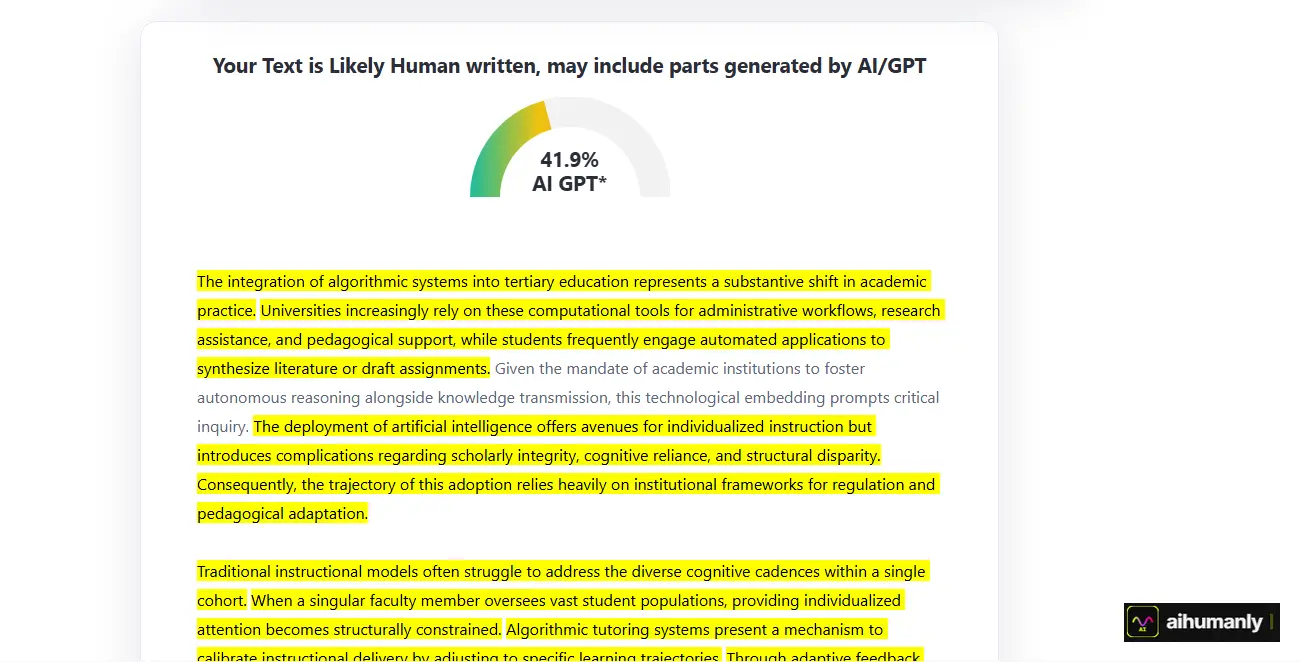
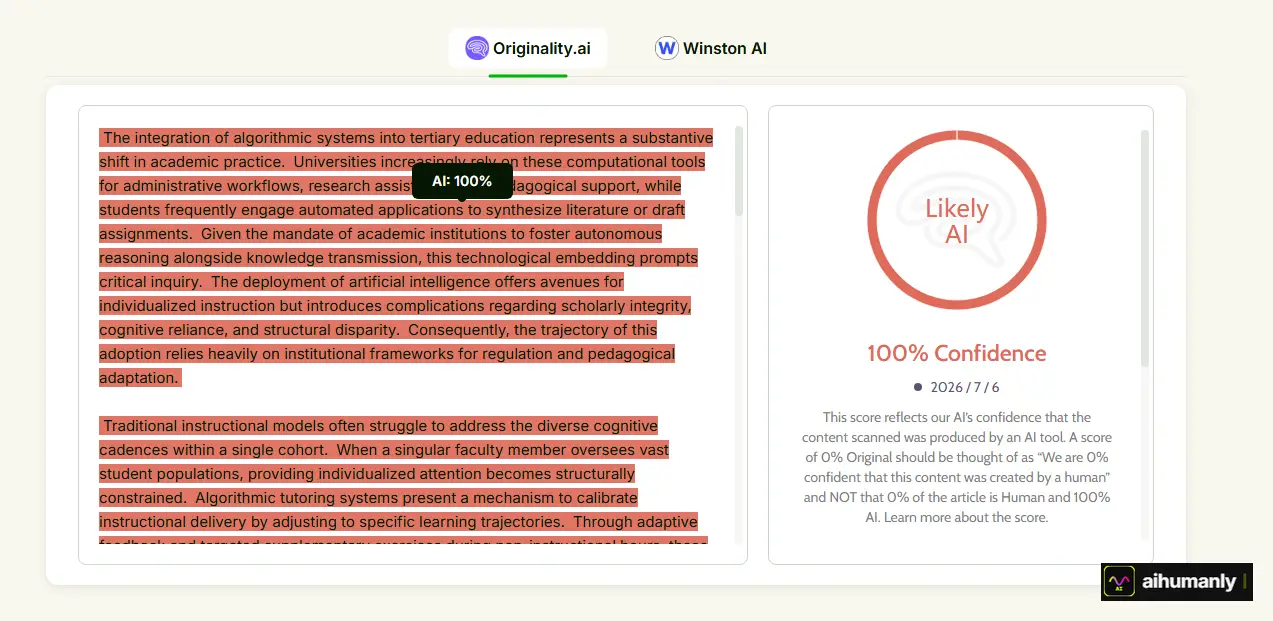
| Detector | AI Score | Verdict |
|---|---|---|
| GPTZero | 100% | AI |
| ZeroGPT | 41.9% | Human |
| Originality.ai | 100% | AI |
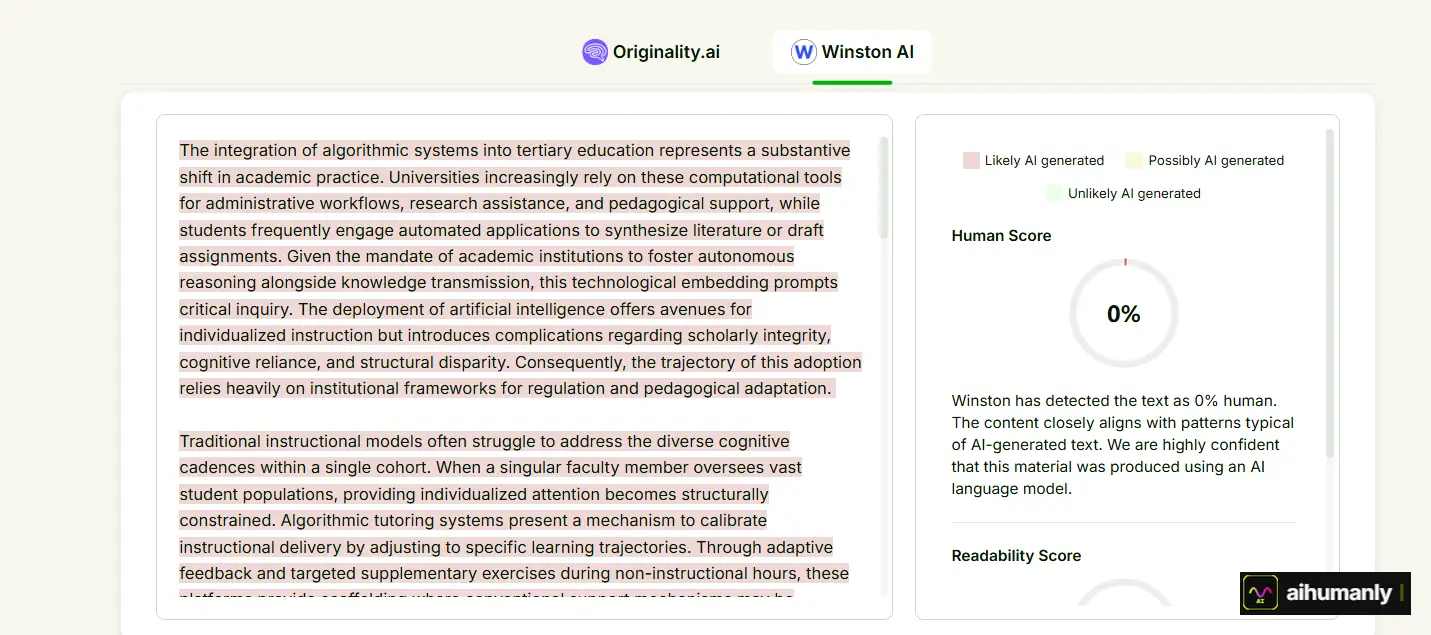
| Winston AI | 100% | AI |
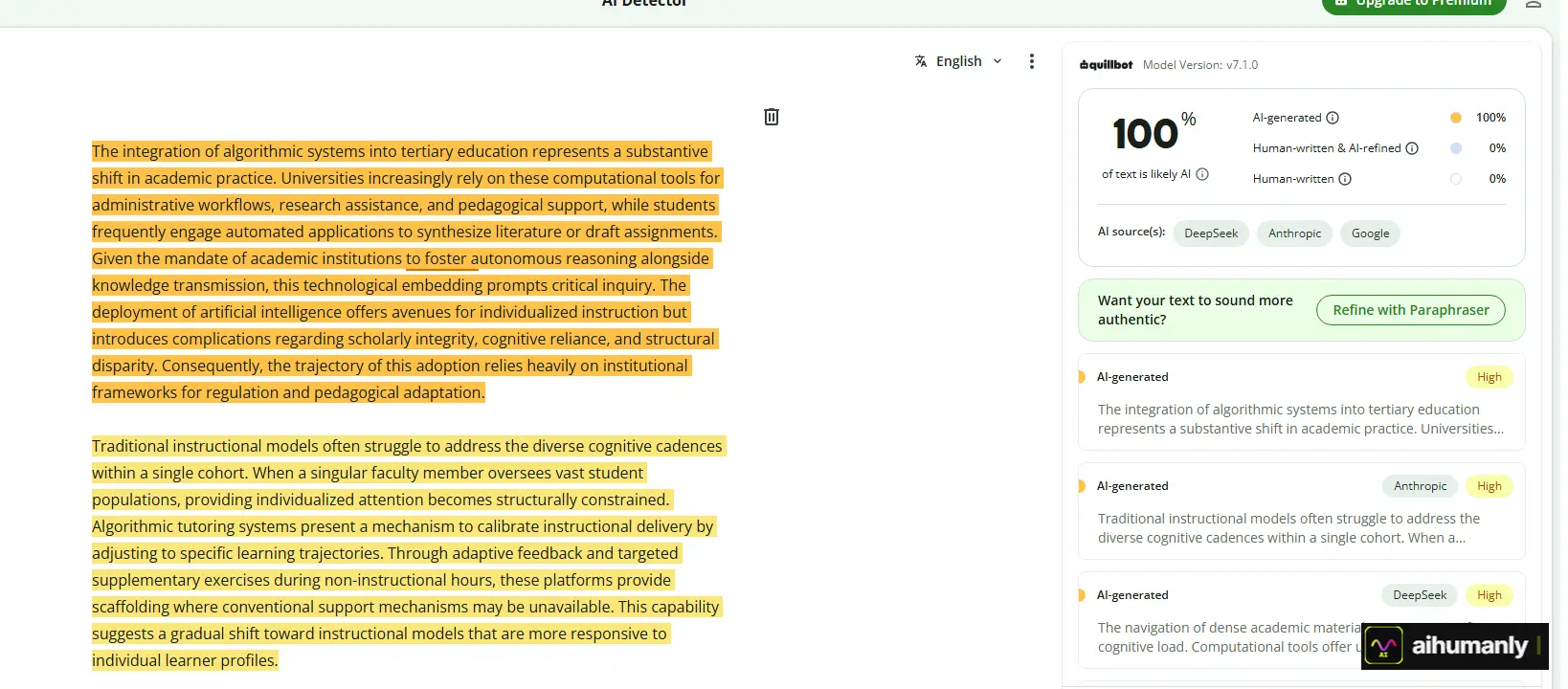
| QuillBot | 100% | AI |
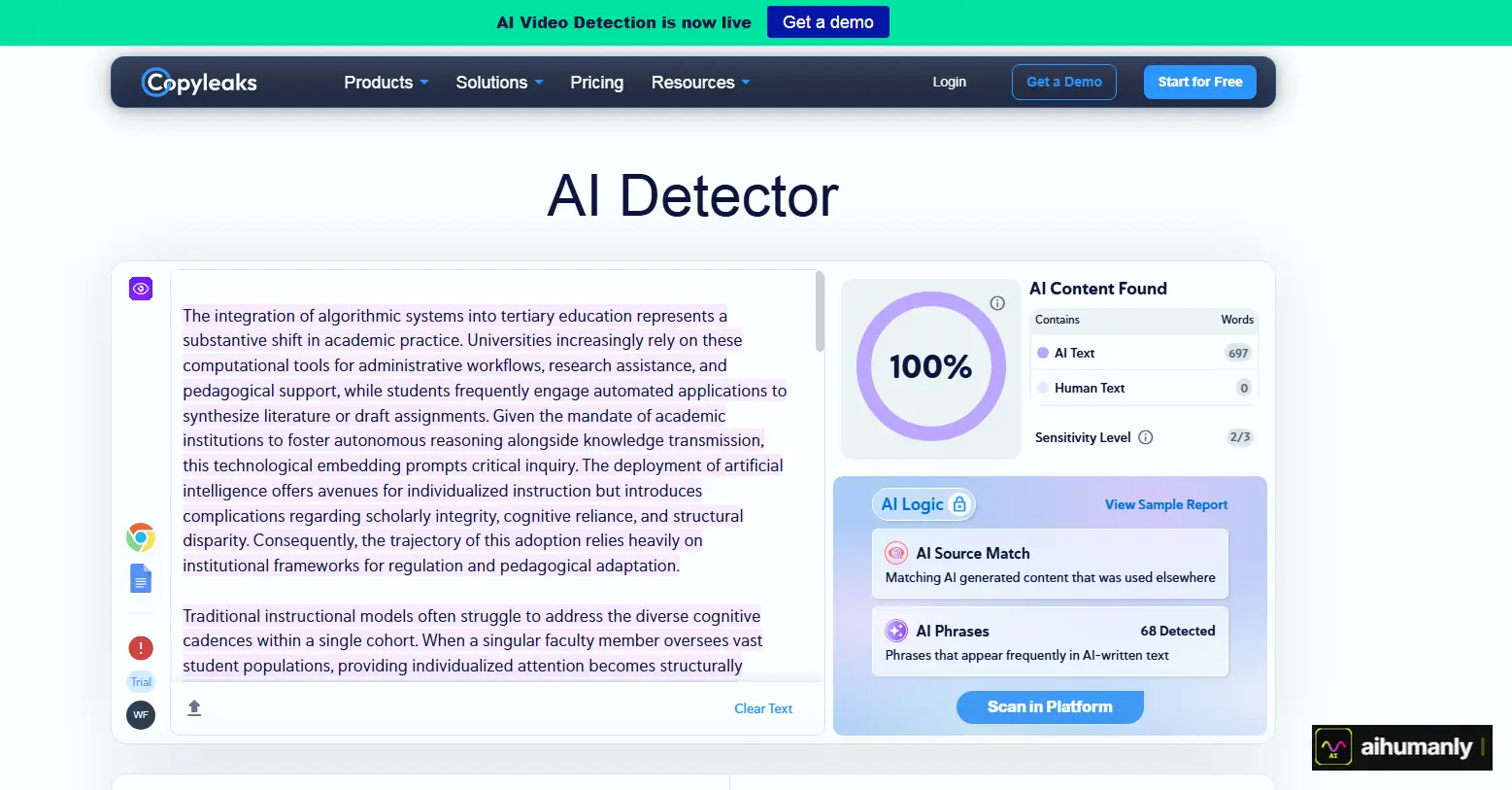
| Copyleaks | 0% | Human |
Result: 4/6 detectors classified the output as AI. This was the weakest detection performance for Essay 1. Only ZeroGPT and Copyleaks classified it as human.
Writing Quality Evaluation
| Dimension | Score / 10 |
|---|---|
| Meaning Preservation | 8 |
| Academic Tone | 8 |
| Grammar & Fluency | 9 |
| Formatting Consistency | 10 |
| Average | 8.75 |
Summary: MyDetector produced the highest writing quality scores for Essay 1. The evaluator praised its grammatical strength, fluency, and format preservation. The text is academically polished and highly readable. However, the tone was noted as "occasionally over-inflated" with jargon-heavy phrases like "diverse cognitive cadences" and "algorithmic tools exacerbating educational disparities." Some specific details from the original were generalized or omitted, including student data protection concerns.
SuperHumanizer — Essay 1 Results
Mode: Academic, Super Ultra Model
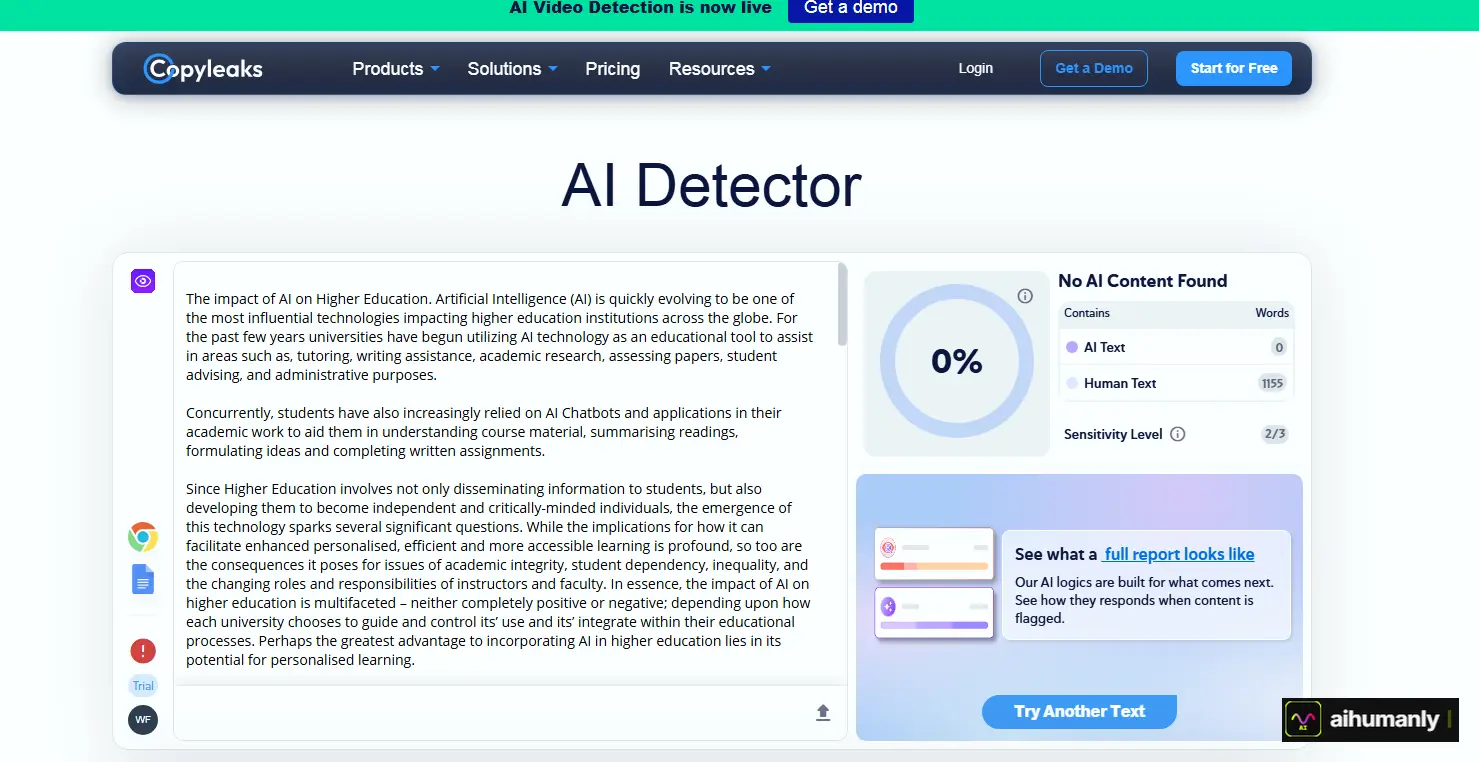
| Detector | AI Score | Verdict |
|---|---|---|
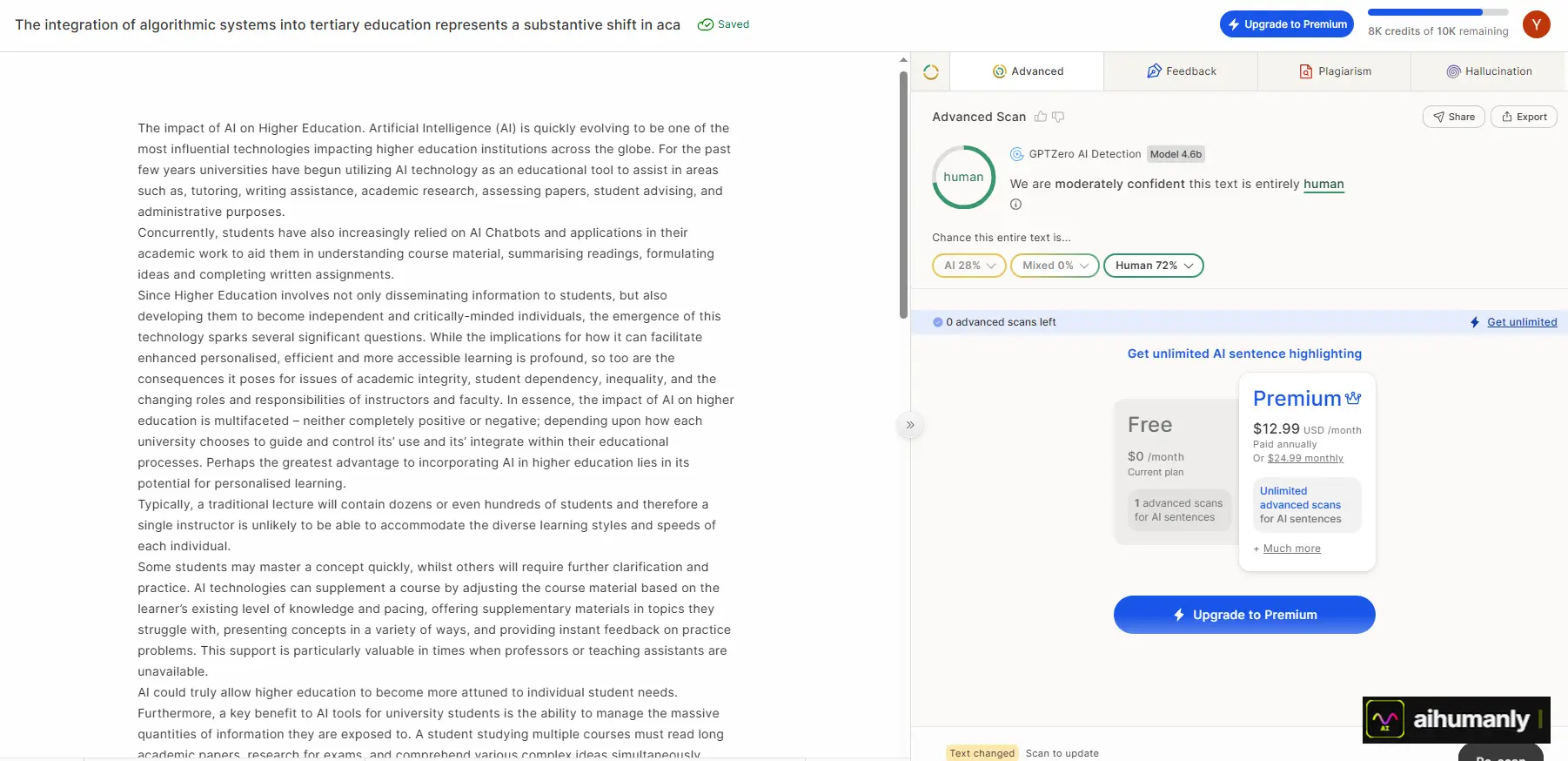
| GPTZero | 28% | Human |
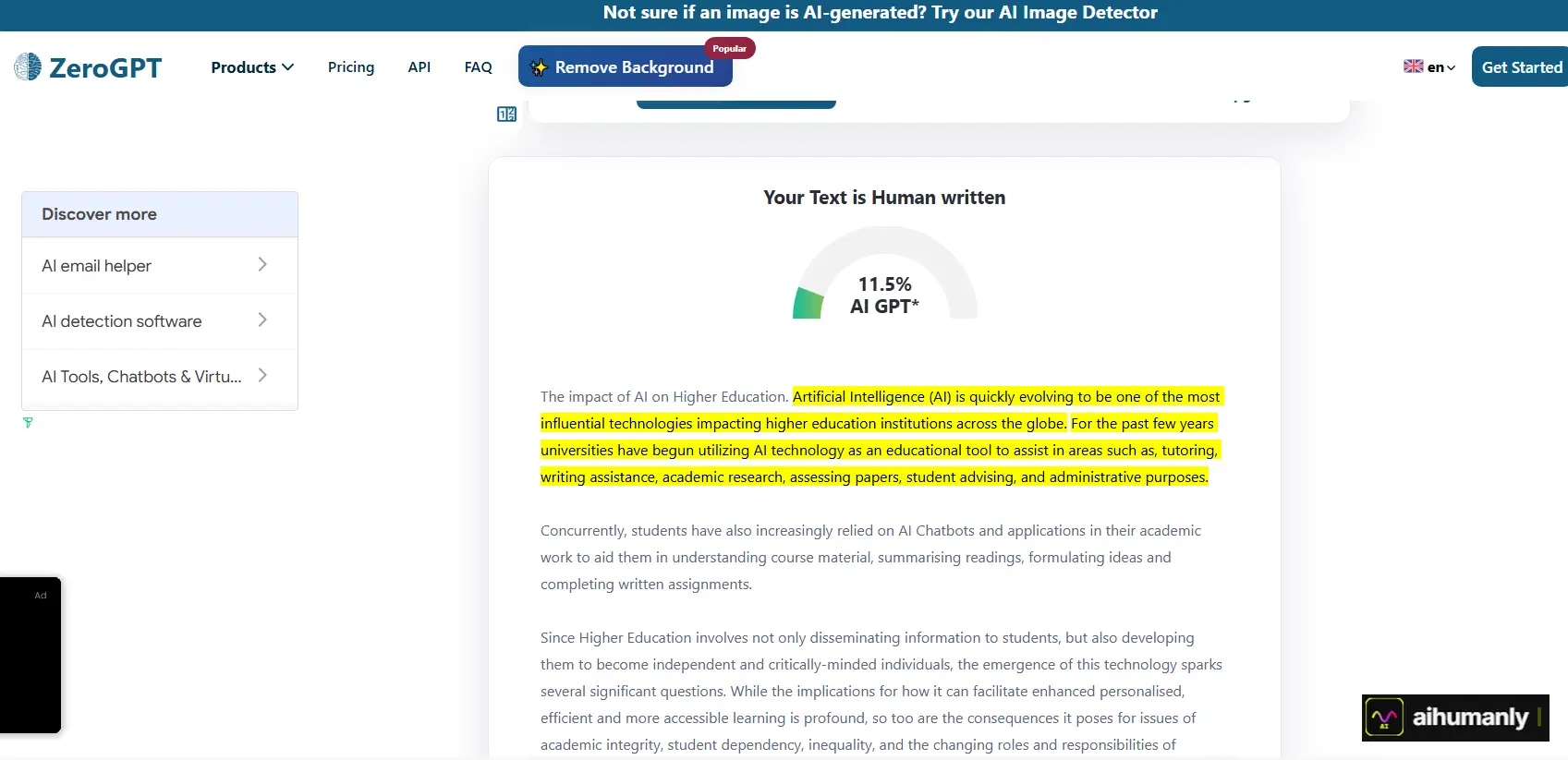
| ZeroGPT | 11.5% | Human |
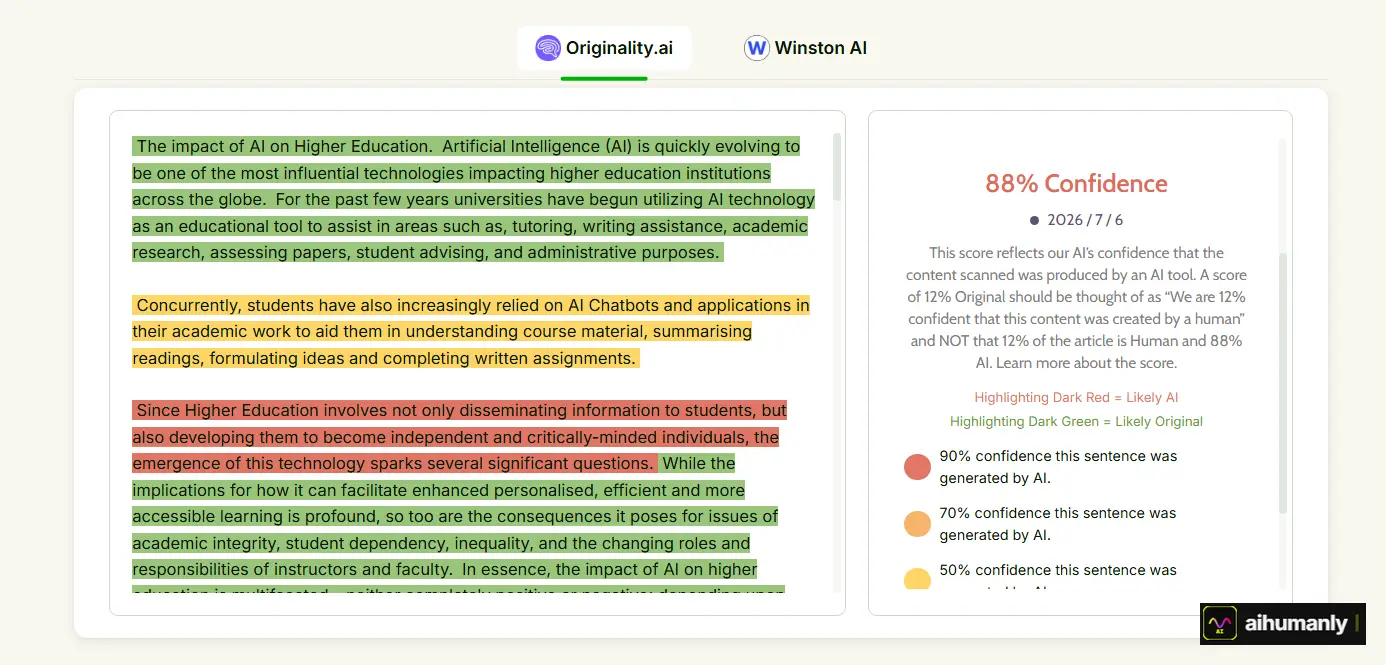
| Originality.ai | 88% | AI |
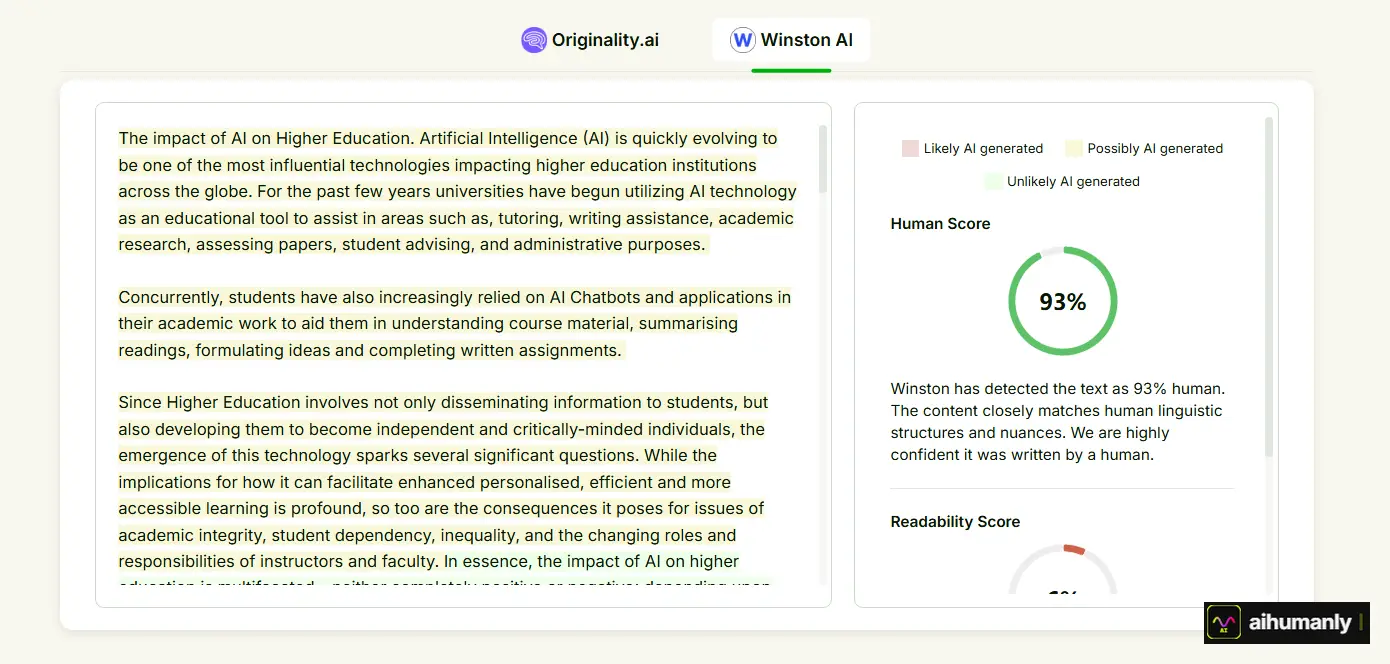
| Winston AI | 7% | Human |
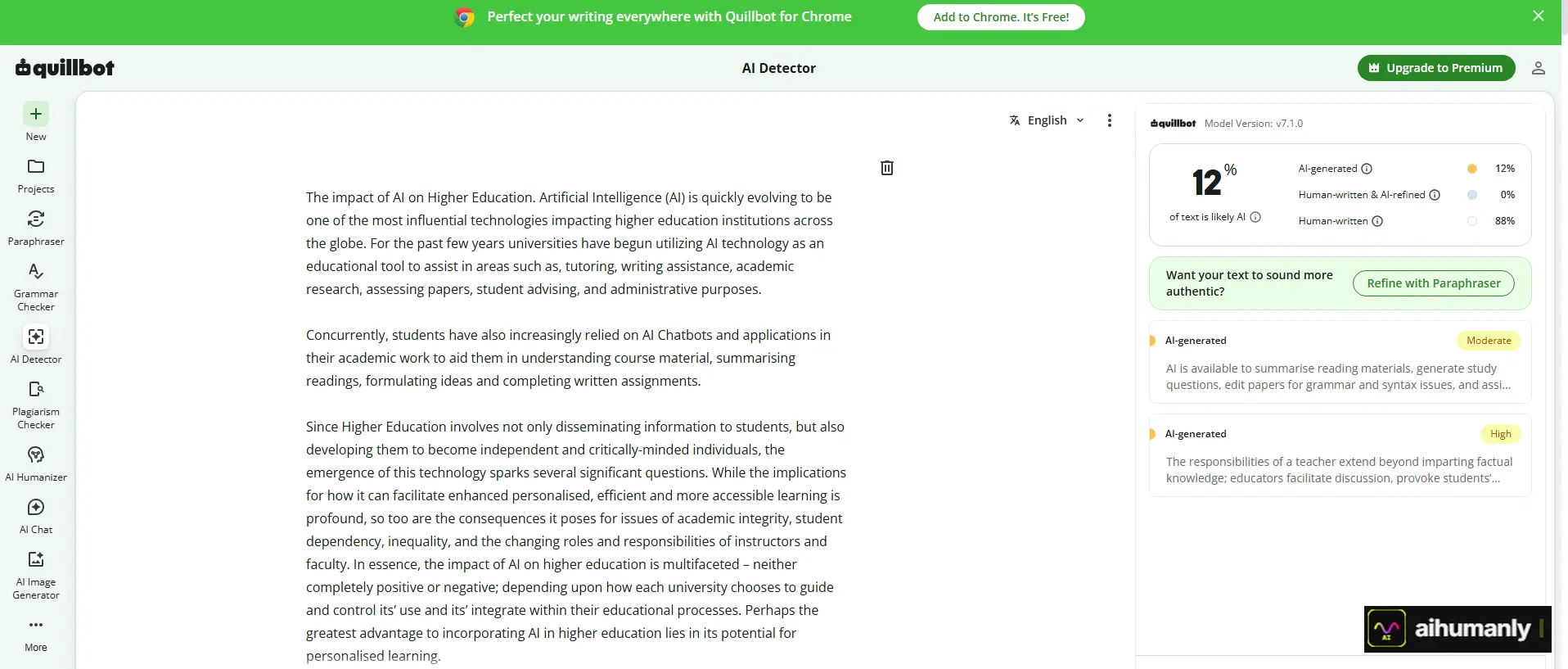
| QuillBot | 12% | Human |
| Copyleaks | 0% | Human |
Result: 5/6 detectors classified the output as human. Only Originality.ai flagged it as AI (88%). This was a strong detection result.
Writing Quality Evaluation
| Dimension | Score / 10 |
|---|---|
| Meaning Preservation | 7 |
| Academic Tone | 6 |
| Grammar & Fluency | 5 |
| Formatting Consistency | 4 |
| Average | 5.5 |
Summary: SuperHumanizer produced the weakest writing quality for Essay 1. While it passed most detectors, the text had significant problems. The evaluator noted frequent grammar and punctuation errors, inconsistent capitalization ("Higher Education," "AI Chatbots"), missing conclusion, fragmented paragraphs, and awkward phrasing. Specific errors included "its' use," "its' integrate" (incorrect possessive), "may never fully grasping" (verb form error), and the addition of a title not present in the original. The evaluator concluded the text "needs major editing before it is suitable for English academic use."
Results for Essay 2: Graduate-Level Research Discussion
Topic: The Role of Renewable Energy Policy in Accelerating Sustainable Economic Development
Source: Claude Opus 4.8
HumanizeAI.pro — Essay 2 Results
Mode: Standard, Ultra Run
| Detector | AI Score | Verdict |
|---|---|---|
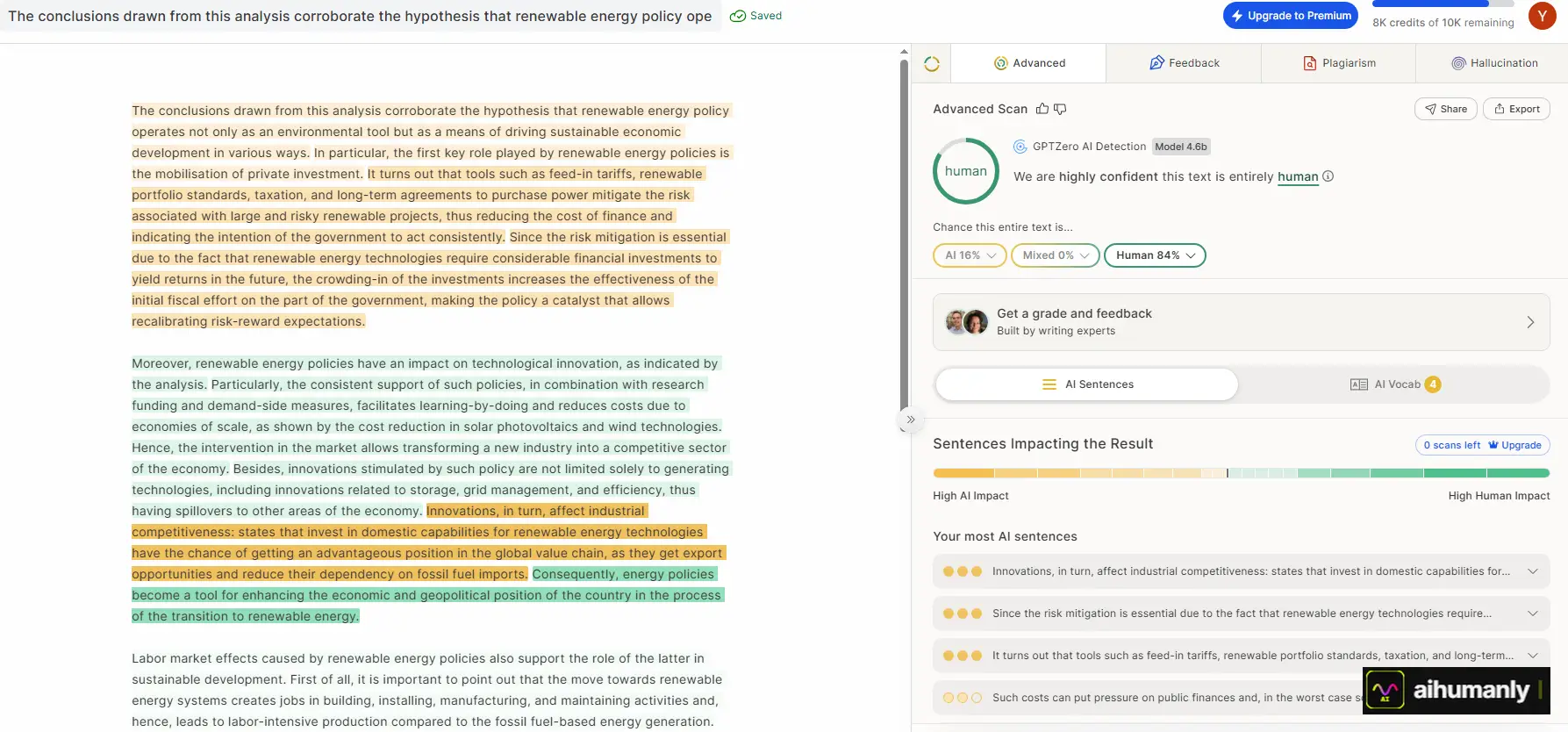
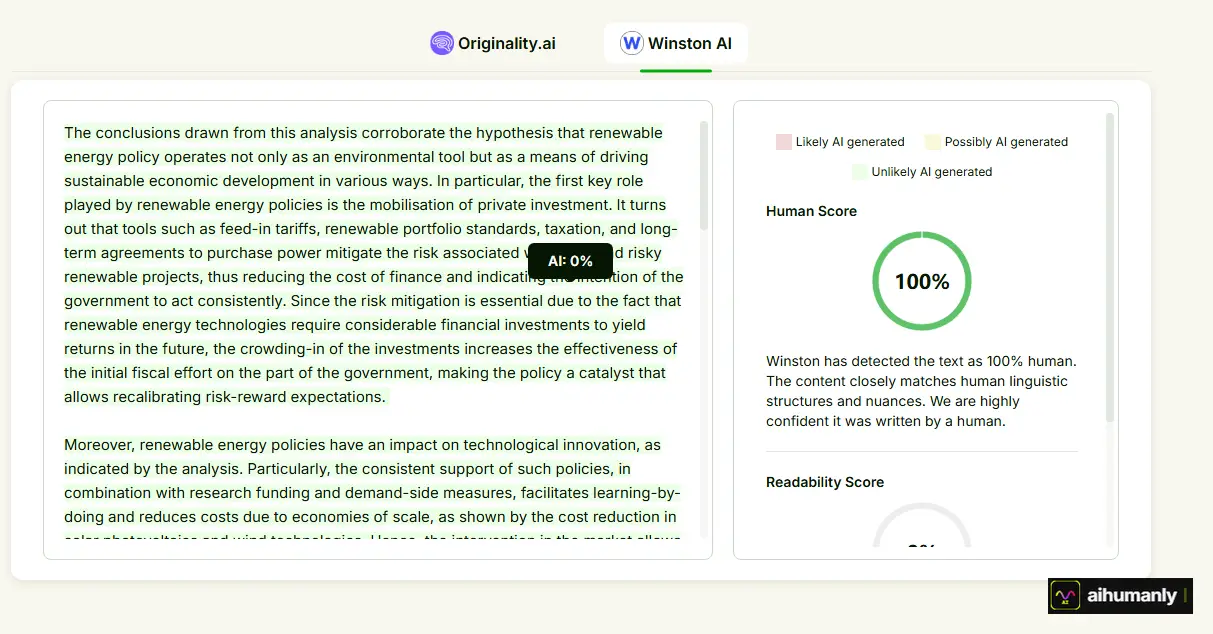
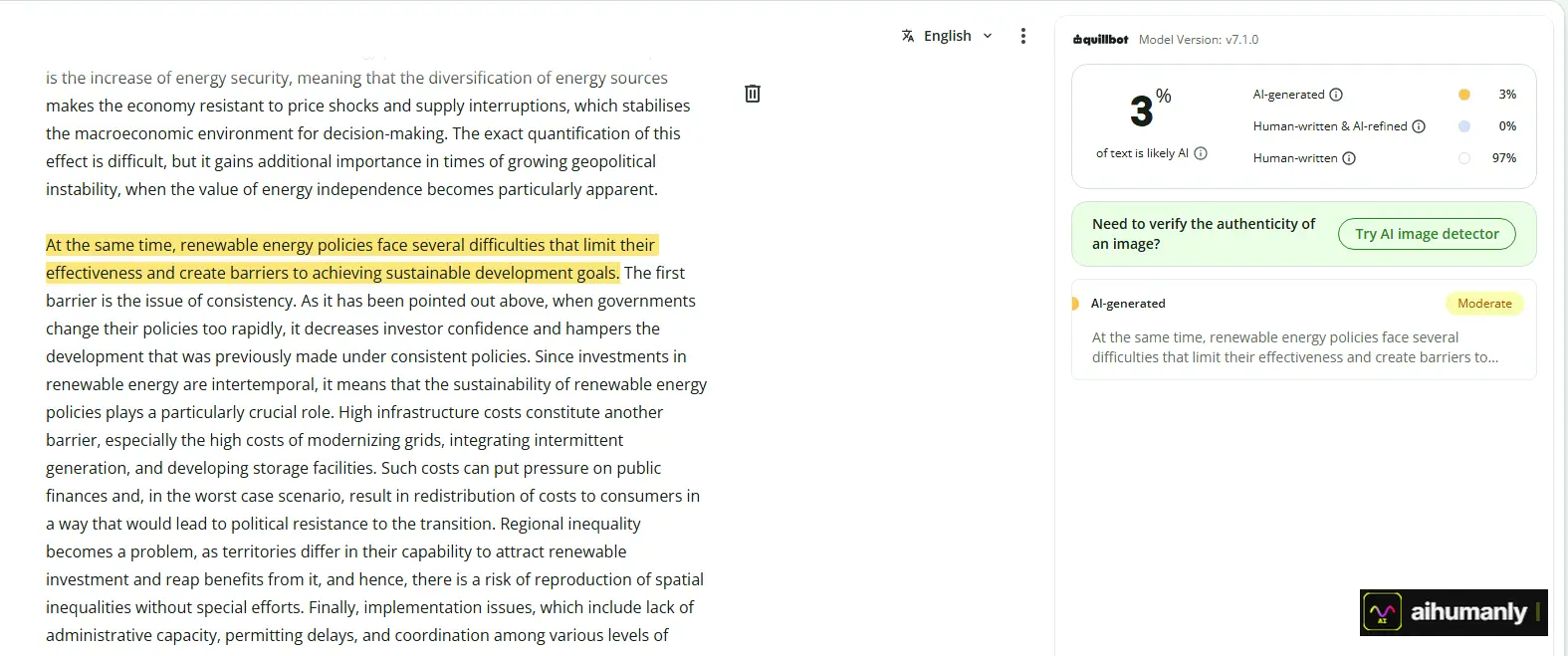
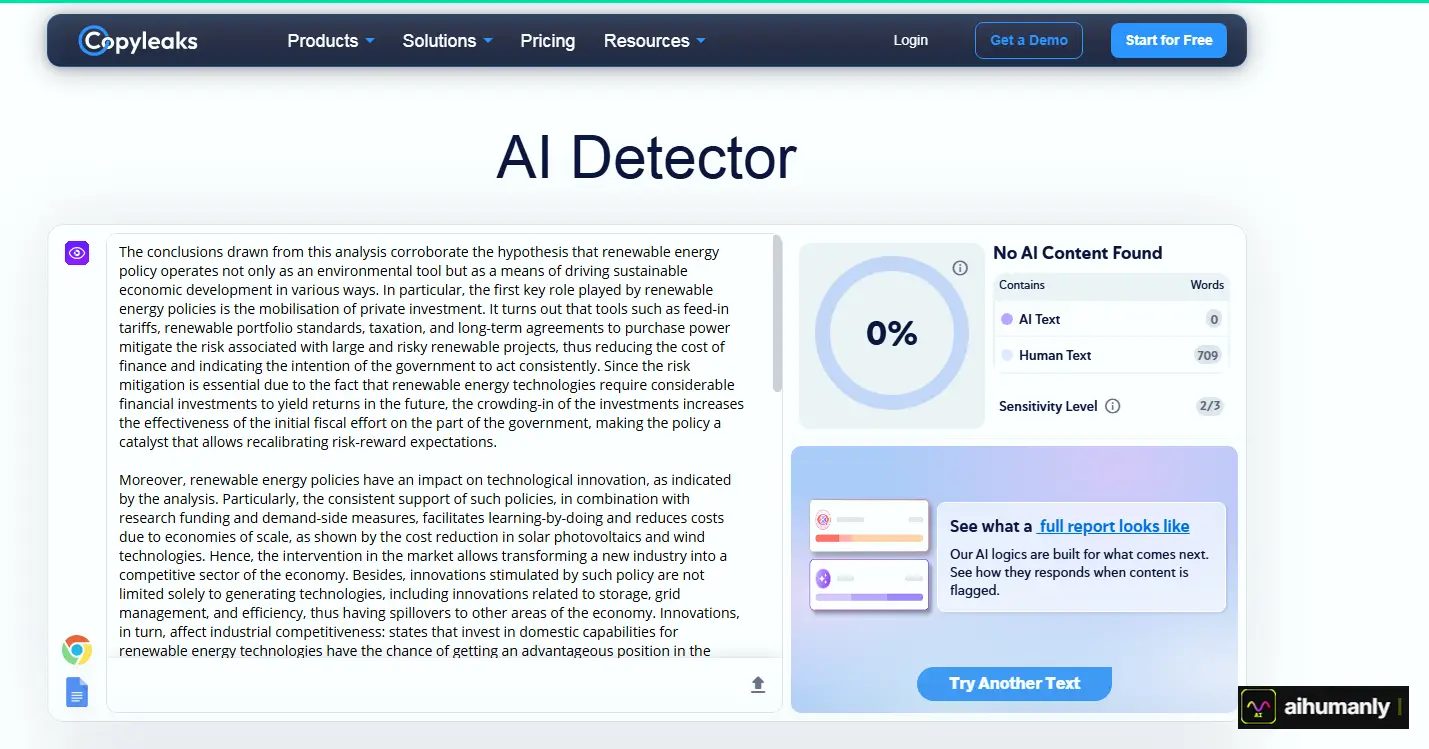
| GPTZero | 16% | Human |
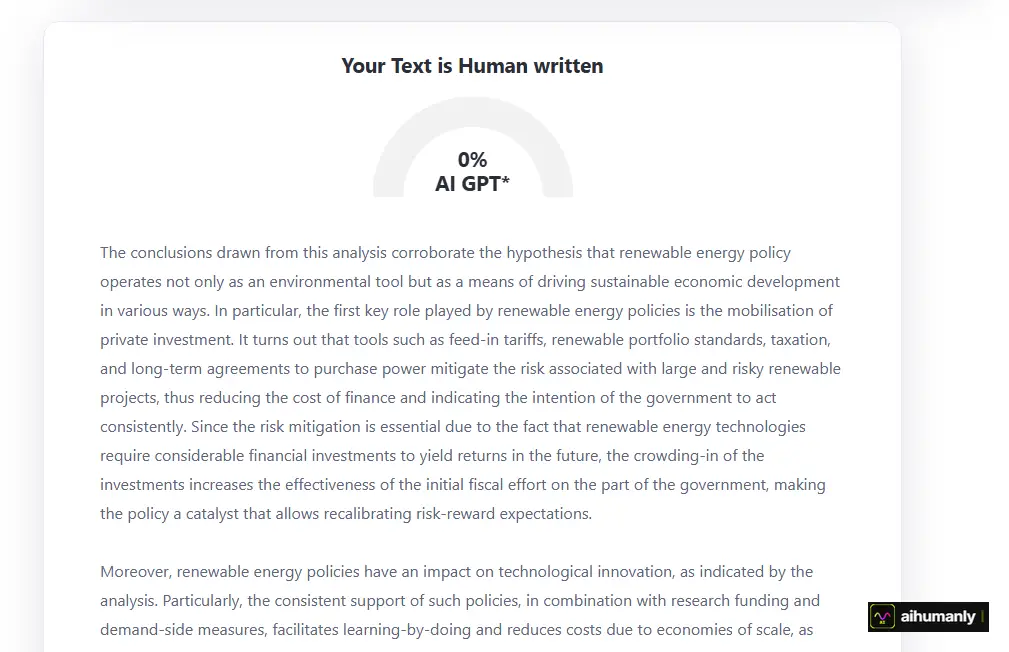
| ZeroGPT | 0% | Human |
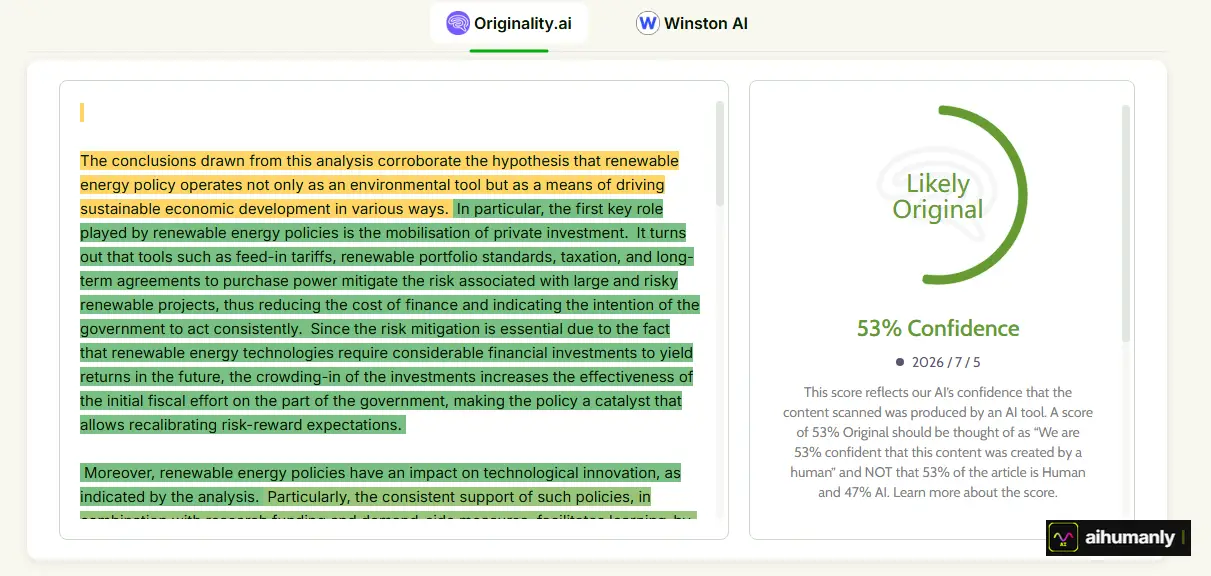
| Originality.ai | 47% | Human |
| Winston AI | 0% | Human |
| QuillBot | 3% | Human |
| Copyleaks | 0% | Human |
Result: 6/6 detectors classified the output as human. Perfect detection evasion on the graduate-level essay.
Writing Quality Evaluation
| Dimension | Score / 10 |
|---|---|
| Meaning Preservation | 7 |
| Academic Tone | 7 |
| Grammar & Fluency | 7 |
| Formatting Consistency | 7 |
| Average | 7.0 |
Summary: HumanizeAI.pro scored consistently across all four dimensions (7/10 each). It preserved the broad argument but weakened or omitted several important qualifications from the original, including the discussion of geographic distribution of employment and the final conditional conclusion. The evaluator noted informal phrasing like "It turns out that" and "First of all," which are less suitable for graduate-level academic writing. The text merged the original's final two paragraphs into one, slightly reducing structural clarity.
MyDetector — Essay 2 Results
Mode: General Writing, Base Model
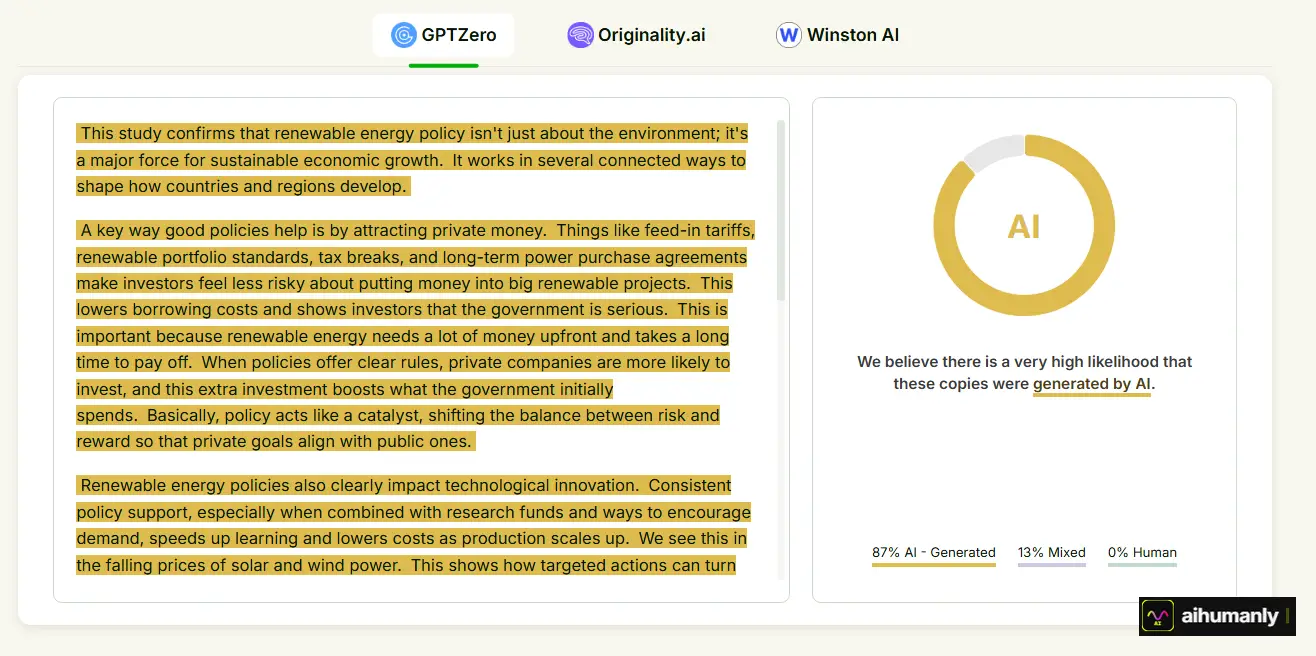
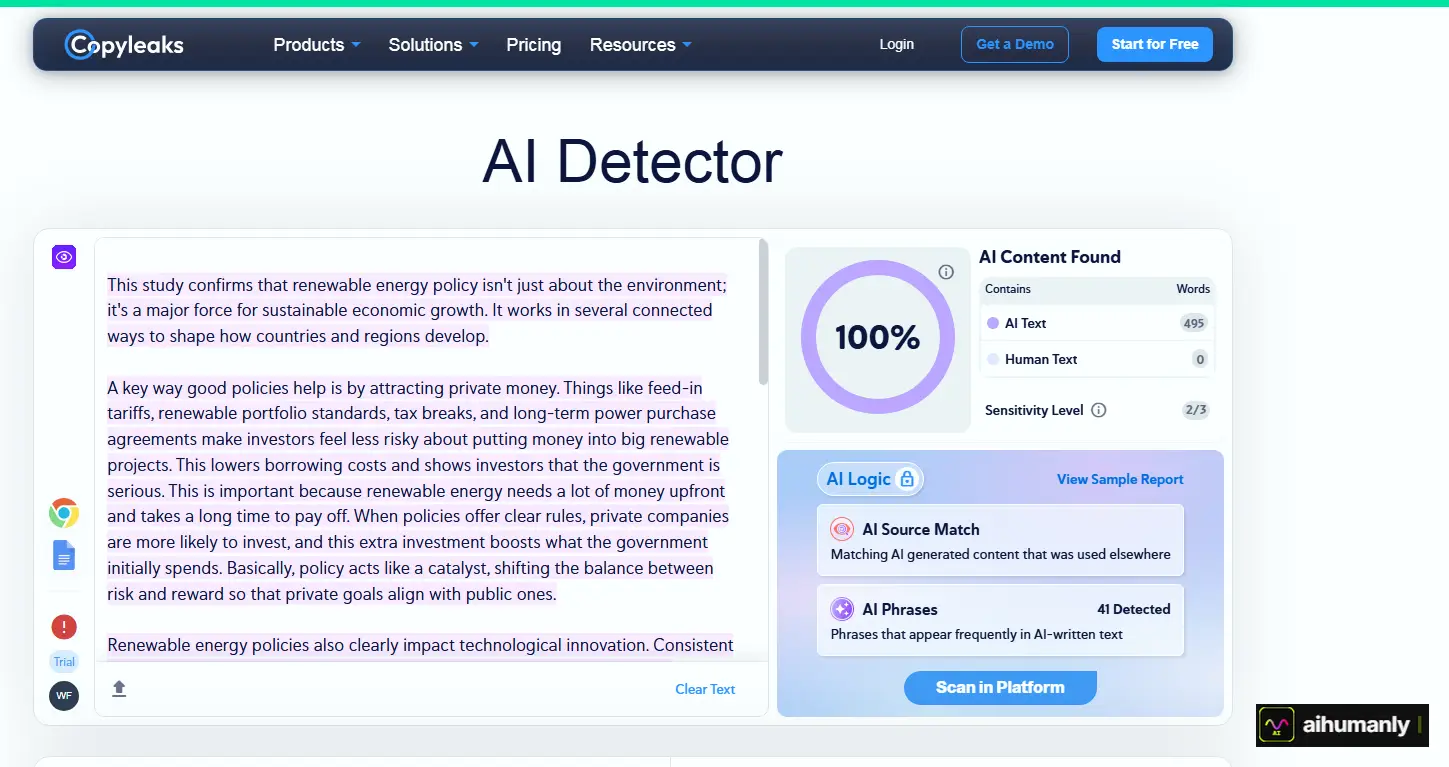
| Detector | AI Score | Verdict |
|---|---|---|
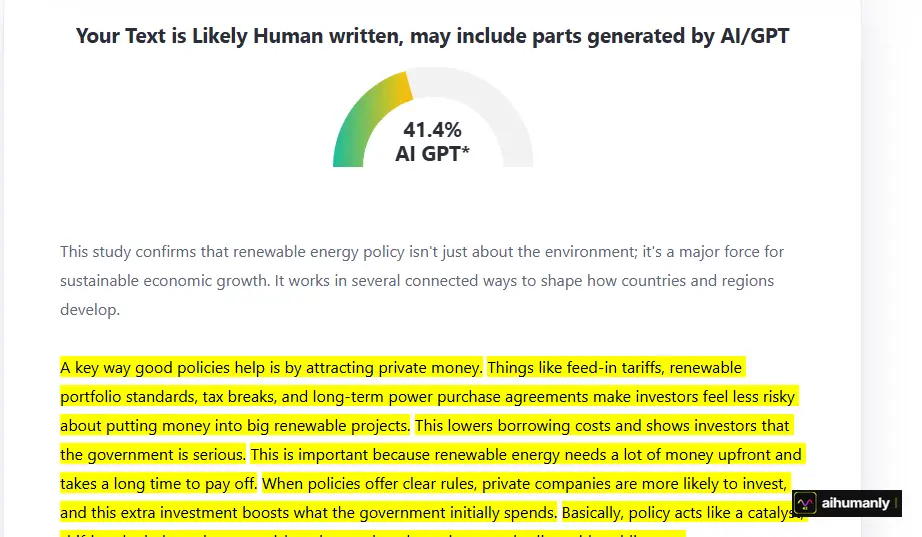
| GPTZero | 87% | AI |
| ZeroGPT | 41.4% | Human |
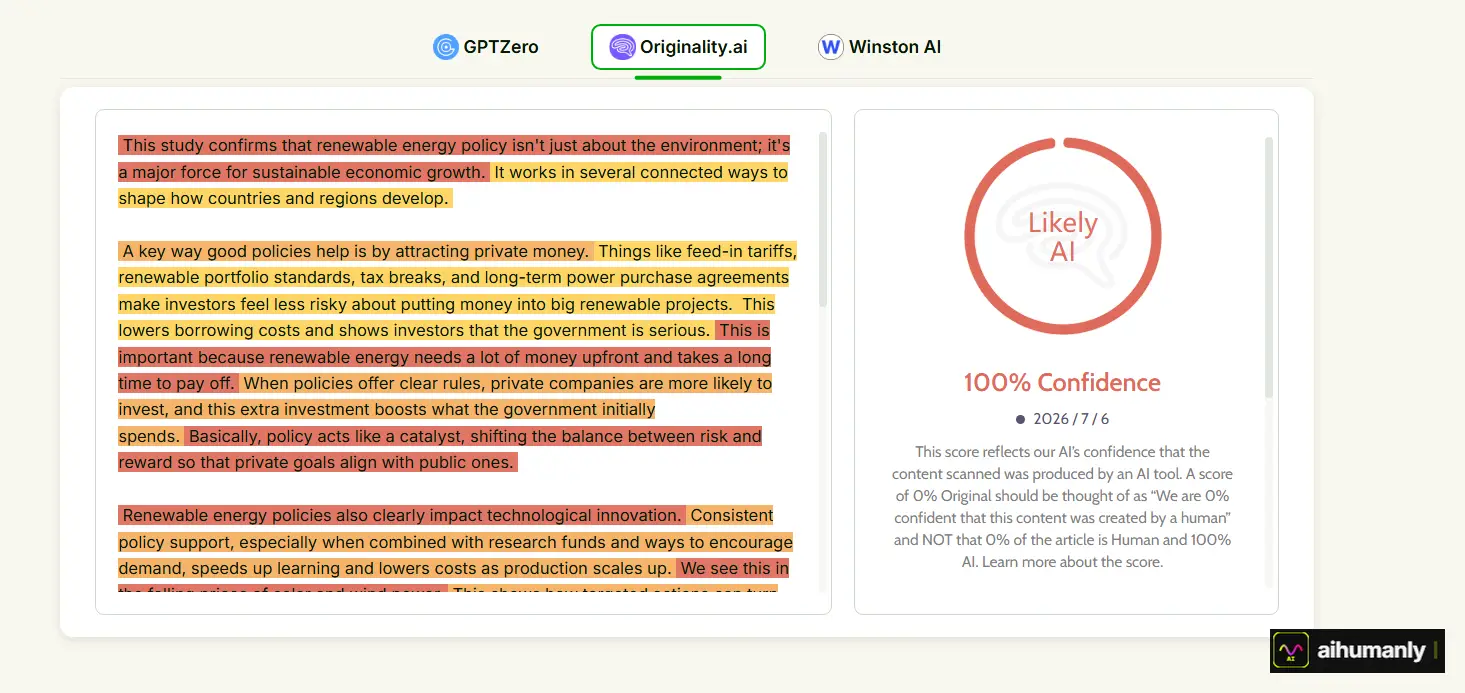
| Originality.ai | 100% | AI |
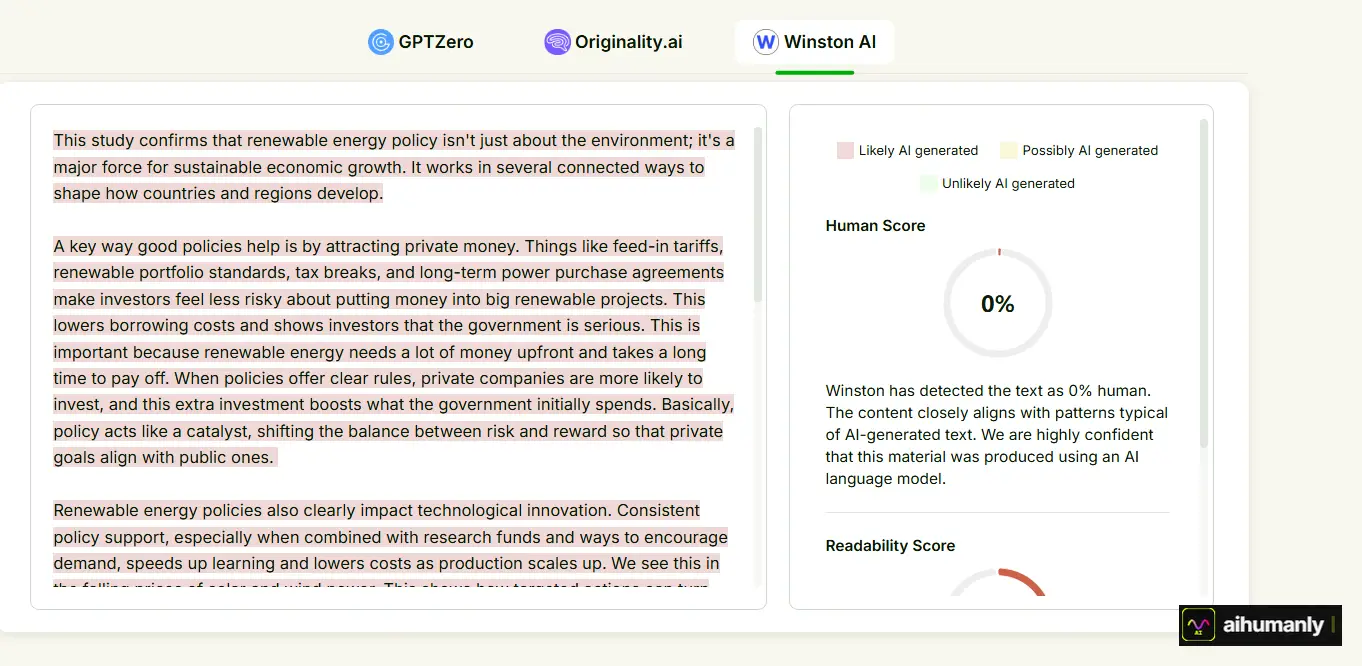
| Winston AI | 100% | AI |
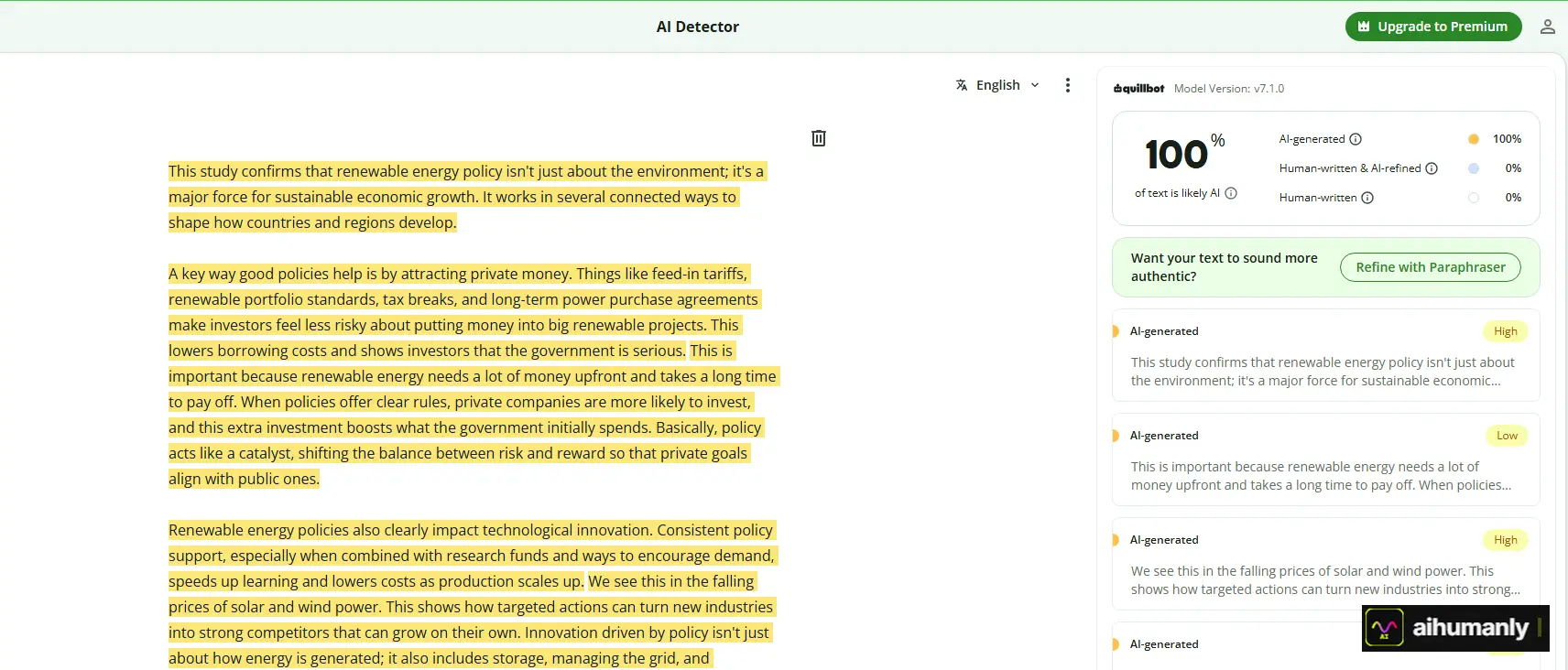
| QuillBot | 100% | AI |
| Copyleaks | 100% | AI |
Result: 5/6 detectors classified the output as AI. This was the worst detection result across all six tests.
Writing Quality Evaluation
| Dimension | Score / 10 |
|---|---|
| Meaning Preservation | 6 |
| Academic Tone | 6 |
| Grammar & Fluency | 7 |
| Formatting Consistency | 6 |
| Average | 6.25 |
Summary: MyDetector's General Writing / Base Model setting produced the weakest result for Essay 2. It completely omitted the final two paragraphs of the original, which contained the critical discussion of policy limitations, infrastructure costs, regional inequality, and implementation challenges. The evaluator noted that the tone was "too conversational for formal academic writing," with phrases like "isn't just about the environment," "attracting private money," "Things like," and "Basically." While readable, the text lost significant academic nuance and was reduced from 6 paragraphs to 4.
SuperHumanizer — Essay 2 Results
Mode: General, Super Ultra Model
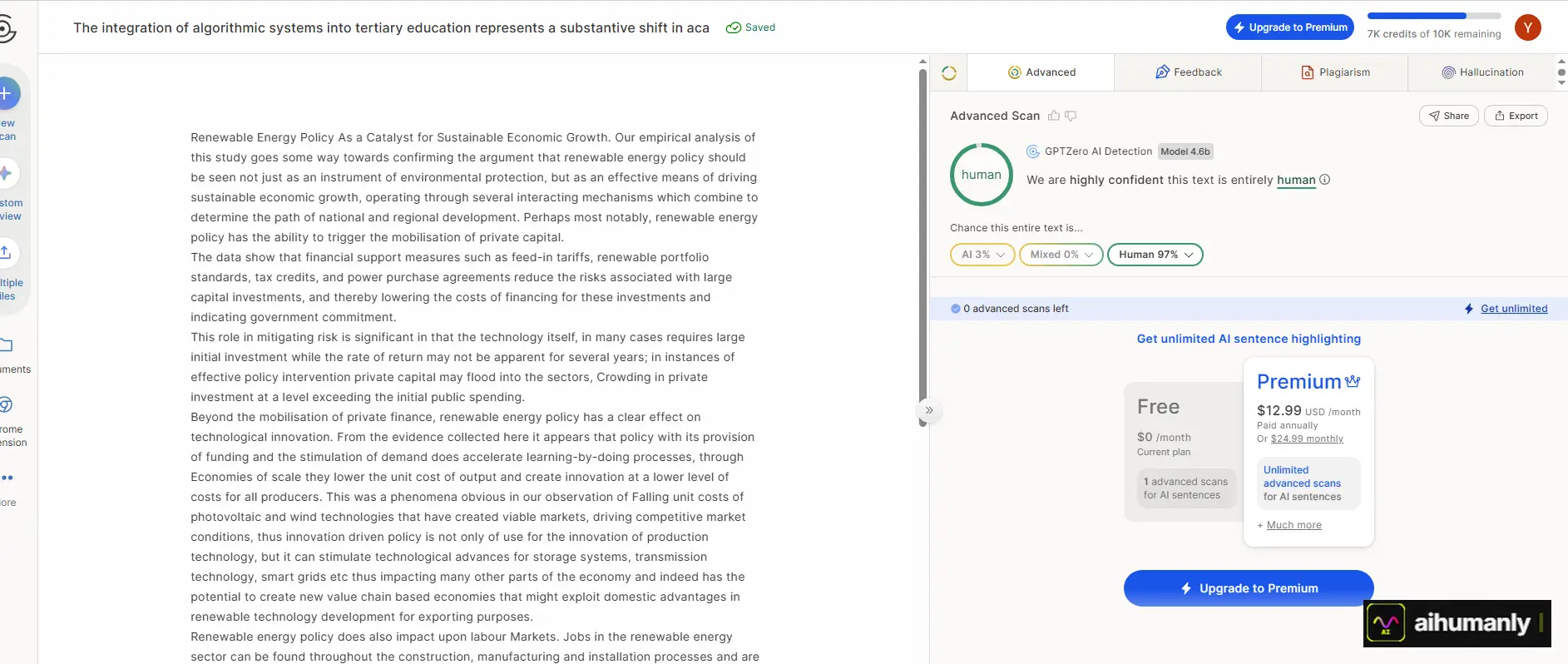
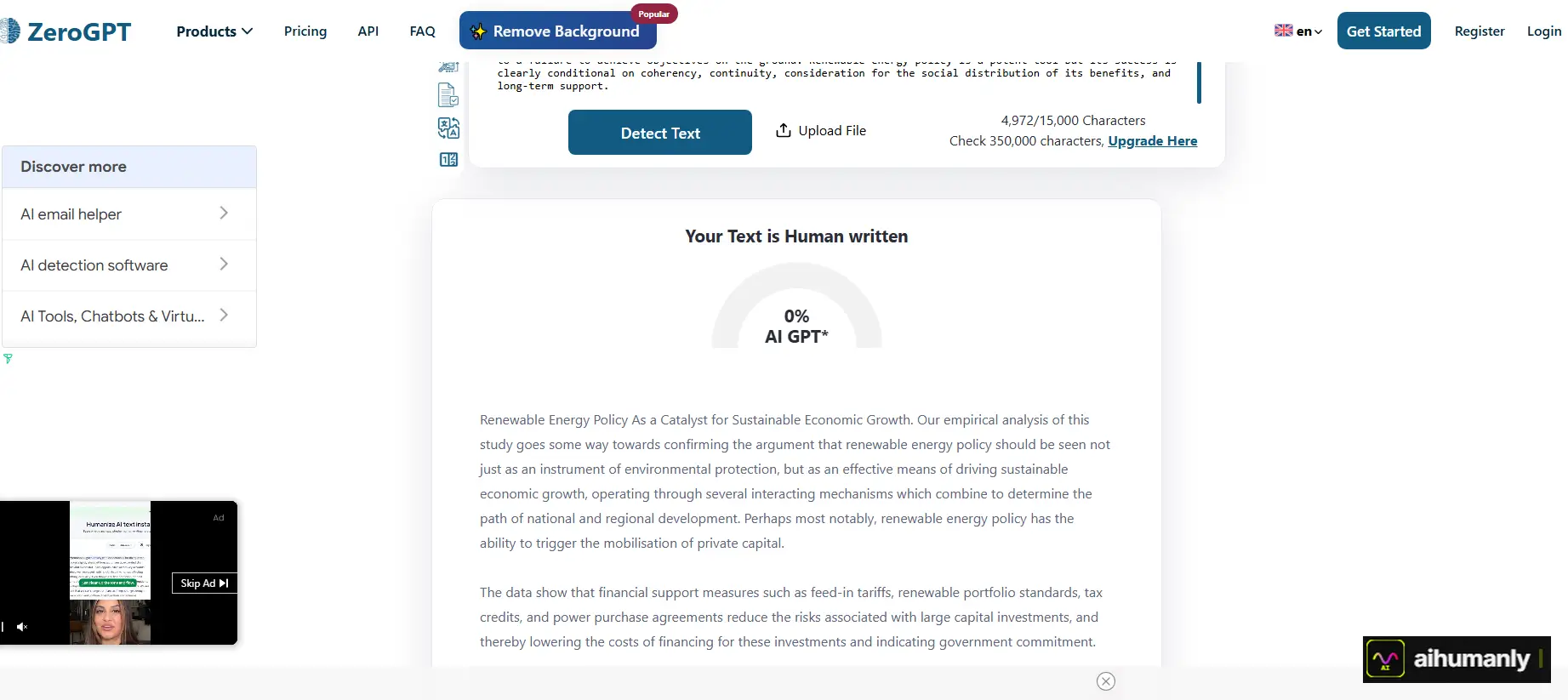
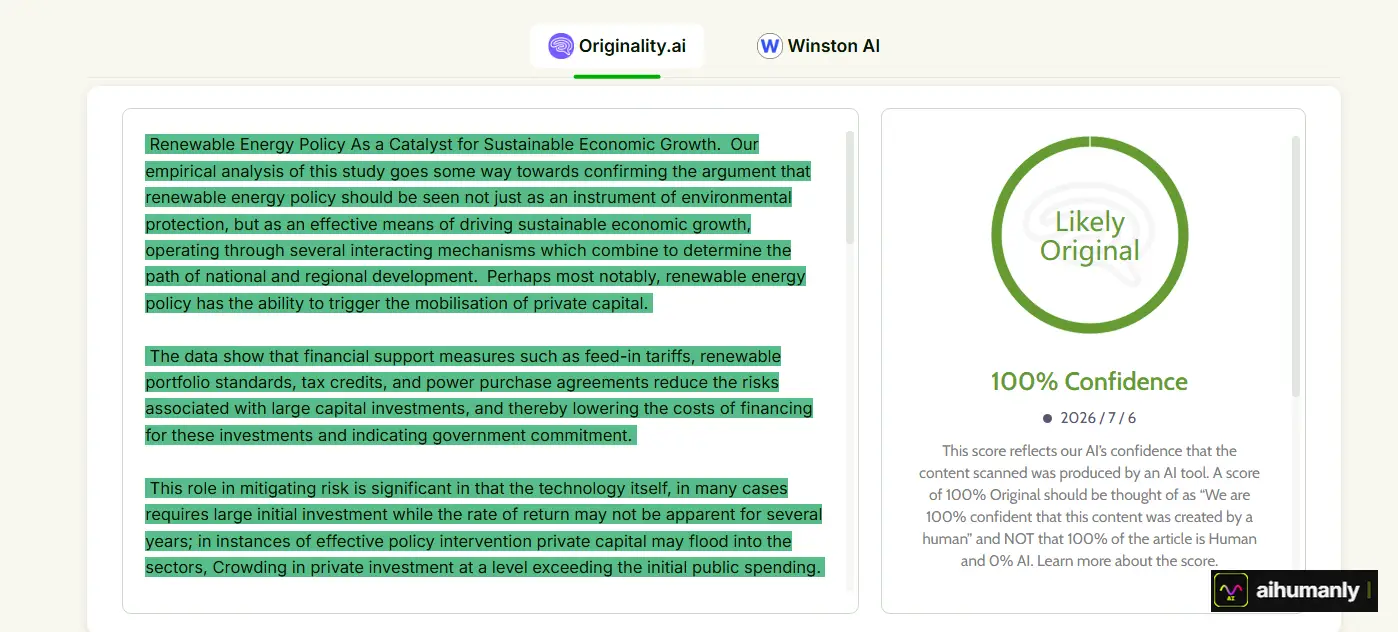
| Detector | AI Score | Verdict |
|---|---|---|
| GPTZero | 3% | Human |
| ZeroGPT | 0% | Human |
| Originality.ai | 0% | Human |
| Winston AI | 0% | Human |
| QuillBot | 0% | Human |
| Copyleaks | 0% | Human |
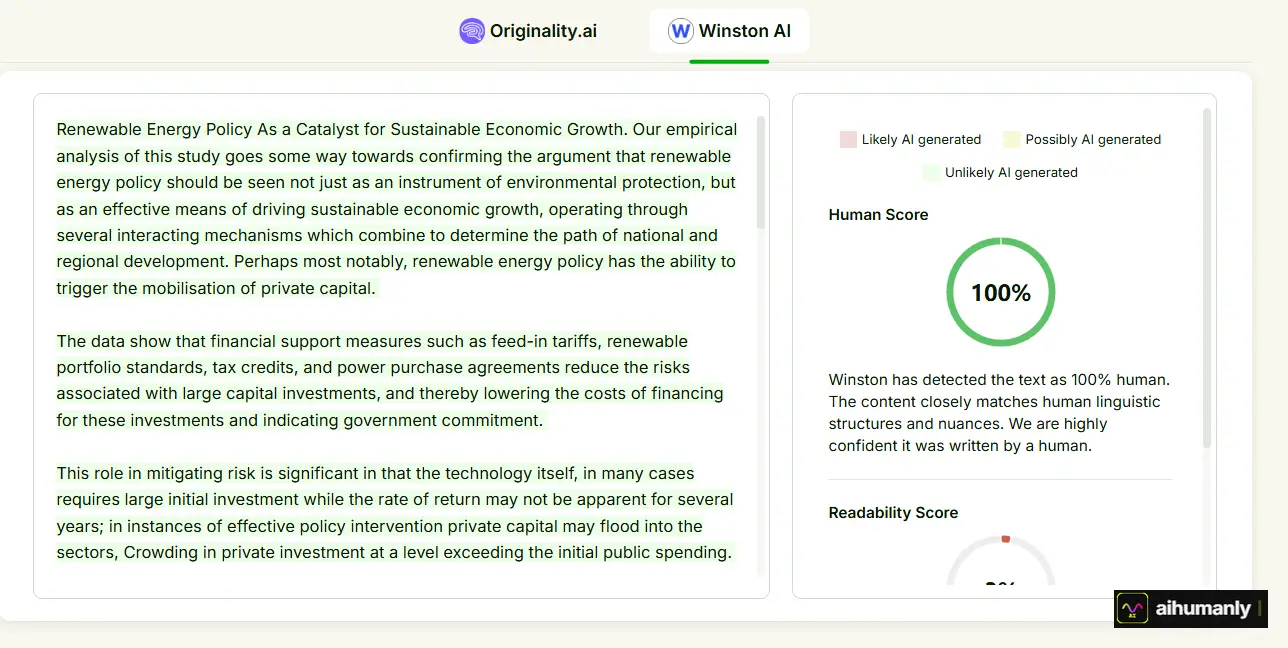
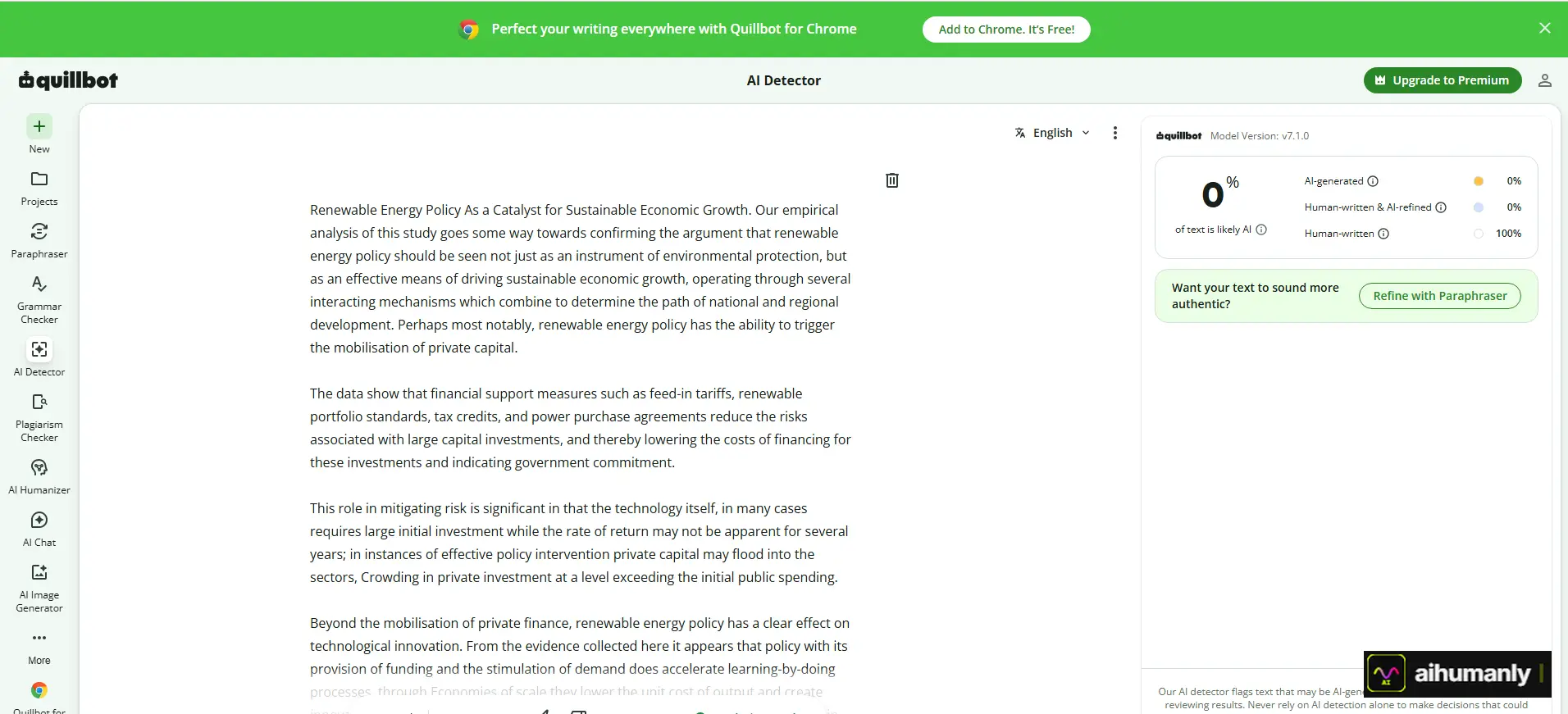
Result: 6/6 detectors classified the output as human with 0% AI scores on 5 of 6 detectors. This was the strongest detection result across the entire test.
Writing Quality Evaluation
| Dimension | Score / 10 |
|---|---|
| Meaning Preservation | 7 |
| Academic Tone | 5 |
| Grammar & Fluency | 4 |
| Formatting Consistency | 6 |
| Average | 5.5 |
Summary: SuperHumanizer achieved the best detection evasion but the worst writing quality for Essay 2. The evaluator identified frequent grammatical errors, run-on sentences, spelling mistakes ("geopoltical"), inconsistent capitalization ("Policy," "Governments," "Economies," "Falling," "Markets," "Net"), and incorrect spacing ("co- ordination"). Examples include "This was a phenomena" (should be "phenomenon"), "through Economies of scale they lower the unit cost" (run-on with capitalization errors), and "macro economic" instead of "macroeconomic." The text added an unnecessary title and used first-person phrasing ("Our empirical analysis") not present in the original. The evaluator concluded the text "needs major editing."
Side-by-Side AI Detection Score Comparison
This table brings together all AI detection results in one view. Lower percentages are better (less likely to be detected as AI).
| Text Version | GPTZero | ZeroGPT | Originality.ai | Winston AI | QuillBot | Copyleaks | Detectors Passed |
|---|---|---|---|---|---|---|---|
| Essay 1 — HumanizeAI.pro | 33% H | 27.9% H | 41% H | 26% H | 4% H | 0% H | 6/6 |
| Essay 1 — MyDetector | 100% AI | 41.9% H | 100% AI | 100% AI | 100% AI | 0% H | 2/6 |
| Essay 1 — SuperHumanizer | 28% H | 11.5% H | 88% AI | 7% H | 12% H | 0% H | 5/6 |
| Essay 2 — HumanizeAI.pro | 16% H | 0% H | 47% H | 0% H | 3% H | 0% H | 6/6 |
| Essay 2 — MyDetector | 87% AI | 41.4% H | 100% AI | 100% AI | 100% AI | 100% AI | 1/6 |
| Essay 2 — SuperHumanizer | 3% H | 0% H | 0% H | 0% H | 0% H | 0% H | 6/6 |
Key: H = classified as Human, AI = classified as AI-generated
Side-by-Side Writing Quality Comparison
This table compares the writing quality of each humanized output, as evaluated by GPT-5.5 independently.
| Tool / Version | Meaning Preservation | Academic Tone | Grammar & Fluency | Formatting | Average |
|---|---|---|---|---|---|
| Essay 1 — HumanizeAI.pro | 8 | 7 | 7 | 10 | 8.0 |
| Essay 1 — MyDetector | 8 | 8 | 9 | 10 | 8.75 |
| Essay 1 — SuperHumanizer | 7 | 6 | 5 | 4 | 5.5 |
| Essay 2 — HumanizeAI.pro | 7 | 7 | 7 | 7 | 7.0 |
| Essay 2 — MyDetector | 6 | 6 | 7 | 6 | 6.25 |
| Essay 2 — SuperHumanizer | 7 | 5 | 4 | 6 | 5.5 |
Which AI Humanizer Performed Best?
Best Overall: HumanizeAI.pro
HumanizeAI.pro achieved the most balanced performance across both detection evasion and writing quality:
- Detection: Passed 12/12 detector checks (6/6 on both essays)
- Writing Quality: Average scores of 8.0 (Essay 1) and 7.0 (Essay 2)
- Consistency: Performed well on both undergraduate and graduate-level text
It is the only tool that passed every single detector while maintaining acceptable-to-good academic writing quality.
Best for Lowering AI Detection Scores: SuperHumanizer
SuperHumanizer produced the lowest AI scores overall, achieving 0% on 5/6 detectors for Essay 2. It passed 11/12 detector checks across both essays. However, this came at a steep cost: its writing quality was the worst (average 5.5, with Grammar & Fluency scores of 4–5/10).
Best for Writing Quality: MyDetector (Essay 1 only)
MyDetector's Academic/Pro Model setting for Essay 1 produced the highest writing quality scores (8.75 average), with a 9/10 for Grammar & Fluency. The output was grammatically strong, fluent, and well-formatted. Unfortunately, this mode failed 4/6 detectors, meaning the polished text was still easily flagged as AI.
Best for Academic Tone: MyDetector (Essay 1, 8/10)
MyDetector's Pro Model maintained the most consistently formal and precise academic register for Essay 1. The evaluator praised its vocabulary, objectivity, and discipline-appropriate terminology. The trade-off was detection failure on 4/6 detectors.
Most Consistent Across Both Essays: HumanizeAI.pro
HumanizeAI.pro was the only tool that delivered respectable results on both essays. SuperHumanizer had dramatic quality problems on both essays. MyDetector performed well on Essay 1 writing quality but collapsed on Essay 2 detection (5/6 AI flags).
What the Test Results Mean
1. Detection evasion and writing quality trade off against each other
This was the clearest finding. SuperHumanizer produced the lowest AI detection scores but the worst writing. MyDetector produced the best writing (for Essay 1) but the worst detection results. HumanizeAI.pro found the best middle ground.
2. Detectors disagree dramatically
The same text can be flagged as 100% AI by one detector and 0% AI by another. For example, MyDetector's Essay 1 output scored 100% AI on GPTZero, Originality.ai, Winston AI, and QuillBot, but 0% AI on Copyleaks. This inconsistency underscores why no single detector should be treated as definitive.
3. Graduate-level text is harder to humanize well
All three tools scored lower writing quality on the graduate-level essay (Essay 2) than on the undergraduate essay (Essay 1). The more complex sentence structures, nuanced qualifications, and formal academic register of the Claude-generated text were harder to rewrite without losing meaning or introducing errors.
4. Copyleaks was the most lenient detector
Copyleaks classified 5/6 humanized outputs as human (0% AI), only flagging MyDetector's Essay 2 output. This suggests Copyleaks may be easier to pass than other detectors in this set.
5. Originality.ai and Winston AI were the strictest
These two detectors flagged more outputs as AI than any others. Originality.ai classified 4/6 outputs as AI (including SuperHumanizer's Essay 1 at 88%). Winston AI flagged MyDetector on both essays at 100%.
Limitations of This AI Humanizer Review
- English only. Results for other languages may differ.
- Two text samples. Academic writing spans many styles; two essays cannot represent all use cases.
- Detector algorithms update. AI detectors change over time; results from July 2026 may not hold indefinitely.
- Mode-dependent. Each tool offers different modes and settings. We tested specific combinations; other settings may produce different results.
- One evaluation run. The GPT-5.5 writing quality evaluation was performed once per output. Multiple evaluation runs could provide more robust quality scores.
- No Turnitin direct test. We did not test through an institutional Turnitin account. Results through official channels may differ.
Ethical Note on AI Humanizers and Academic Writing
This review is conducted for research, transparency, and tool evaluation purposes only.
Students should follow their institution's academic integrity policies. Submitting AI-generated or AI-humanized text as entirely original work may violate honor codes, even if the text passes AI detectors. AI tools should support learning — not replace critical thinking, original research, and proper citation practices.
The purpose of this test is to understand how these tools perform, not to encourage academic misconduct.
Final Verdict
We tested HumanizeAI.pro, MyDetector AI Humanizer, and SuperHumanizer on two English academic essays using seven AI detectors and an independent writing quality evaluation. Here is what we found:
HumanizeAI.pro is the best overall choice. It passed 100% of detector checks (12/12) while maintaining acceptable academic writing quality (7.0–8.0 average). Its outputs need minor editing for grammar and academic tone, but the meaning and structure are well preserved.
MyDetector produces the most polished academic prose in its Pro Model (8.75 average for Essay 1), but its detection evasion is inconsistent. It passed only 3/12 detector checks overall, making it unreliable if the primary goal is reducing AI detection scores.
SuperHumanizer is the most effective at evading detection — achieving 0% AI scores on 5/6 detectors for Essay 2 — but the writing quality is poor (5.5 average). Outputs contain frequent grammar errors, awkward phrasing, inconsistent formatting, and missing content. Major manual editing would be required before academic use.
The bottom line: If you need a tool that balances detection evasion with writing quality, HumanizeAI.pro is the clear winner. If you prioritize polished academic prose and are less concerned about detectors, MyDetector's Pro Model is worth considering. If detection evasion is your only concern and you are willing to heavily edit the output, SuperHumanizer may work — but expect to spend significant time fixing the text.
Appendix
Appendix A: Prompts Used to Generate the Test Texts
Prompt 1: Undergraduate Argumentative Essay (GPT-5.5)
Write an English undergraduate argumentative essay of approximately 650-800 words on the topic: "The Impact of Artificial Intelligence on Higher Education."The essay should sound like a real university student's academic assignment for a general education or education technology course. Use a clear introduction, thesis statement, body paragraphs, and conclusion. The tone should be formal but not overly advanced.Discuss both the benefits and challenges of AI in higher education, including personalized learning, academic integrity, student dependency, equal access, and the changing role of teachers.Do not include citations, footnotes, or a reference list. Do not use bullet points or section headings. Write in continuous academic prose with clear paragraph structure.Prompt 2: Graduate-Level Research Discussion (Claude Opus 4.8)
Write an English graduate-level research discussion section of approximately 750-900 words on the topic: "The Role of Renewable Energy Policy in Accelerating Sustainable Economic Development."The writing should resemble the discussion section of a master's-level research paper. Use a formal academic tone, analytical reasoning, and complex but readable sentence structures.Discuss how renewable energy policy can influence private investment, technological innovation, labor markets, energy security, industrial competitiveness, and long-term sustainable economic growth. Also address possible limitations, including policy inconsistency, infrastructure costs, regional inequality, and implementation challenges.Do not include citations, footnotes, or a reference list. Do not use bullet points or headings. Write as continuous academic prose and make it realistic for graduate-level academic writing.Appendix B: Original AI-Generated Text for Essay 1
Generated by: GPT-5.5
Artificial intelligence is becoming one of the most influential technologies in higher education. In recent years, universities have started using AI tools for tutoring, writing support, research assistance, grading, student advising, and administrative tasks. At the same time, students are increasingly using AI chatbots and other applications to help them study, summarize readings, generate ideas, and complete assignments. Because higher education is meant not only to deliver information but also to develop independent thinking, the growth of AI raises important questions. AI can make learning more personalized, efficient, and accessible, but it can also create problems related to academic integrity, student dependency, inequality, and the changing role of teachers. Therefore, the impact of AI on higher education is neither entirely positive nor entirely negative; it depends on how universities choose to regulate, teach, and integrate it.
One of the most important benefits of AI in higher education is personalized learning. In traditional university classrooms, one instructor may teach dozens or even hundreds of students at the same time. This makes it difficult to meet every student's individual needs. Some students may understand the material quickly, while others may need more explanation or practice. AI tools can help by adapting to a student's level and learning pace. For example, an AI tutoring program can provide extra exercises in areas where a student is struggling, explain a concept in different ways, or give immediate feedback on a practice question. This kind of support can be especially useful outside classroom hours, when professors or teaching assistants may not be available. In this way, AI has the potential to make higher education more responsive to individual learners.
AI can also support students by helping them manage the large amount of information they encounter in university. Many students have to read long articles, prepare for exams, and organize complex ideas across several courses. AI tools can assist with summarizing texts, creating study questions, checking grammar, or suggesting ways to structure an essay. When used responsibly, these tools can help students become more efficient and confident. For students who are learning in a second language, AI writing and translation tools may reduce some barriers and allow them to participate more fully in academic work. Similarly, students with disabilities may benefit from speech-to-text tools, text-to-speech programs, or AI systems that help organize notes and tasks. These examples show that AI can improve access to learning when it is used as a supportive tool rather than a replacement for effort.
However, AI also creates serious challenges for academic integrity. Universities rely on the idea that students should submit work that reflects their own understanding and abilities. AI tools make it easier for students to generate essays, solve problems, or complete assignments without doing the required learning. This does not only create unfairness between students; it also weakens the value of education itself. If a student uses AI to write an entire paper, the student may receive a grade but lose the opportunity to practice research, analysis, and argumentation. In response, universities need clear policies that define acceptable and unacceptable uses of AI. At the same time, instructors may need to redesign assignments so that they focus more on process, reflection, oral explanation, and original application rather than only final written products.
Another concern is student dependency. While AI can help students learn, it can also make them less willing to struggle with difficult tasks. Learning often requires confusion, trial and error, and persistence. If students immediately ask an AI tool for answers whenever they face difficulty, they may not develop the problem-solving skills that higher education is supposed to build. For example, a student who always uses AI to outline essays may never learn how to organize an argument independently. A student who uses AI to solve every math problem may not understand the reasoning behind the solution. This does not mean that AI should be banned, but students need to be taught how to use it critically. They should learn to question AI responses, check for errors, and treat AI as a guide rather than an authority.
Equal access is another major issue. Although AI is often presented as a tool that can make education more inclusive, access to AI technologies is not equal. Some students can afford paid versions of advanced tools, high-speed internet, and newer devices, while others cannot. Universities with larger budgets may be able to purchase powerful AI systems and train faculty to use them, while underfunded institutions may fall behind. This could increase existing inequalities in higher education. If AI becomes a major part of learning, then access to reliable AI tools may become almost as important as access to textbooks or libraries. Universities and governments should therefore consider how to provide fair access, protect student data, and prevent AI from becoming another source of educational privilege.
The role of teachers is also changing because of AI. Some people fear that AI will replace professors, but this view misunderstands the deeper purpose of teaching. AI can deliver information and provide quick feedback, but it cannot fully replace human judgment, mentorship, empathy, and classroom discussion. Teachers do more than explain content; they encourage students, challenge assumptions, evaluate complex thinking, and create learning communities. However, AI may change what teachers spend their time doing. Instead of focusing mainly on delivering basic information, instructors may spend more time guiding discussions, designing meaningful assessments, and helping students evaluate information critically. In this sense, AI should not replace teachers but push universities to rethink teaching in a more interactive and reflective way.
In conclusion, artificial intelligence is reshaping higher education in significant ways. It offers valuable opportunities for personalized learning, academic support, accessibility, and efficiency. At the same time, it raises difficult concerns about cheating, overreliance, unequal access, and the future role of teachers. The central issue is not whether AI will be used in universities, because it is already becoming part of academic life. The real question is how it should be used. Higher education institutions should develop clear guidelines, teach students responsible AI literacy, and ensure that technology supports rather than weakens learning. If used thoughtfully, AI can become a powerful educational tool. If used carelessly, it may damage the very skills and values that universities are meant to protect.
Appendix C: Humanized Versions of Essay 1
HumanizeAI.pro — Academic Mode
Artificial intelligence is gaining prominence as a technology within higher education. In recent years, universities started using AI software to assist in tutoring, writing, researching, grading, advising, and other administrative processes. Moreover, students are increasingly using AI chatbots and other applications to help them learn, summarize texts, generate ideas, and complete assignments. Considering that the purpose of higher education is not only to teach people certain knowledge but also foster critical thinking and independence, the development of AI brings forward some serious issues. AI can make the process of learning more personalized, efficient, and accessible, but there are some concerns associated with the integrity of education, student dependency, inequality, and changing roles of the educator. Thus, the influence of AI on higher education is ambiguous and depends on how this technology will be regulated, taught, and integrated into learning.
One of the most obvious advantages of AI in higher education is the possibility of personalized learning. In traditional university settings, one instructor can teach dozens or even hundreds of students at a time. This makes it impossible to tailor education to the needs of each student as some can learn quickly and some require more explanation and practice. An AI system can adjust to the individual student's level and speed by providing additional practice in areas of difficulty, suggesting alternative explanations or giving feedback on the practice problems. Such kind of help can be especially useful after classes when instructors or teaching assistants are unavailable. In this way, AI can help to make higher education more personalized.
Moreover, AI can help students deal with the vast amount of information encountered at university. Students have to read long articles, prepare for exams, and organize their thoughts on multiple subjects. With the help of an AI tool, one can summarize texts, generate study questions, check grammar and give advice on how to organize an essay. The proper use of this technology can increase the efficiency and boost confidence of students. For those who study in a second language, AI writing and translating tools can reduce possible barriers and allow for full participation in education. Furthermore, students with disabilities can get the help of speech-to-text and text-to-speech technologies, as well as AI systems that can take notes and organize tasks. Thus, AI can make learning more accessible when used as an assisting tool and not a replacement for efforts.
However, AI brings some considerable threats to the integrity of education. The concept of universities presupposes that students submit their works showing their own understanding of the material. With the help of AI technology, one can easily produce essays, solutions to problems, or other assignments without having learned the necessary material. This creates an imbalance among students and diminishes the significance of education. Therefore, universities have to establish clear policies of using AI in terms of what is allowed and what is not. Besides, instructors may have to reconsider the assignments and design them in such a way that would stress process and reflection, oral presentation, and application of knowledge, not just a written product.
Student dependency is another issue created by AI technology. Though it can assist in learning process, it can also make students less willing to struggle with difficulties. Learning is usually associated with confusion, trial and error, and persistence. When a student always turns to the help of an AI tool when encountering difficulties, he or she does not develop such skills as problem-solving which are important in higher education. For instance, a student relying on an AI tool to create an outline of an essay does not learn to organize his or her thoughts on his own; a student using AI solutions to all mathematical problems does not learn the logic behind them. However, it does not mean that AI should be forbidden, but it means that students should learn to use AI critically by questioning its responses, checking them for mistakes, and treating it not as a source of answers but as a guide.
The issue of equity of access to AI technologies is quite significant as well. Even though AI is often seen as a tool that allows for better inclusion, access to AI technologies is unequal as some students can afford paid versions of advanced tools, fast internet, and new devices while some do not have access to such services. Colleges and universities with larger budgets can purchase advanced AI technologies and train the staff to use them while those with smaller budgets can lag behind, thus aggravating existing inequalities in higher education. If AI becomes a part of the learning process, access to AI tools will become as important as access to textbooks or libraries. Hence, universities and governments have to think of the measures for fair access and protection of student data as well as preventing AI from becoming a tool that causes further inequality in education.
Furthermore, the role of educators is also changing under the influence of AI. Some fear that AI will replace professors, but this assumption is based on misunderstanding of the purposes of education. AI is able to disseminate information and give feedback instantly, but it can never replace human judgment, mentoring, empathy, and class discussion. The job of educators is much more than information dissemination as they inspire students, challenge their opinions, evaluate complex thinking, and help to develop learning communities. However, AI might change the allocation of teachers' time making them spend more time facilitating discussions, designing quality assessments, and helping students to analyze information critically. In this way, AI should not replace educators but force them to rethink pedagogical approaches focusing on interaction and reflection.
To sum up, artificial intelligence changes higher education significantly. AI provides students with an opportunity for personalized learning, assistance, accessibility, and efficiency; however, it also creates some serious concerns associated with cheating, overdependence, inequality, and changing roles of educators. The main problem here is not whether AI will be used in universities - it is already a part of education - but how it should be used. Higher education institutions have to establish some guidelines for using AI, teach students to use AI responsibly and make sure that technology assists in learning, not obstructs it. If used wisely, AI can become an excellent educational tool, otherwise, it will spoil the skills and values preserved in education.
MyDetector — Academic, Pro Model
The integration of algorithmic systems into tertiary education represents a substantive shift in academic practice. Universities increasingly rely on these computational tools for administrative workflows, research assistance, and pedagogical support, while students frequently engage automated applications to synthesize literature or draft assignments. Given the mandate of academic institutions to foster autonomous reasoning alongside knowledge transmission, this technological embedding prompts critical inquiry. The deployment of artificial intelligence offers avenues for individualized instruction but introduces complications regarding scholarly integrity, cognitive reliance, and structural disparity. Consequently, the trajectory of this adoption relies heavily on institutional frameworks for regulation and pedagogical adaptation.
Traditional instructional models often struggle to address the diverse cognitive cadences within a single cohort. When a singular faculty member oversees vast student populations, providing individualized attention becomes structurally constrained. Algorithmic tutoring systems present a mechanism to calibrate instructional delivery by adjusting to specific learning trajectories. Through adaptive feedback and targeted supplementary exercises during non-instructional hours, these platforms provide scaffolding where conventional support mechanisms may be unavailable. This capability suggests a gradual shift toward instructional models that are more responsive to individual learner profiles.
The navigation of dense academic material presents a significant cognitive load. Computational tools offer utility in managing this volume by extracting core arguments from extensive literature or providing structural frameworks for initial drafting. Such mechanisms, when applied judiciously, can reduce operational friction for learners. For individuals managing specific learning disabilities or operating in a secondary language, the mediation provided by translation algorithms and speech-recognition software can lower traditional barriers to academic engagement. In these contexts, the technology operates as cognitive scaffolding rather than an operational substitute for foundational effort.
Conversely, the ease with which these models generate coherent academic output complicates established frameworks of scholarly assessment. The foundational premise of university evaluation rests on work reflecting individual cognitive effort. Utilizing generative systems to bypass initial learning processes distorts evaluative metrics and undermines the broader pedagogical objective. A reliance on automated text generation deprives learners of the iterative struggle necessary for developing analytical acuity. Addressing this vulnerability requires institutions to articulate precise boundaries of acceptable use and reconsider assessment designs, shifting focus toward methodological processes, oral defense, and real-time application rather than relying exclusively on final written artifacts.
Beyond immediate integrity concerns, prolonged reliance on computational assistance may induce a broader cognitive dependency. Intellectual maturation inherently requires friction, uncertainty, and persistent problem-solving. A paradigm wherein learners immediately defer to algorithmic output when encountering difficulty risks atrophying the very analytical capacities higher education seeks to cultivate. Outsourcing structural organization or mathematical reasoning to automated systems obscures the underlying logic required for conceptual mastery. Cultivating digital literacy is thus essential. Students must be trained to interrogate algorithmic outputs, recognizing them as probabilistic models rather than definitive intellectual authorities.
The integration of these tools also intersects with existing socioeconomic stratifications. While frequently framed as a democratizing force, the distribution of advanced computational resources remains uneven. Access to sophisticated models, necessary hardware, and reliable infrastructure frequently requires financial capital. Institutions possessing substantial endowments can readily incorporate advanced systems and provide requisite faculty training, whereas under-resourced entities may struggle to keep pace. To mitigate the risk of algorithmic tools exacerbating educational disparities, strategic interventions at the policy level are required to ensure equitable distribution of technological resources.
The proliferation of these technologies further necessitates a recalibration of faculty roles. While algorithmic systems excel at information dissemination and rapid formative assessment, they lack the capacity for empathetic mentorship and complex evaluative judgment. Faculty effort can subsequently pivot away from the rudimentary transmission of foundational concepts toward the facilitation of critical discourse and the design of nuanced evaluative frameworks. The technology functions not as a replacement for human instruction but as a catalyst for refining pedagogical focus.
The embedding of computational algorithms into academic environments introduces mechanisms for enhanced accessibility and customized support while simultaneously surfacing vulnerabilities related to academic misconduct and resource inequality. The presence of these tools within academic ecosystems is an established reality. The imperative now lies in formulating robust regulatory paradigms and instructional strategies. Through deliberate integration, these systems can function as vital instruments for intellectual development, provided their deployment remains aligned with the core objectives of higher learning.
SuperHumanizer — Academic, Super Ultra Model
The impact of AI on Higher Education. Artificial Intelligence (AI) is quickly evolving to be one of the most influential technologies impacting higher education institutions across the globe. For the past few years universities have begun utilizing AI technology as an educational tool to assist in areas such as, tutoring, writing assistance, academic research, assessing papers, student advising, and administrative purposes.
Concurrently, students have also increasingly relied on AI Chatbots and applications in their academic work to aid them in understanding course material, summarising readings, formulating ideas and completing written assignments.
Since Higher Education involves not only disseminating information to students, but also developing them to become independent and critically-minded individuals, the emergence of this technology sparks several significant questions. While the implications for how it can facilitate enhanced personalised, efficient and more accessible learning is profound, so too are the consequences it poses for issues of academic integrity, student dependency, inequality, and the changing roles and responsibilities of instructors and faculty. In essence, the impact of AI on higher education is multifaceted - neither completely positive or negative; depending upon how each university chooses to guide and control its' use and its' integrate within their educational processes. Perhaps the greatest advantage to incorporating AI in higher education lies in its potential for personalised learning.
Typically, a traditional lecture will contain dozens or even hundreds of students and therefore a single instructor is unlikely to be able to accommodate the diverse learning styles and speeds of each individual.
Some students may master a concept quickly, whilst others will require further clarification and practice. AI technologies can supplement a course by adjusting the course material based on the learner's existing level of knowledge and pacing, offering supplementary materials in topics they struggle with, presenting concepts in a variety of ways, and providing instant feedback on practice problems. This support is particularly valuable in times when professors or teaching assistants are unavailable.
AI could truly allow higher education to become more attuned to individual student needs. Furthermore, a key benefit to AI tools for university students is the ability to manage the massive quantities of information they are exposed to. A student studying multiple courses must read long academic papers, research for exams, and comprehend various complex ideas simultaneously.
AI is available to summarise reading materials, generate study questions, edit papers for grammar and syntax issues, and assist with formatting an essay.
This technology can enable students to become more productive and increase their confidence in their academic output, provided it is used thoughtfully. This can provide invaluable support for students who may experience barriers when writing or learning in their second language by providing a more inclusive learning experience. Likewise, students with a learning disability can utilize speech-to-text technology, a screen reader or an AI assistant to organise notes and assignments. It is these applications that provide the proof of AI's positive contribution to the accessibility of learning, when utilised as supplementary technology to traditional means.
There are, however, serious ethical and academic integrity challenges created by the proliferation of AI in higher education institutions.
One of the foundational principles of universities is to ensure students produce their own work that accurately reflect their abilities and their understanding of the course material. With AI applications enabling easy access to automatically generated papers, assignments, and answers, students have an unprecedented opportunity to cheat in academic work. Not only does this render the assessment processes and students' academic output inequitable between learners; it diminishes the value of the entire educational process itself.
In such a scenario where a student purchases an AI generated paper, their only achievement is the grade they receive - they miss the opportunities to undertake rigorous research, analyse information, and develop strong arguments. Universities must consequently implement and regulate clear policies concerning AI usage within an educational environment and consider reframing course assessments to focus less on end-of-term output and more on the learning journey and development process including reflective assignments or oral defenses. There is a risk of students becoming overly reliant on the ease of access to solutions AI provides.
Learning frequently involves ambiguity and requires trial-and-error; therefore, the immediate appeal of seeking a solution from AI instead of persisting with the challenging work of understanding and overcoming academic difficulties may stifle students' ability to develop critical and independent thought.
A student who uses AI to prepare an essay structure may not learn to organize a thesis in their own right, while one who consistently uses AI to solve their math problems may never fully grasping the underlying methodology. Such tools are obviously not inherently negative but require a teaching of their judicious use; students should be educated to question the data AI provides, identify its flaws, and engage with it as a supportive tool rather than an unquestionable oracle. Access is another fundamental aspect which AI in education raises concerns about. It's common for people to frame AI as the equaliser of opportunity, however the reality is quite stark.
Higher education institutions or individuals who can afford paid, advanced AI tools and have reliable high-speed internet access have a clear advantage over those that cannot afford such luxuries or maintain necessary technical infrastructure.
Institutions with limited budgets may lack the funds to invest in cutting-edge AI technology and adequately train faculty on its use and thus may lag behind their better-resourced counterparts in its utilisation. If AI is integral to the learning process at a later date, this technology may well serve as yet another gateway to exacerbating inequalities in higher education. As AI systems gain an increasing role in teaching and learning, it is imperative that governing bodies address the equitable distribution of this technology, the ethical utilisation and ownership of data gathered by it, and that access to qualityAI is afforded in an inclusive manner rather than becoming another element of institutional privilege.
One aspect where the influence of AI on Higher education appears to be most pronounced is the altering of the role of teachers. The concern that AI would wholly replace educators is one borne from an incomplete understanding of teaching's essential role. Although AI may excel at information transmission and offer swift feedback on a student's work, it is incapable of fully replacing human judgment, pedagogical mentoring, interpersonal understanding, classroom discussion, or the emotional support and inspiration a human educator provides.
The responsibilities of a teacher extend beyond imparting factual knowledge; educators facilitate discussion, provoke students' assumptions, challenge students' thinking, and build communities of learning.
However, the tasks educators dedicate their time to may shift with AI integration; rather than focussing solely on delivering standard information to large groups, they may find themselves engaged more in guiding discussions, developing creative and meaningful assignments, and helping students critically evaluate complex and vast amounts of information. AI is not necessarily a replacement but a catalyst for rethinking the nature of teaching in a more collaborative and reflective direction.
Appendix D: Original AI-Generated Text for Essay 2
Generated by: Claude Opus 4.8
The findings of this study reinforce the proposition that renewable energy policy functions not merely as an environmental instrument but as a substantive driver of sustainable economic development, operating through several interrelated channels that collectively shape the trajectory of national and regional growth. Central among these is the capacity of well-designed policy frameworks to mobilise private investment. The evidence suggests that instruments such as feed-in tariffs, renewable portfolio standards, tax incentives, and long-term power purchase agreements reduce the perceived risk associated with capital-intensive renewable projects, thereby lowering the cost of financing and signalling credible governmental commitment to investors. This risk-mitigation function is particularly significant because renewable energy technologies typically demand substantial upfront capital while yielding returns over extended time horizons. Where policy provides regulatory certainty, private actors appear more willing to commit resources, and the resulting crowding-in of investment amplifies the initial fiscal outlay of the state. In this sense, policy operates as a catalyst that recalibrates the expected balance between risk and reward, aligning private incentives with public objectives.
Beyond investment, renewable energy policy exerts a discernible influence on technological innovation. The analysis indicates that sustained policy support, especially when coupled with research funding and demand-side measures, accelerates learning-by-doing and drives down unit costs through economies of scale. This dynamic, frequently observed in the declining cost curves of solar photovoltaic and wind technologies, illustrates how targeted intervention can transform nascent industries into competitive sectors capable of self-sustaining growth. Importantly, innovation induced by policy is not confined to generation technologies alone but extends to storage, grid management, and efficiency solutions, thereby generating spillover effects across the broader economy. Such innovation carries implications for industrial competitiveness, as early movers in renewable manufacturing and deployment may secure advantageous positions in emerging global value chains. The strategic dimension of energy policy therefore becomes apparent: states that cultivate domestic capabilities in renewable technologies stand to benefit from export opportunities and reduced dependence on imported fossil fuels, thereby strengthening both their economic resilience and their geopolitical standing.
The labour market implications of renewable energy policy further substantiate its developmental role. The transition towards renewable systems tends to generate employment across construction, installation, manufacturing, and maintenance activities, and these positions are often more labour-intensive per unit of energy produced than their fossil-fuel counterparts. Nevertheless, the aggregate employment effect must be interpreted with caution, since job creation in renewable sectors may be partially offset by contraction in extractive and conventional energy industries. The net outcome depends substantially upon the pace of transition, the availability of retraining programmes, and the geographic distribution of new and displaced employment. This observation gestures towards one of the more persistent tensions within renewable energy policy, namely the challenge of ensuring that the benefits of transition are equitably distributed rather than concentrated among regions and populations already advantaged by existing economic structures.
Energy security represents an additional channel through which policy contributes to sustainable growth. By diversifying the energy mix and reducing reliance on volatile fossil-fuel markets, renewable deployment insulates economies from price shocks and supply disruptions, thereby stabilising the macroeconomic environment in which longer-term investment decisions are made. This stabilising function is difficult to quantify precisely, yet its significance is amplified in an era of heightened geopolitical uncertainty, where the strategic value of domestically generated energy has become increasingly apparent.
Despite these promising channels, the evidence also compels a measured acknowledgement of the limitations and constraints that attend renewable energy policy. Foremost among these is the problem of policy inconsistency. Where governments alter or withdraw support prematurely, investor confidence erodes, and the resulting uncertainty can stall or reverse progress achieved during periods of stable commitment. The intertemporal nature of renewable investment renders it acutely vulnerable to political cycles and shifting priorities, suggesting that the durability of policy is as consequential as its initial design. Infrastructure costs constitute a further impediment, particularly the substantial expenditure required to modernise grids, integrate intermittent generation, and develop adequate storage capacity. These costs may strain public finances and, in the absence of careful management, could be transferred to consumers in ways that provoke political resistance and undermine the social legitimacy of the transition.
Regional inequality further complicates the picture, as the capacity to attract renewable investment and to absorb its benefits is unevenly distributed across territories with differing resource endowments, institutional capacities, and levels of development. Without deliberate corrective measures, renewable energy policy risks reproducing or exacerbating existing spatial disparities. Finally, implementation challenges, encompassing administrative capacity, permitting delays, and coordination failures among governance levels, frequently constrain the translation of ambitious policy objectives into tangible outcomes. These considerations do not negate the developmental potential of renewable energy policy but rather delineate the conditions under which that potential may be realised. Taken together, the findings suggest that renewable energy policy can accelerate sustainable economic development, yet its efficacy is contingent upon coherence, credibility, distributional sensitivity, and sustained institutional commitment over time.
Appendix E: Humanized Versions of Essay 2
HumanizeAI.pro — Standard, Ultra Run
The conclusions drawn from this analysis corroborate the hypothesis that renewable energy policy operates not only as an environmental tool but as a means of driving sustainable economic development in various ways. In particular, the first key role played by renewable energy policies is the mobilisation of private investment. It turns out that tools such as feed-in tariffs, renewable portfolio standards, taxation, and long-term agreements to purchase power mitigate the risk associated with large and risky renewable projects, thus reducing the cost of finance and indicating the intention of the government to act consistently. Since the risk mitigation is essential due to the fact that renewable energy technologies require considerable financial investments to yield returns in the future, the crowding-in of the investments increases the effectiveness of the initial fiscal effort on the part of the government, making the policy a catalyst that allows recalibrating risk-reward expectations.
Moreover, renewable energy policies have an impact on technological innovation, as indicated by the analysis. Particularly, the consistent support of such policies, in combination with research funding and demand-side measures, facilitates learning-by-doing and reduces costs due to economies of scale, as shown by the cost reduction in solar photovoltaics and wind technologies. Hence, the intervention in the market allows transforming a new industry into a competitive sector of the economy. Besides, innovations stimulated by such policy are not limited solely to generating technologies, including innovations related to storage, grid management, and efficiency, thus having spillovers to other areas of the economy. Innovations, in turn, affect industrial competitiveness: states that invest in domestic capabilities for renewable energy technologies have the chance of getting an advantageous position in the global value chain, as they get export opportunities and reduce their dependency on fossil fuel imports. Consequently, energy policies become a tool for enhancing the economic and geopolitical position of the country in the process of the transition to renewable energy.
Labor market effects caused by renewable energy policies also support the role of the latter in sustainable development. First of all, it is important to point out that the move towards renewable energy systems creates jobs in building, installing, manufacturing, and maintaining activities and, hence, leads to labor-intensive production compared to the fossil fuel-based energy generation. However, the overall employment effect of renewable energy policies should be evaluated carefully, as the emergence of jobs in the new industry is partially offset by job losses in the extractive and conventional energy industry. Therefore, the net effect depends on the speed of the transition and retraining programmes. This observation highlights one of the main problems related to the implementation of renewable energy policies, namely the problem of equitable distribution of the benefits of transition.
Another channel via which renewable energy policies facilitate sustainable development is the increase of energy security, meaning that the diversification of energy sources makes the economy resistant to price shocks and supply interruptions, which stabilises the macroeconomic environment for decision-making. The exact quantification of this effect is difficult, but it gains additional importance in times of growing geopolitical instability, when the value of energy independence becomes particularly apparent.
At the same time, renewable energy policies face several difficulties that limit their effectiveness and create barriers to achieving sustainable development goals. The first barrier is the issue of consistency. As it has been pointed out above, when governments change their policies too rapidly, it decreases investor confidence and hampers the development that was previously made under consistent policies. Since investments in renewable energy are intertemporal, it means that the sustainability of renewable energy policies plays a particularly crucial role. High infrastructure costs constitute another barrier, especially the high costs of modernizing grids, integrating intermittent generation, and developing storage facilities. Such costs can put pressure on public finances and, in the worst case scenario, result in redistribution of costs to consumers in a way that would lead to political resistance to the transition. Regional inequality becomes a problem, as territories differ in their capability to attract renewable investment and reap benefits from it, and hence, there is a risk of reproduction of spatial inequalities without special efforts. Finally, implementation issues, which include lack of administrative capacity, permitting delays, and coordination among various levels of governance, sometimes prevent the transformation of ambitious goals into results.
MyDetector — General Writing, Base Model
This study confirms that renewable energy policy isn't just about the environment; it's a major force for sustainable economic growth. It works in several connected ways to shape how countries and regions develop.
A key way good policies help is by attracting private money. Things like feed-in tariffs, renewable portfolio standards, tax breaks, and long-term power purchase agreements make investors feel less risky about putting money into big renewable projects. This lowers borrowing costs and shows investors that the government is serious. This is important because renewable energy needs a lot of money upfront and takes a long time to pay off. When policies offer clear rules, private companies are more likely to invest, and this extra investment boosts what the government initially spends. Basically, policy acts like a catalyst, shifting the balance between risk and reward so that private goals align with public ones.
Renewable energy policies also clearly impact technological innovation. Consistent policy support, especially when combined with research funds and ways to encourage demand, speeds up learning and lowers costs as production scales up. We see this in the falling prices of solar and wind power. This shows how targeted actions can turn new industries into strong competitors that can grow on their own. Innovation driven by policy isn't just about how energy is generated; it also includes storage, managing the grid, and improving efficiency, which benefits the wider economy. Companies that are early leaders in making and using renewable technology can gain an advantage in global markets. This highlights the strategic side of energy policy: countries that develop their own renewable technology capabilities can benefit from exports and rely less on imported fossil fuels, making them more economically stable and improving their global standing.
The effects on jobs also show how renewable energy policy contributes to development. The shift to renewable systems creates jobs in building, installing, manufacturing, and maintaining these systems. These jobs often require more workers per unit of energy produced compared to fossil fuels. However, we need to be careful about the overall job numbers, as new jobs in renewables might be balanced out by job losses in mining and traditional energy sectors. The final impact depends a lot on how quickly the transition happens, whether there are training programs available, and where the new and lost jobs are located. This points to a constant challenge with renewable energy policy: making sure the benefits of this shift are shared fairly and don't just go to regions and people who are already well-off.
Energy security is another area where policy helps sustainable growth. By diversifying our energy sources and depending less on unpredictable fossil fuel markets, renewable energy shields economies from sudden price changes and supply problems. This stabilizes the economy, which is crucial for making long-term investment decisions. It's hard to put an exact number on this benefit, but it's increasingly important in times of global uncertainty when the value of locally produced energy is becoming more obvious.
SuperHumanizer — General, Super Ultra Model
Renewable Energy Policy As a Catalyst for Sustainable Economic Growth. Our empirical analysis of this study goes some way towards confirming the argument that renewable energy policy should be seen not just as an instrument of environmental protection, but as an effective means of driving sustainable economic growth, operating through several interacting mechanisms which combine to determine the path of national and regional development. Perhaps most notably, renewable energy policy has the ability to trigger the mobilisation of private capital.
The data show that financial support measures such as feed-in tariffs, renewable portfolio standards, tax credits, and power purchase agreements reduce the risks associated with large capital investments, and thereby lowering the costs of financing for these investments and indicating government commitment.
This role in mitigating risk is significant in that the technology itself, in many cases requires large initial investment while the rate of return may not be apparent for several years; in instances of effective policy intervention private capital may flood into the sectors, Crowding in private investment at a level exceeding the initial public spending.
Beyond the mobilisation of private finance, renewable energy policy has a clear effect on technological innovation. From the evidence collected here it appears that policy with its provision of funding and the stimulation of demand does accelerate learning-by-doing processes, through Economies of scale they lower the unit cost of output and create innovation at a lower level of costs for all producers. This was a phenomena obvious in our observation of Falling unit costs of photovoltaic and wind technologies that have created viable markets, driving competitive market conditions, thus innovation driven policy is not only of use for the innovation of production technology, but it can stimulate technological advances for storage systems, transmission technology, smart grids etc thus impacting many other parts of the economy and indeed has the potential to create new value chain based economies that might exploit domestic advantages in renewable technology development for exporting purposes.
Renewable energy policy does also impact upon labour Markets. Jobs in the renewable energy sector can be found throughout the construction, manufacturing and installation processes and are typically more labor-intensive per unit of output produced than those found in conventional energy sectors. It is important, however, to view job creation as a Net positive impact: since jobs will be lost from existing, conventional energy sectors and as total net employment gains might be only limited to overall size of the sector, it may vary depending on the pace and structure of this transition. This points to an often contentious debate within the renewables sphere regarding equitable redistribution of jobs and the impact of job losses and creation between various communities across different parts of regions.
A key contribution to sustainable economic growth, derived through this policy, comes in the form of energy security. By fostering a more diverse range of domestically produced, alternative forms of energy renewable policy may thus help protect economies against price volatilities in global fossil fuel markets. This helps contribute to a stable macro economic environment in which longer term investments can be more assured, and this becomes increasingly important in our increasingly turbulent geopoltical climate.
While the above demonstrate the considerable potential of renewable energy policy to stimulate and support economic growth, we must also concede limitations, and constrain policy effectiveness. Inconsistencies in Policy will cause investment and development to stall. If Governments move their support and/or policies without adequate notice this uncertainty undermines the certainty needed for such large, long-term investment projects, leading to delays or cancellations.
Infrastructure costs can also be significant - large investments to update the transmission and distribution grid and to provide storage to accommodate intermittency could impose large costs on both Government and consumers and be politically damaging to governments.
The unequal distribution of opportunity between regions, the capacity to attract renewable investment being higher in some than in others is another constraint to policy. The need to consider and manage spatial distribution inequalities throughout the policy process becomes evident. Implementation can often be a challenge, where lack of administrative capacity and co- ordination failures between levels of governance lead to a failure to achieve objectives on the ground. Renewable energy policy is a potent tool but its success is clearly conditional on coherency, continuity, consideration for the social distribution of its benefits, and long-term support.