Herramientas de humanización de IA probadas: HumanizeAI.pro vs MyDetector vs SuperHumanizer para escritura académica en inglés

Los ensayos en inglés generados por IA están por todas partes ahora. Estudiantes, investigadores y profesionales utilizan herramientas como ChatGPT y Claude para redactar contenido todos los días. Al mismo tiempo, los detectores de IA como GPTZero, Originality.ai y Turnitin se han convertido en un estándar en las universidades y en los flujos de trabajo editoriales.
Las herramientas de humanización de IA afirman reescribir textos generados por IA para que suenen más naturales y superen la detección de IA. ¿Pero realmente funcionan? ¿Y el texto "humanizado" sigue siendo legible, preciso y académicamente apropiado?
En esta reseña, probamos tres herramientas populares de humanización de IA en inglés — HumanizeAI.pro, MyDetector AI Humanizer y SuperHumanizer — utilizando dos ensayos académicos reales. Comprobamos cada resultado con siete detectores de IA diferentes y encargamos una evaluación independiente de la calidad de escritura para cada texto reescrito. Cada resultado a continuación proviene de pruebas reales, no de afirmaciones de marketing.
Resumen rápido de esta prueba de humanización de IA
| Elemento de la prueba | Detalles |
|---|---|
| Idioma probado | Solo inglés |
| Tipo de contenido | Ensayo académico / escritura estilo investigación |
| Herramientas de humanización de IA | HumanizeAI.pro, MyDetector, SuperHumanizer |
| Detectores de IA | GPTZero, ZeroGPT, Originality.ai, Winston AI, QuillBot, Copyleaks |
| Evaluador de calidad de escritura | GPT-5.5 (independiente, controlado por prompt) |
| Dimensiones de calidad | Conservación del significado, Tono académico, Gramática y fluidez, Consistencia de formato |
| Total de resultados humanizados probados | 6 (3 herramientas x 2 ensayos) |
| Objetivo principal | Comparar resultados reales de detección de IA y calidad de escritura entre herramientas |
Por qué probamos las herramientas de humanización de IA en inglés
La mayoría de las reseñas de humanizadores de IA en línea hacen afirmaciones sin mostrar evidencia. Dicen que una herramienta "evade todos los detectores" o "produce texto 100% similar al humano", pero rara vez lo respaldan con datos de pruebas comparativas.
Esta reseña es diferente. Nosotros:
- Utilizamos los mismos dos textos fuente en las tres herramientas
- Probamos cada resultado con los mismos siete detectores
- Hicimos que cada reescritura fuera evaluada independientemente en cuanto a calidad de escritura
- Publicamos los textos originales completos, resultados humanizados e informes de evaluación en el apéndice
El objetivo no es solo ver si las puntuaciones de IA disminuyen. Es responder a una pregunta más difícil: ¿puede un humanizador producir texto que sea simultáneamente resistente a los detectores, académicamente sólido y esté bien escrito?
Herramientas de humanización de IA incluidas en esta reseña
HumanizeAI.pro
Sitio web: https://www.humanizeai.pro/
HumanizeAI.pro es un humanizador de texto de IA dedicado que ofrece múltiples modos de reescritura. Para esta prueba, utilizamos:
- Ensayo 1: Modo académico
- Ensayo 2: Modo estándar con Ultra Run activado
Ambos resultados fueron luego probados en los siete detectores.
MyDetector AI Humanizer
Sitio web: https://mydetector.ai/ai-humanizer/
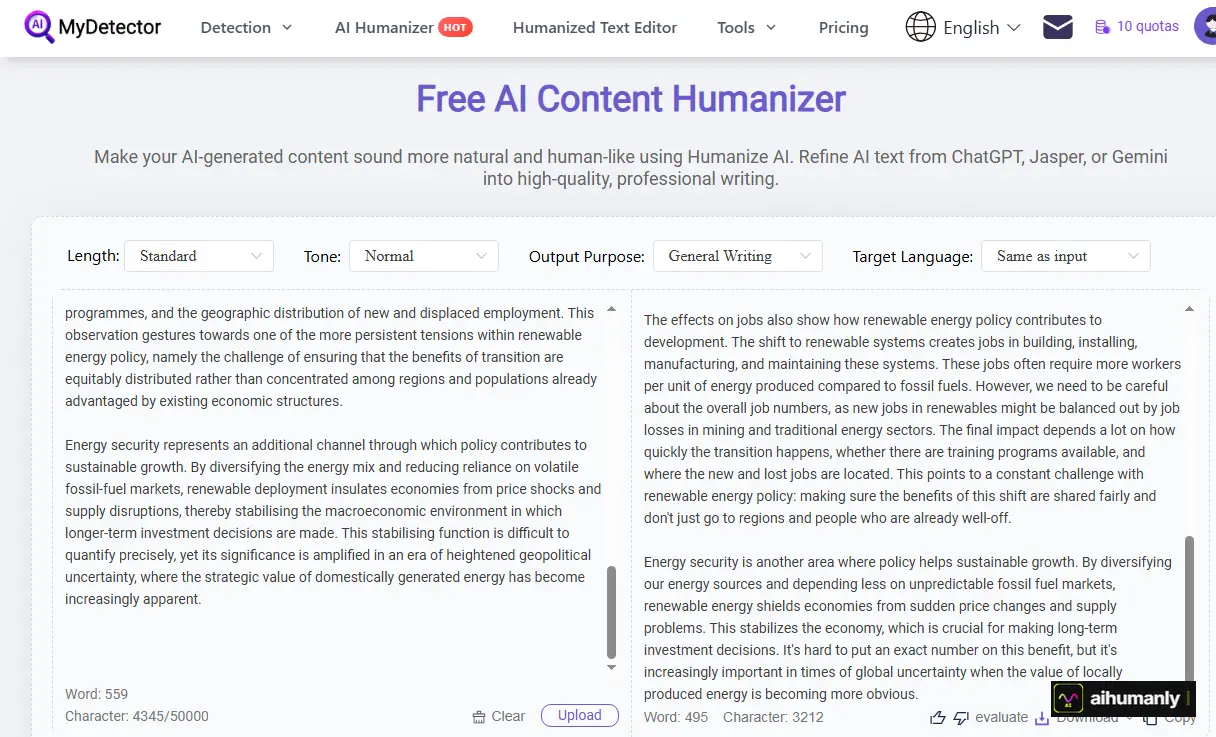
MyDetector es conocido principalmente como una plataforma de detección de IA, pero también incluye un humanizador de IA integrado. Para esta prueba, utilizamos:
- Ensayo 1: Propósito académico con Pro Model
- Ensayo 2: Propósito de escritura general con Base Model
SuperHumanizer
Sitio web: https://superhumanizer.ai/
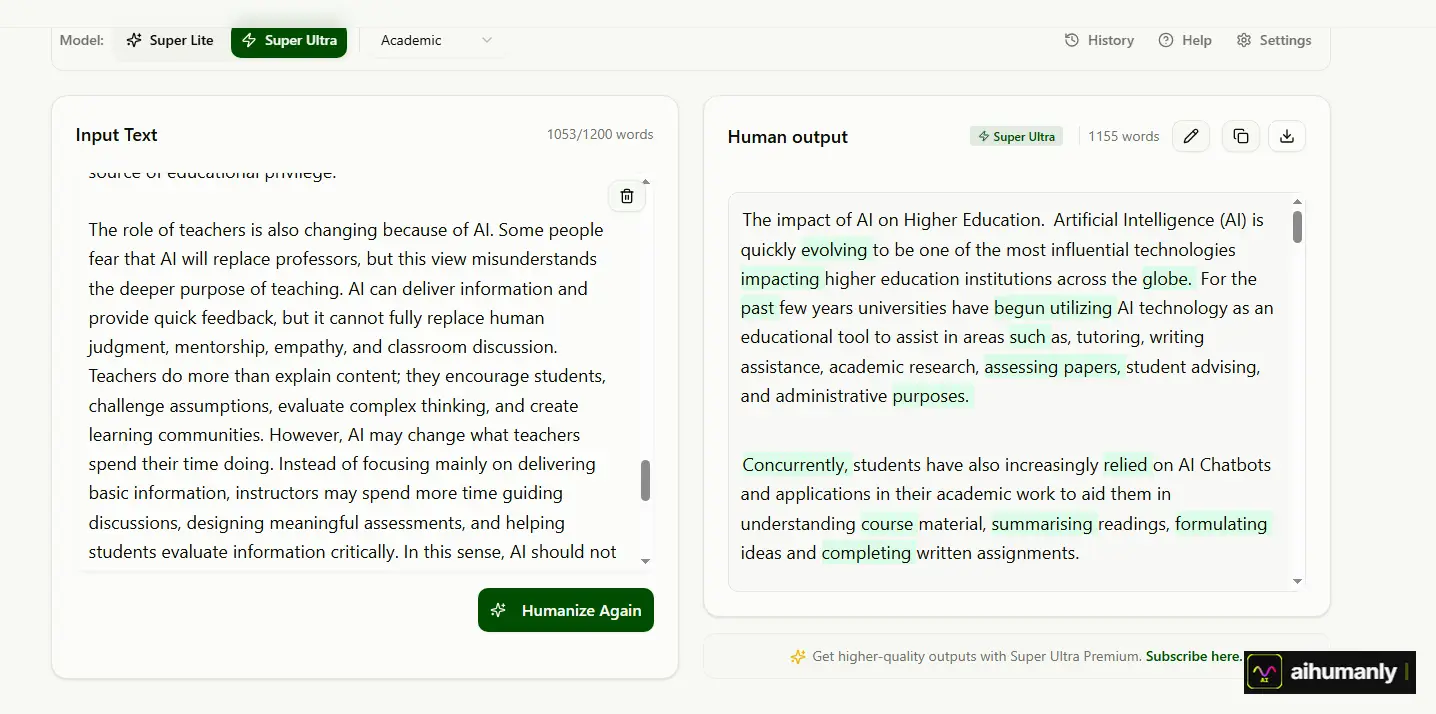
SuperHumanizer se comercializa como un humanizador de IA avanzado capaz de producir texto indetectable. Para esta prueba, utilizamos:
- Ensayo 1: Propósito académico con Super Ultra Model
- Ensayo 2: Propósito general con Super Ultra Model
Herramientas de detección de IA utilizadas en la prueba
Pasamos cada texto —original y humanizado— por los siguientes siete detectores:
1. GPTZero — Uno de los detectores de IA más reconocidos en el ámbito educativo
2. ZeroGPT — Un detector gratuito popular entre los estudiantes
3. Originality.ai — Un detector de pago ampliamente utilizado por editores y agencias de contenido
4. Winston AI — Un detector comercializado para uso académico y profesional
5. QuillBot AI Detector — De los creadores de la popular herramienta de parafraseo
6. Copyleaks AI Detector — Una plataforma de detección de nivel empresarial
Los diferentes detectores utilizan distintos algoritmos, y los resultados pueden variar drásticamente para el mismo texto. Algunos proporcionan puntuaciones porcentuales; otros dan una etiqueta binaria o categórica. Registramos tanto la puntuación numérica como el veredicto final (IA / Humano) siempre que estuvo disponible.
Metodología de prueba
Paso 1 — Generar textos originales en inglés con IA
Generamos dos textos académicos originales en inglés utilizando diferentes modelos de IA:
1. Ensayo 1 — Ensayo argumentativo de pregrado
- Tema: El impacto de la inteligencia artificial en la educación superior
- Generado por: GPT-5.5
- Estilo: Nivel de pregrado, argumento equilibrado, estructura clara
2. Ensayo 2 — Discusión de investigación de nivel de posgrado
- Tema: El papel de la política de energía renovable en la aceleración del desarrollo económico sostenible
- Generado por: Claude Opus 4.8
- Estilo: Nivel de posgrado, analítico, estructuras de oraciones complejas
El uso de dos modelos fuente diferentes añade una capa extra de realismo: en la práctica, las personas humanizan texto de varios modelos de IA, no solo de uno.
Paso 2 — Humanizar cada ensayo con cada herramienta
Cada ensayo original fue procesado a través de las tres herramientas, produciendo seis resultados humanizados:
| Ensayo | Herramienta de humanización | Modo / Configuración |
|---|---|---|
| Ensayo 1 (Pregrado) | HumanizeAI.pro | Académico |
| Ensayo 1 (Pregrado) | MyDetector | Académico, Pro Model |
| Ensayo 1 (Pregrado) | SuperHumanizer | Académico, Super Ultra Model |
| Ensayo 2 (Posgrado) | HumanizeAI.pro | Estándar, Ultra Run |
| Ensayo 2 (Posgrado) | MyDetector | Escritura general, Base Model |
| Ensayo 2 (Posgrado) | SuperHumanizer | General, Super Ultra Model |
Paso 3 — Probar cada resultado con todos los detectores de IA
Cada resultado humanizado se pasó por los siete detectores de IA. Se capturaron capturas de pantalla para cada resultado.
Paso 4 — Evaluación independiente de la calidad de escritura
La detección de IA es solo la mitad de la historia. Un humanizador podría producir texto que supere los detectores pero que se lea terriblemente mal. Para evaluar la calidad de escritura, encargamos a GPT-5.5 que evaluara cada resultado humanizado frente al original en cuatro dimensiones:
| Dimensión | Qué mide |
|---|---|
| Conservación del significado | ¿La reescritura mantiene el argumento original, los puntos clave y las relaciones lógicas? |
| Tono académico | ¿Es el tono apropiadamente formal, objetivo y preciso? |
| Gramática y fluidez | ¿Es el texto gramaticalmente correcto, natural y legible? |
| Consistencia de formato | ¿La reescritura preserva la estructura de párrafos y el formato originales? |
Cada dimensión se calificó en una escala de 1 a 10. El prompt de evaluación completo y la metodología están documentados en el apéndice.
Textos de prueba utilizados para la reseña
Ensayo de prueba 1 — Ensayo argumentativo de pregrado
Tema: El impacto de la inteligencia artificial en la educación superior
Este tema fue elegido porque es un tema común de ensayo académico relevante para la IA, la educación y la escritura estudiantil. Permite una discusión equilibrada tanto de los beneficios como de las preocupaciones, y refleja el tipo de tarea que se asigna frecuentemente en los cursos de pregrado.
El texto original de GPT-5.5 tiene 8 párrafos, aproximadamente 700 palabras, con una declaración de tesis clara, párrafos de desarrollo que cubren el aprendizaje personalizado, el apoyo académico, la integridad académica, la dependencia, el acceso equitativo y el papel cambiante de los profesores, y un párrafo de conclusión.
El texto original completo se incluye en el Apéndice B.
Ensayo de prueba 2 — Discusión de investigación de nivel de posgrado
Tema: El papel de la política de energía renovable en la aceleración del desarrollo económico sostenible
Este tema fue elegido para probar si los humanizadores de IA pueden manejar escrituras analíticas complejas con tono académico formal, análisis de políticas, razonamiento económico y argumentación estilo investigación. Representa un escenario realista de escritura de nivel de posgrado.
El texto original de Claude Opus 4.8 tiene 6 párrafos, aproximadamente 800 palabras, que cubren la movilización de la inversión privada, la innovación tecnológica, los efectos en el mercado laboral, la seguridad energética y las limitaciones de las políticas, incluyendo la inconsistencia, los costos de infraestructura, la desigualdad regional y los desafíos de implementación.
El texto original completo se incluye en el Apéndice D.
Resultados para el Ensayo 1: Ensayo argumentativo de pregrado
Tema: El impacto de la inteligencia artificial en la educación superior
Fuente: GPT-5.5
HumanizeAI.pro — Resultados del Ensayo 1
Modo: Académico
| Detector | Puntuación de IA | Veredicto |
|---|---|---|
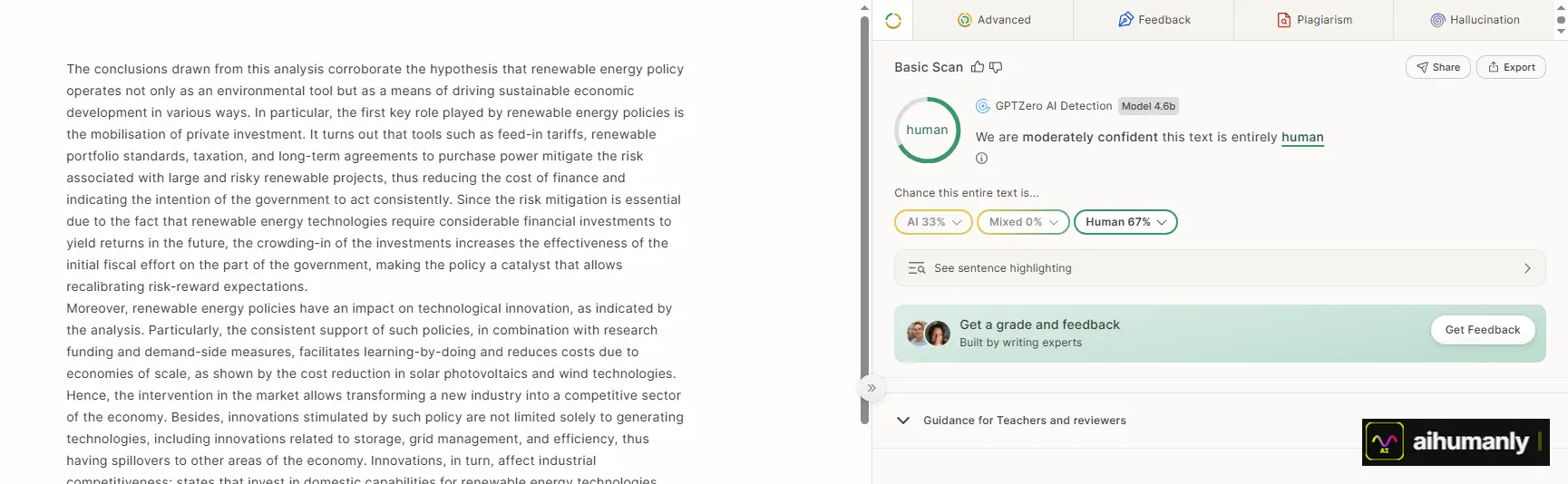
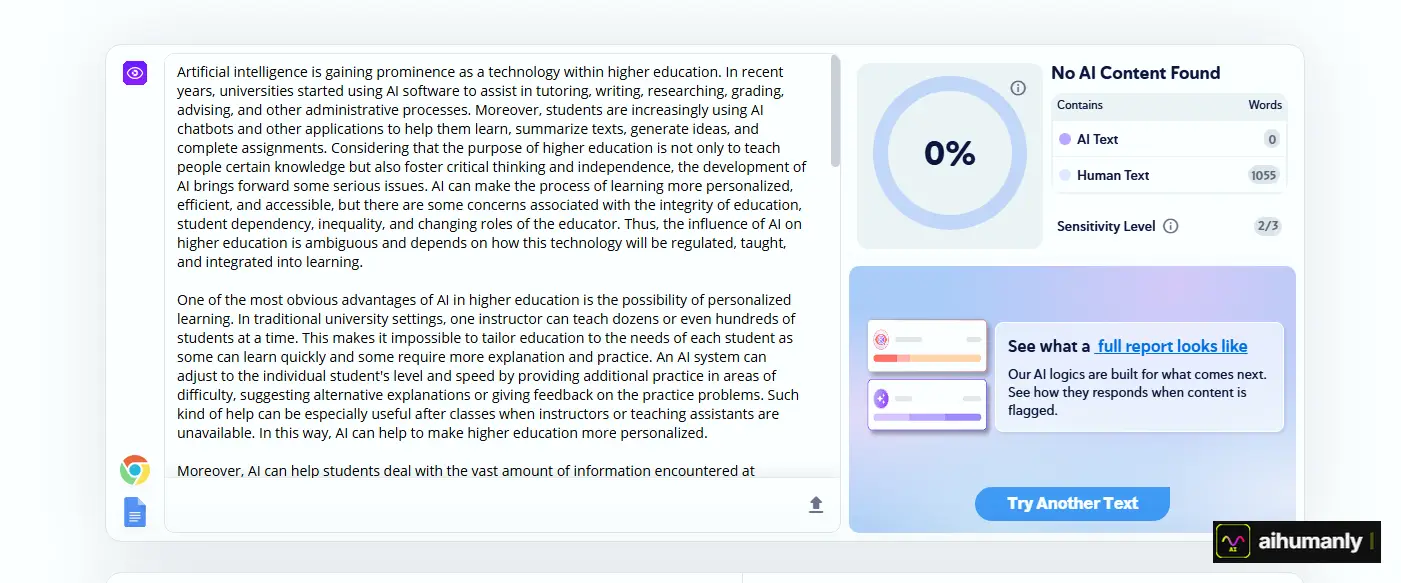
| GPTZero | 33% | Humano |
| ZeroGPT | 27.9% | Humano |
| Originality.ai | 41% | Humano |
| Winston AI | 26% | Humano |
| QuillBot | 4% | Humano |
| Copyleaks | 0% | Humano |
Resultado: 6/6 detectores clasificaron el resultado como humano. Este fue el mejor rendimiento general de detección para el Ensayo 1.
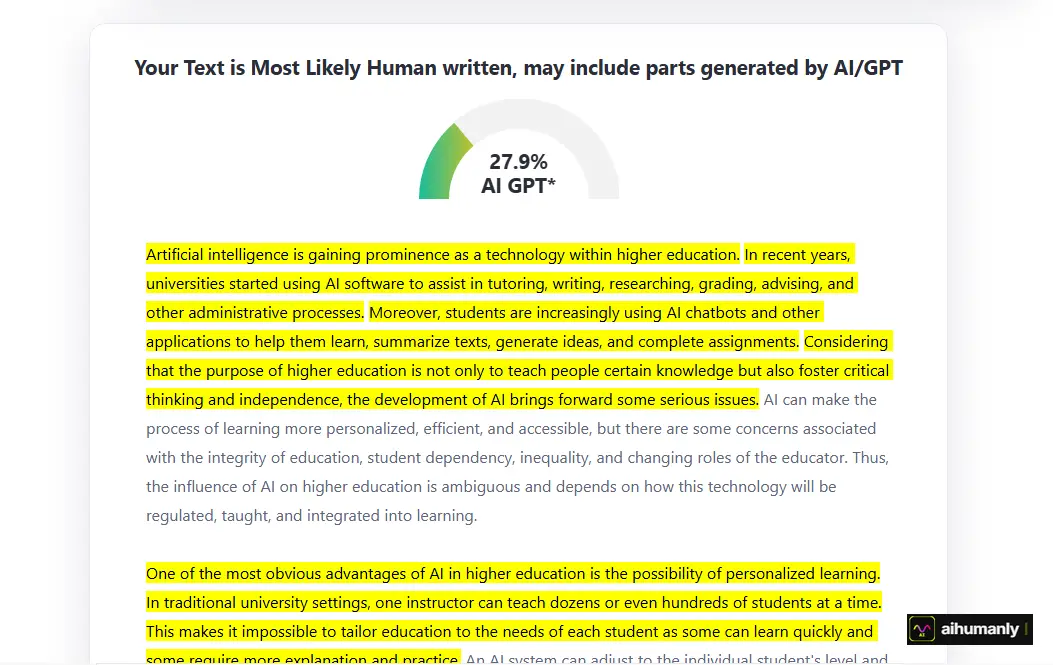
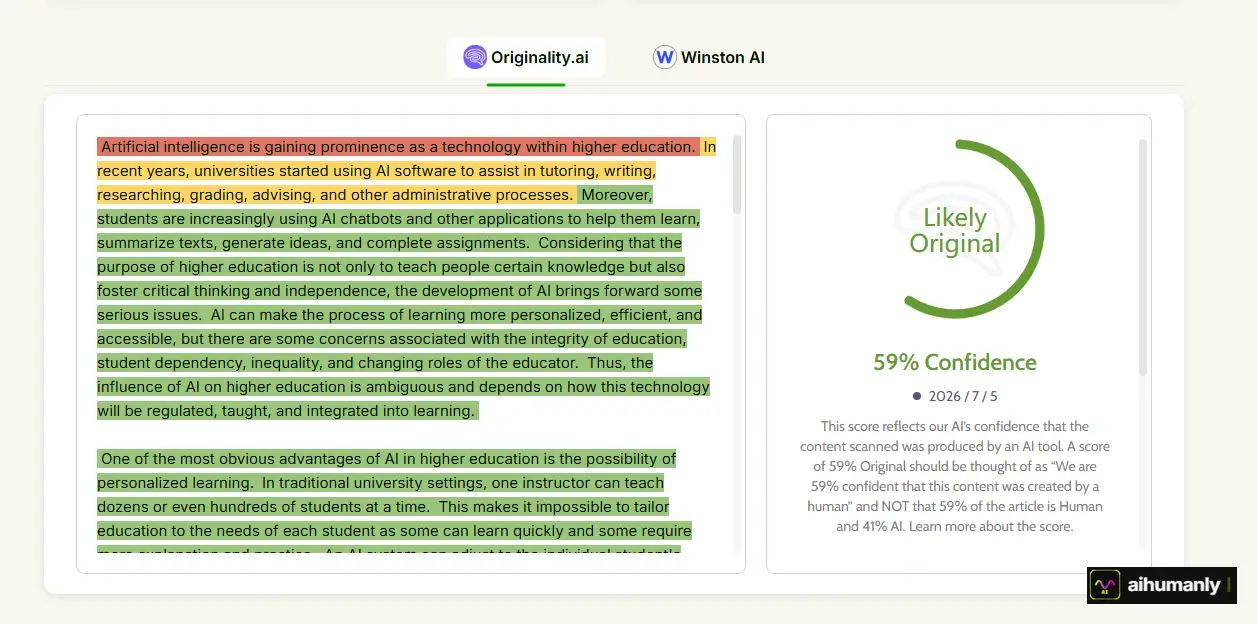
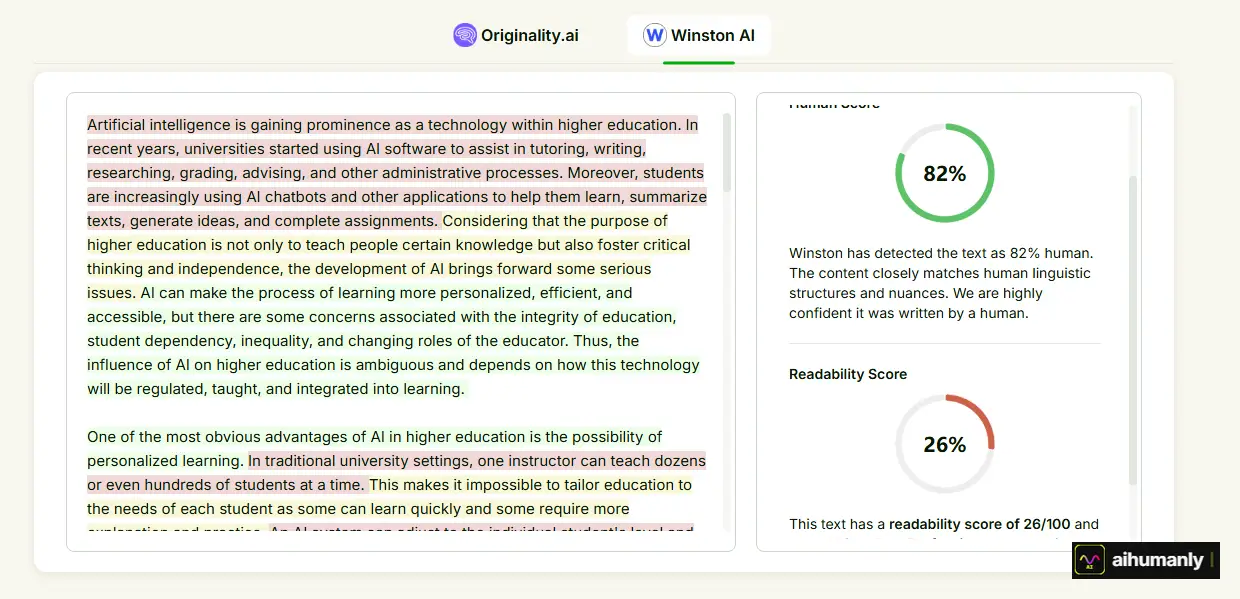
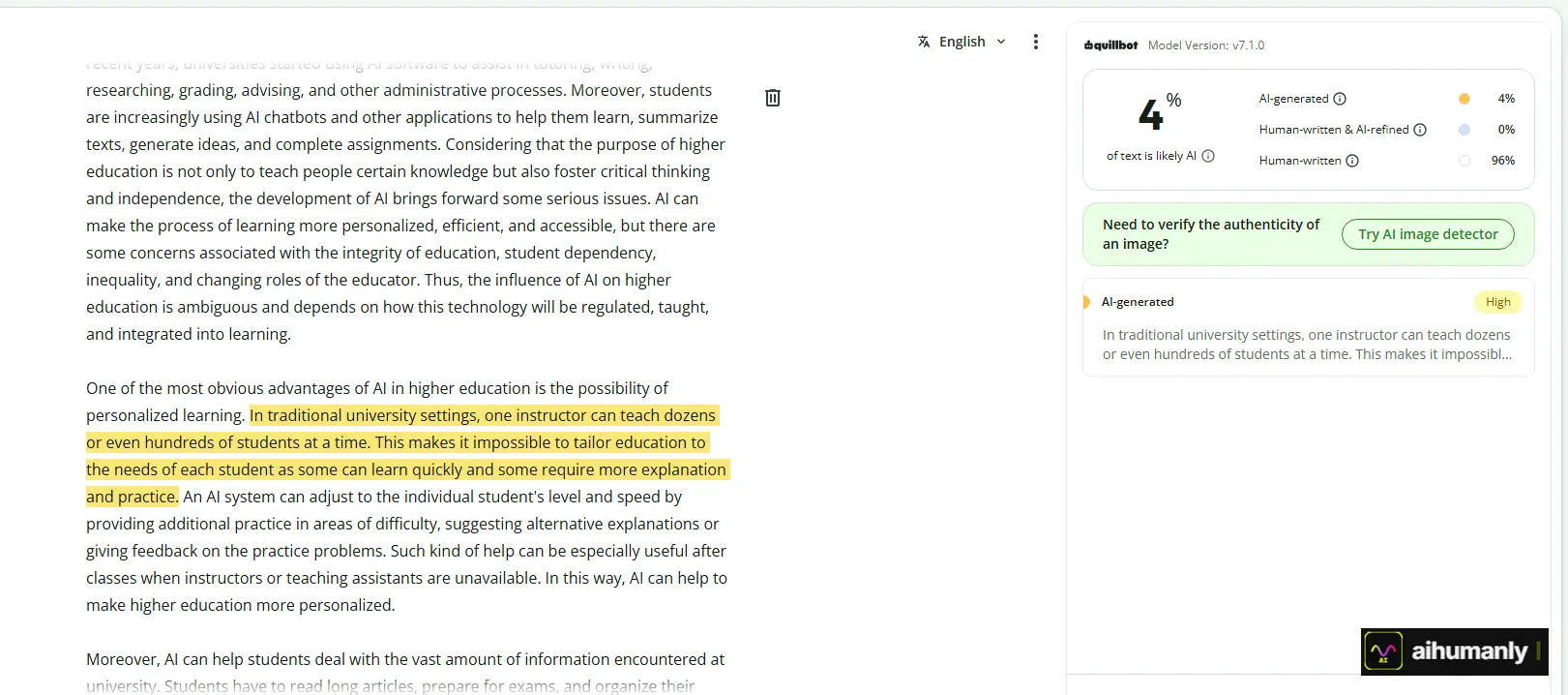
Evaluación de la calidad de escritura
| Dimensión | Puntuación / 10 |
|---|---|
| Conservación del significado | 8 |
| Tono académico | 7 |
| Gramática y fluidez | 7 |
| Consistencia de formato | 10 |
| Promedio | 8.0 |
Resumen: HumanizeAI.pro conservó el argumento principal y la estructura muy bien (Formato: 10/10). La conservación del significado fue fuerte con 8/10, con solo omisiones menores. Las principales debilidades estuvieron en el tono académico y la gramática y fluidez (ambos 7/10), con algunas frases incómodas, problemas con los artículos y colocaciones poco naturales. El evaluador señaló que expresiones como "teach people certain knowledge" y "spoil the skills and values preserved in education" suenan poco naturales en el inglés académico.
MyDetector — Resultados del Ensayo 1
Modo: Académico, Pro Model
| Detector | Puntuación de IA | Veredicto |
|---|---|---|
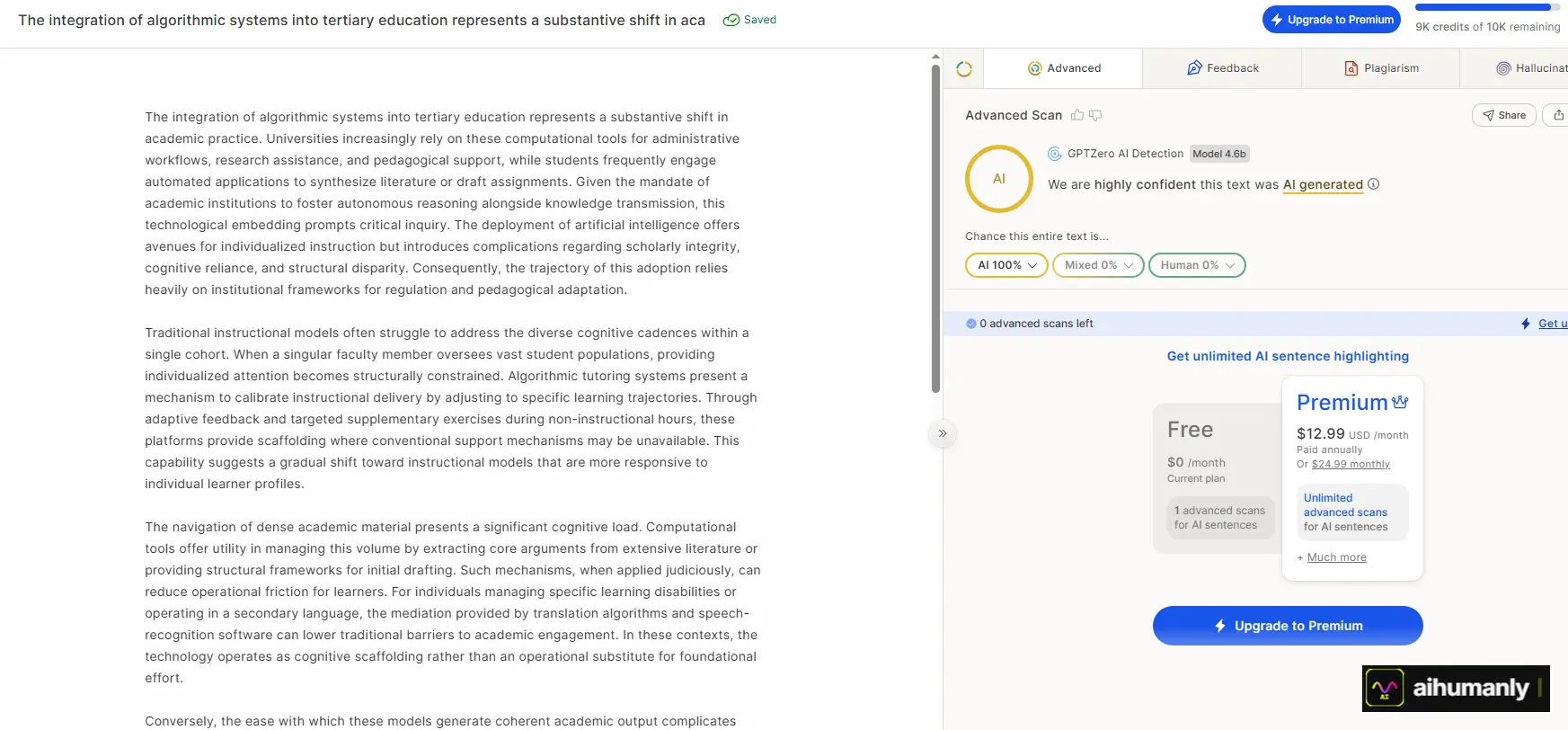
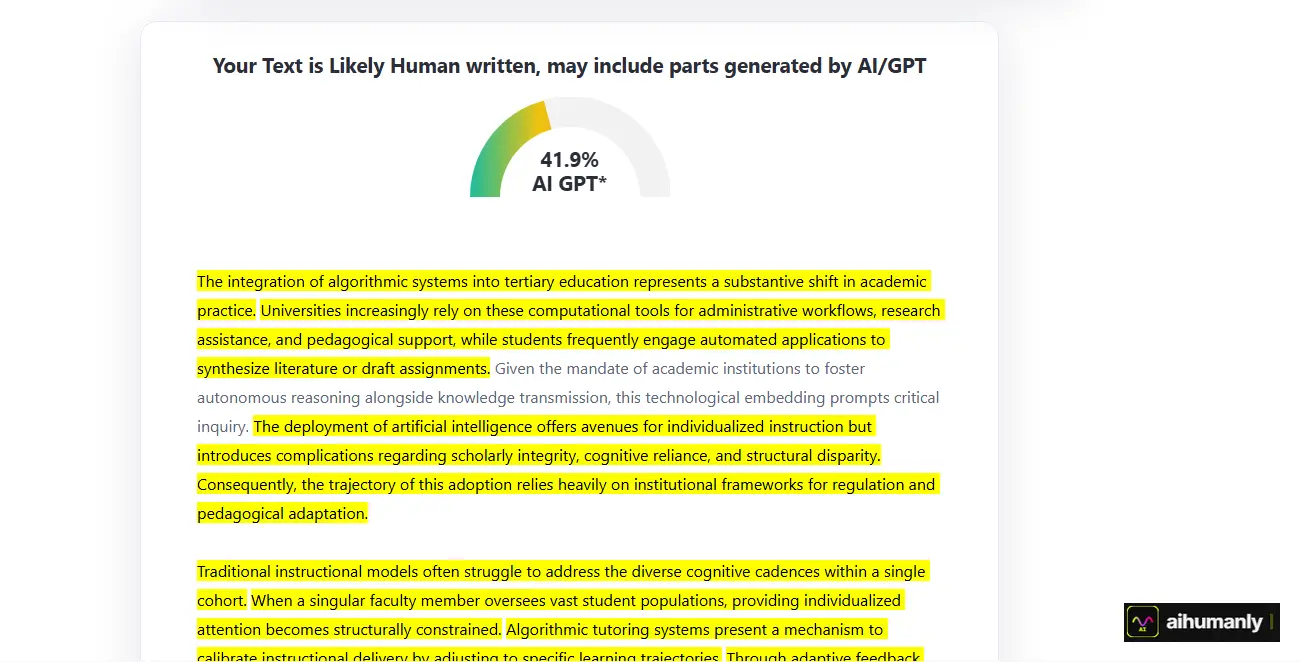
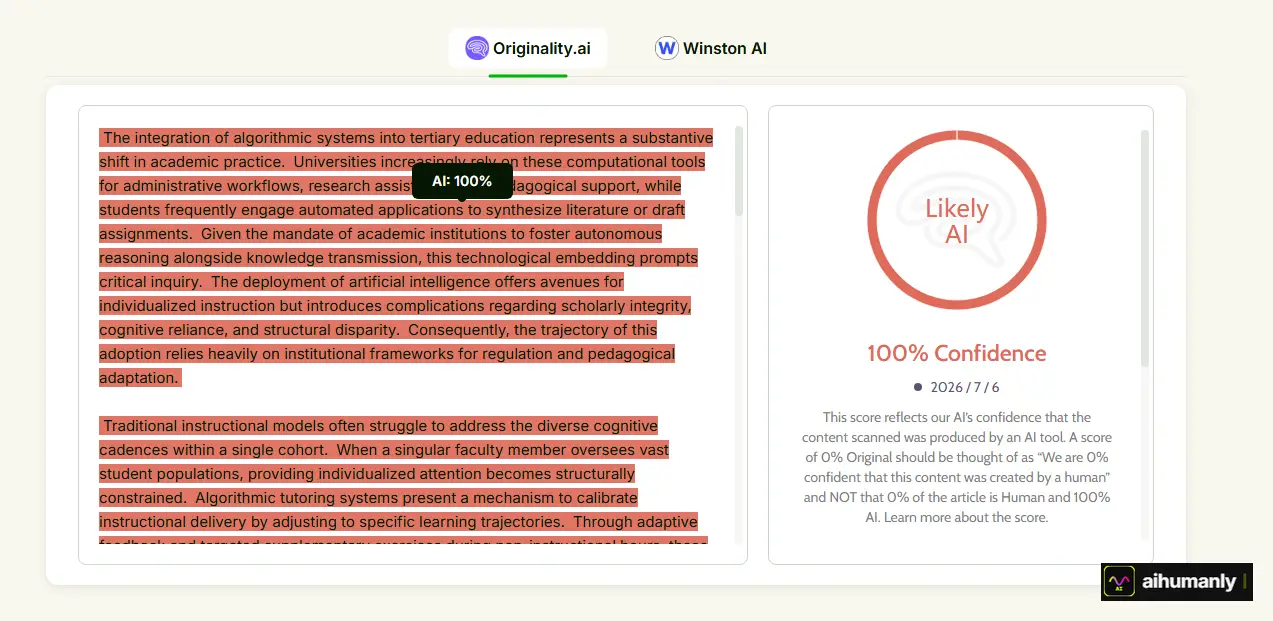
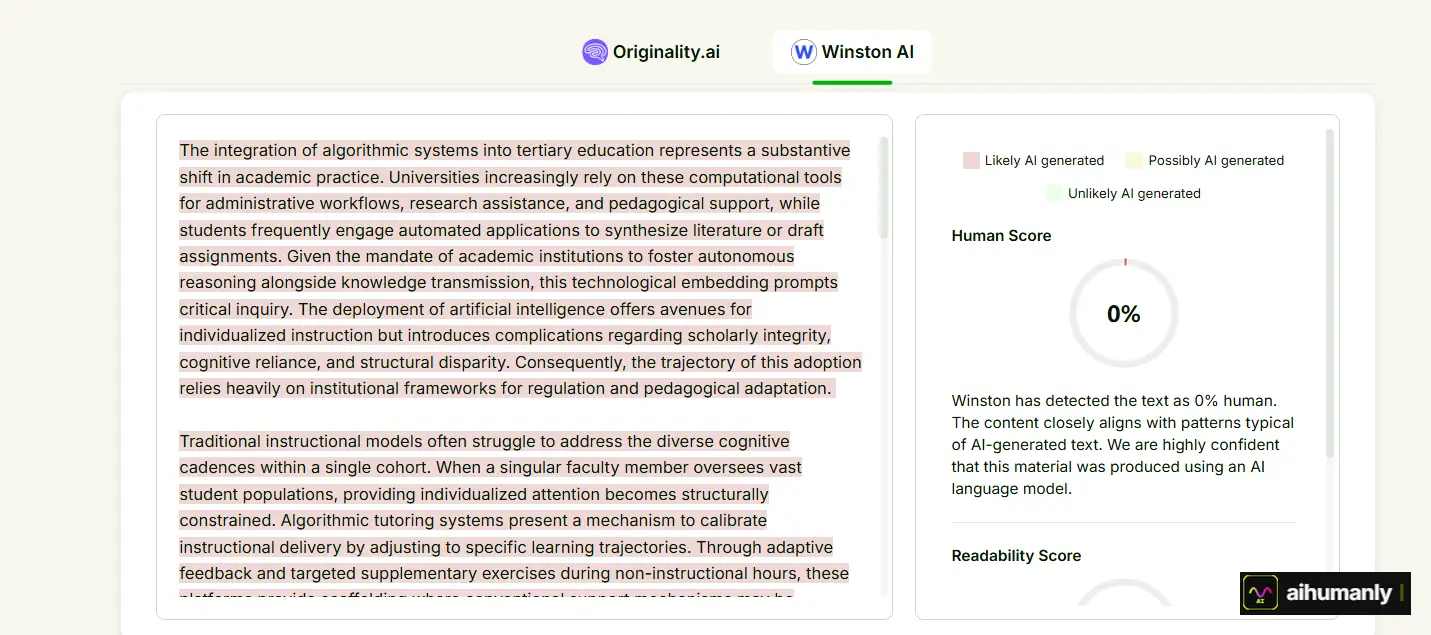
| GPTZero | 100% | IA |
| ZeroGPT | 41.9% | Humano |
| Originality.ai | 100% | IA |
| Winston AI | 100% | IA |
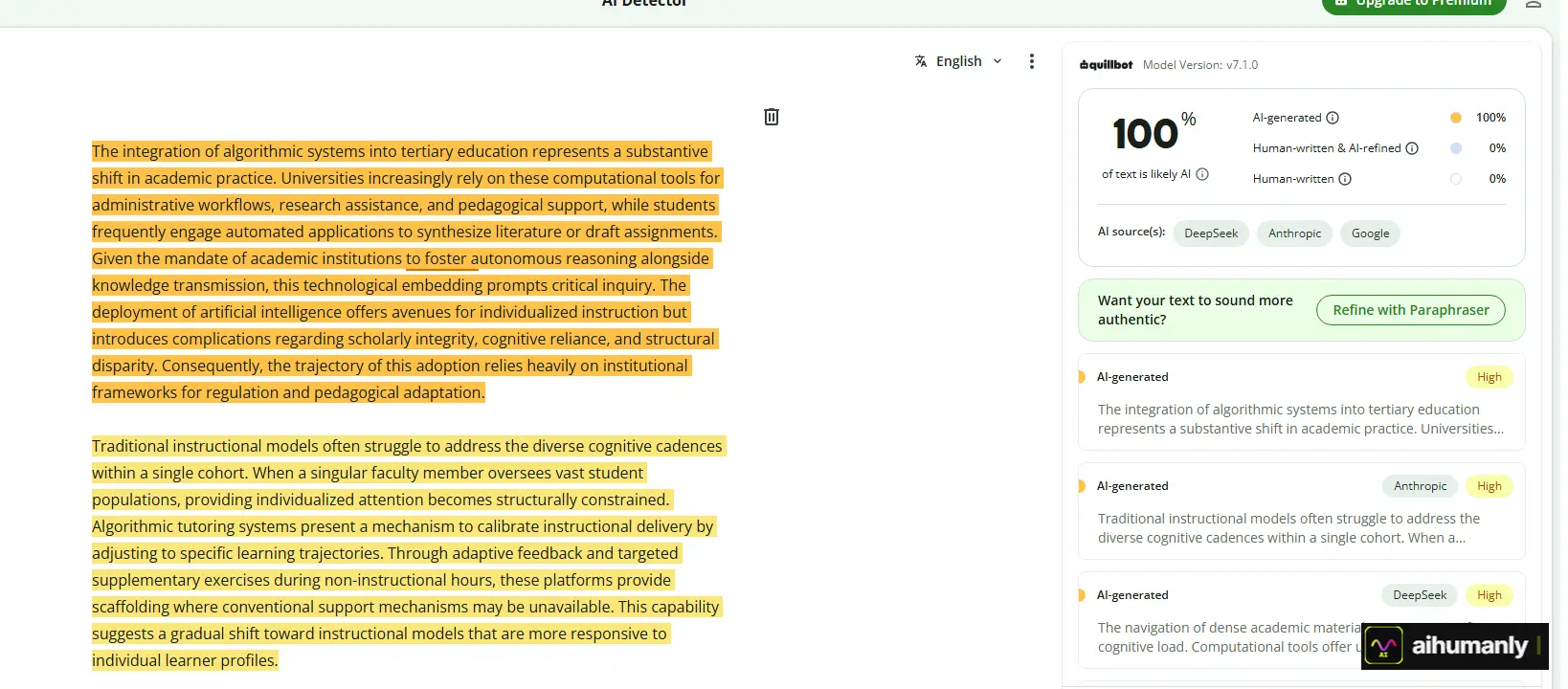
| QuillBot | 100% | IA |
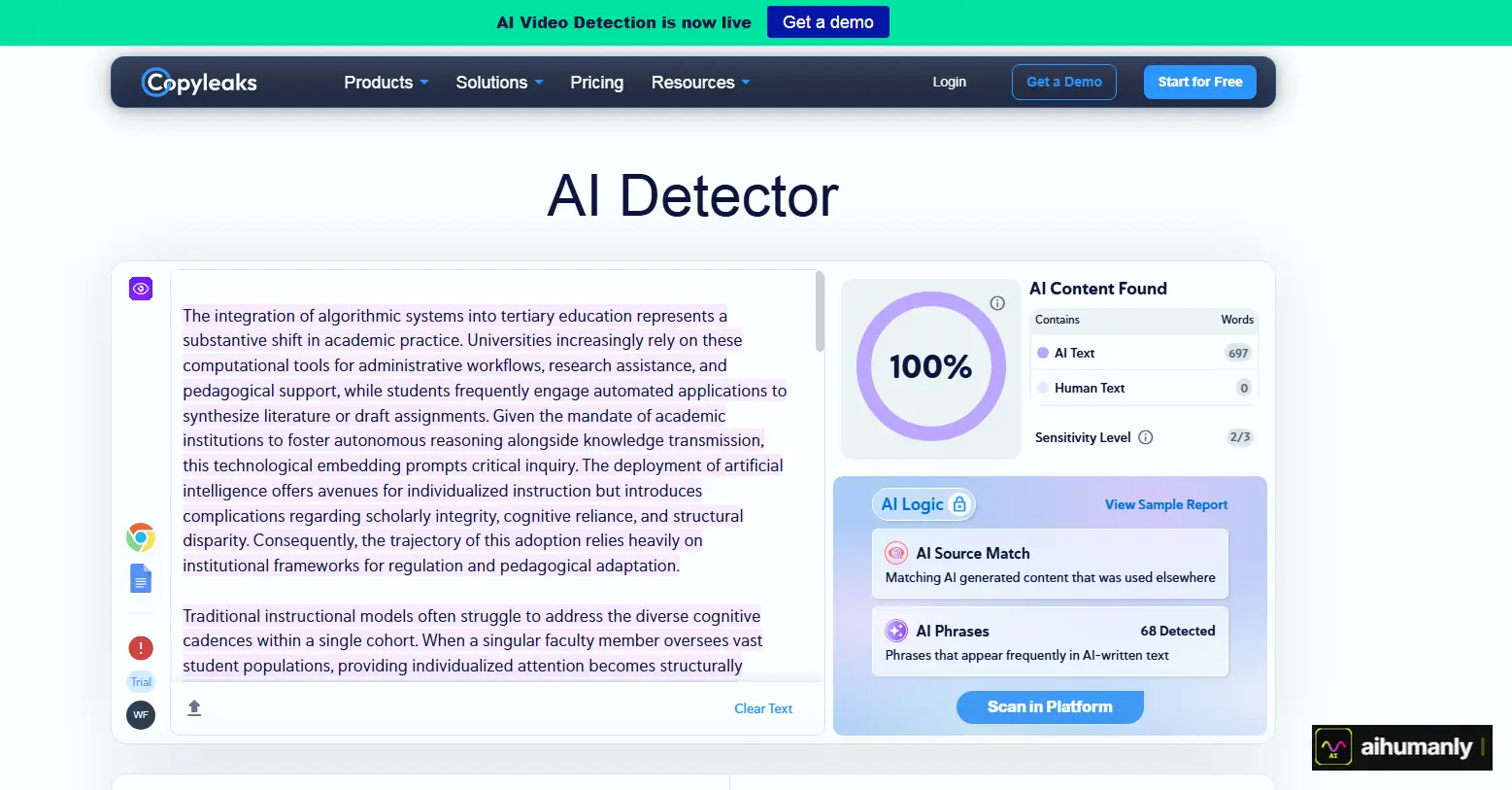
| Copyleaks | 0% | Humano |
Resultado: 4/6 detectores clasificaron el resultado como IA. Este fue el rendimiento de detección más débil para el Ensayo 1. Solo ZeroGPT y Copyleaks lo clasificaron como humano.
Evaluación de la calidad de escritura
| Dimensión | Puntuación / 10 |
|---|---|
| Conservación del significado | 8 |
| Tono académico | 8 |
| Gramática y fluidez | 9 |
| Consistencia de formato | 10 |
| Promedio | 8.75 |
Resumen: MyDetector produjo las puntuaciones de calidad de escritura más altas para el Ensayo 1. El evaluador elogió su solidez gramatical, fluidez y conservación del formato. El texto está académicamente pulido y es muy legible. Sin embargo, se notó que el tono era "ocasionalmente demasiado inflado" con frases cargadas de jerga como "diverse cognitive cadences" y "algorithmic tools exacerbating educational disparities". Algunos detalles específicos del original se generalizaron u omitieron, incluidas las preocupaciones sobre la protección de los datos de los estudiantes.
SuperHumanizer — Resultados del Ensayo 1
Modo: Académico, Super Ultra Model
| Detector | Puntuación de IA | Veredicto |
|---|---|---|
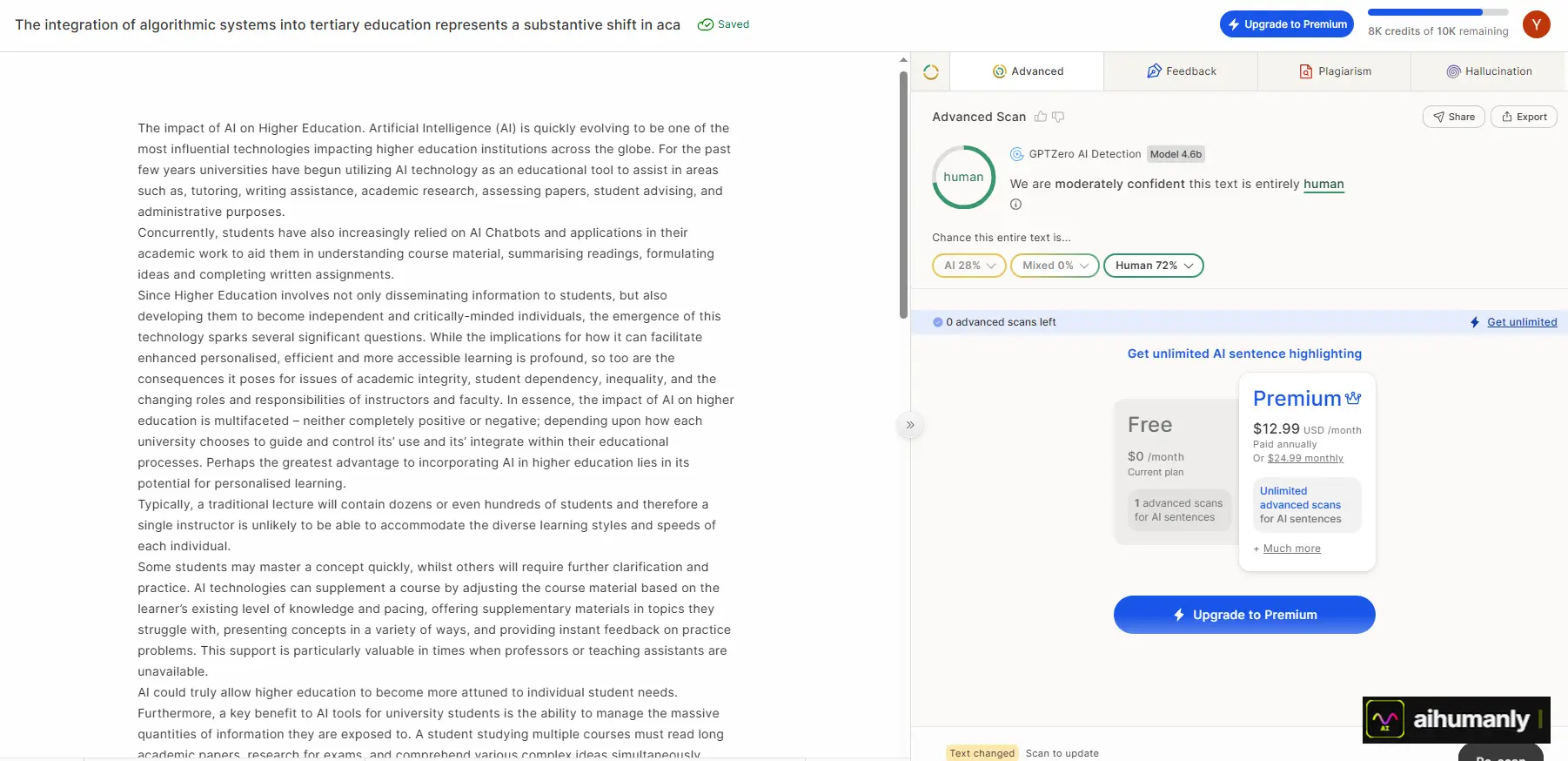
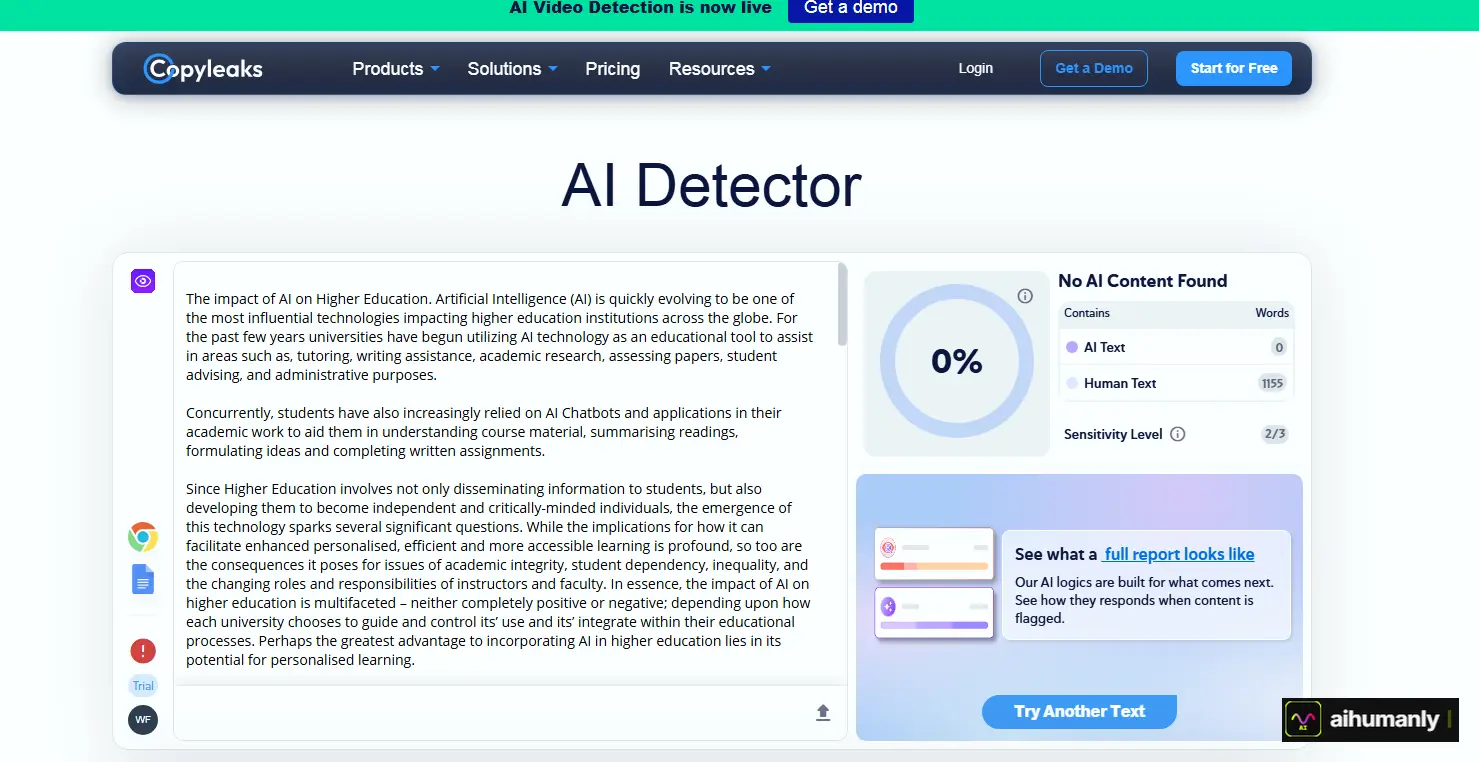
| GPTZero | 28% | Humano |
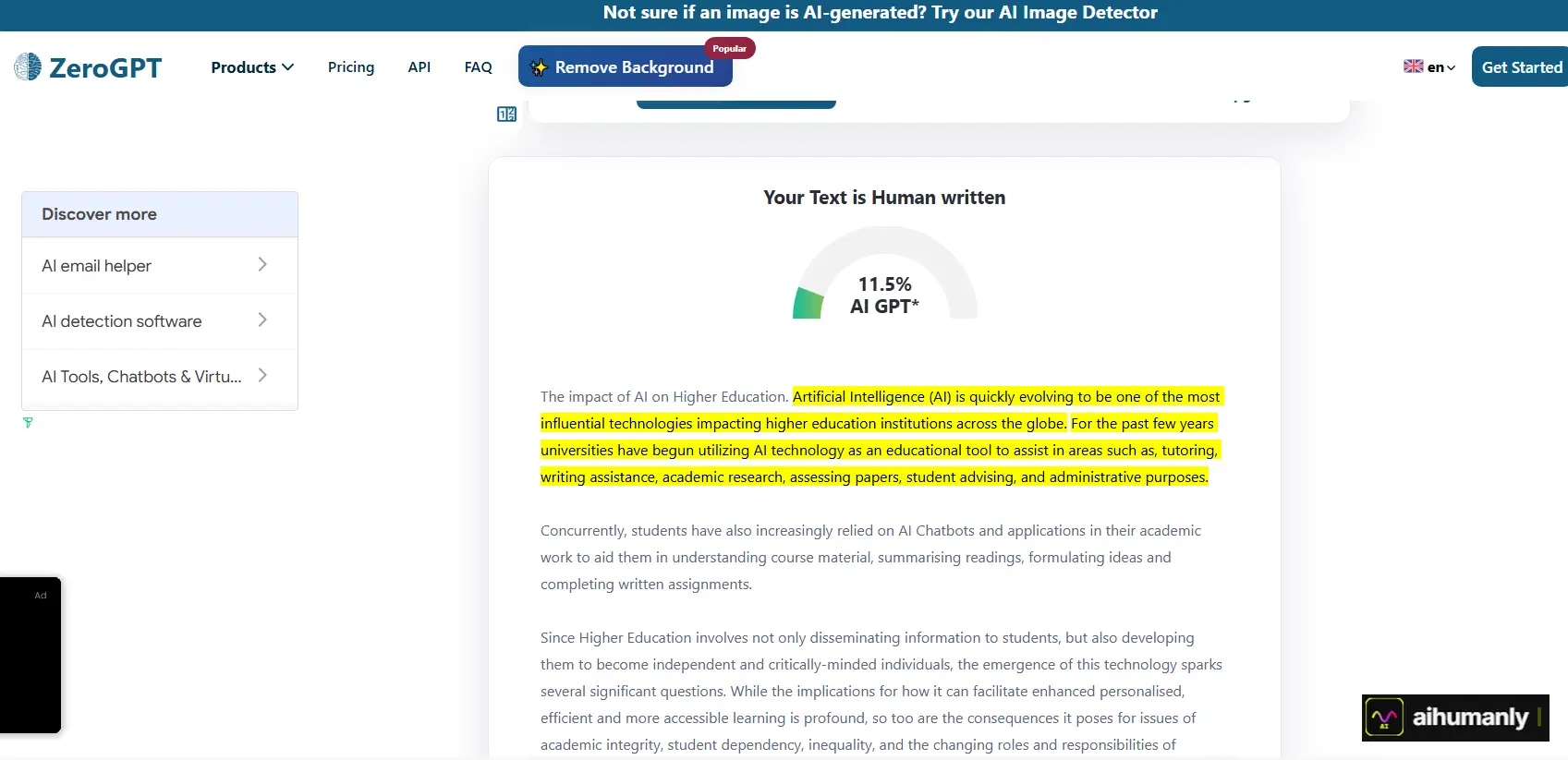
| ZeroGPT | 11.5% | Humano |
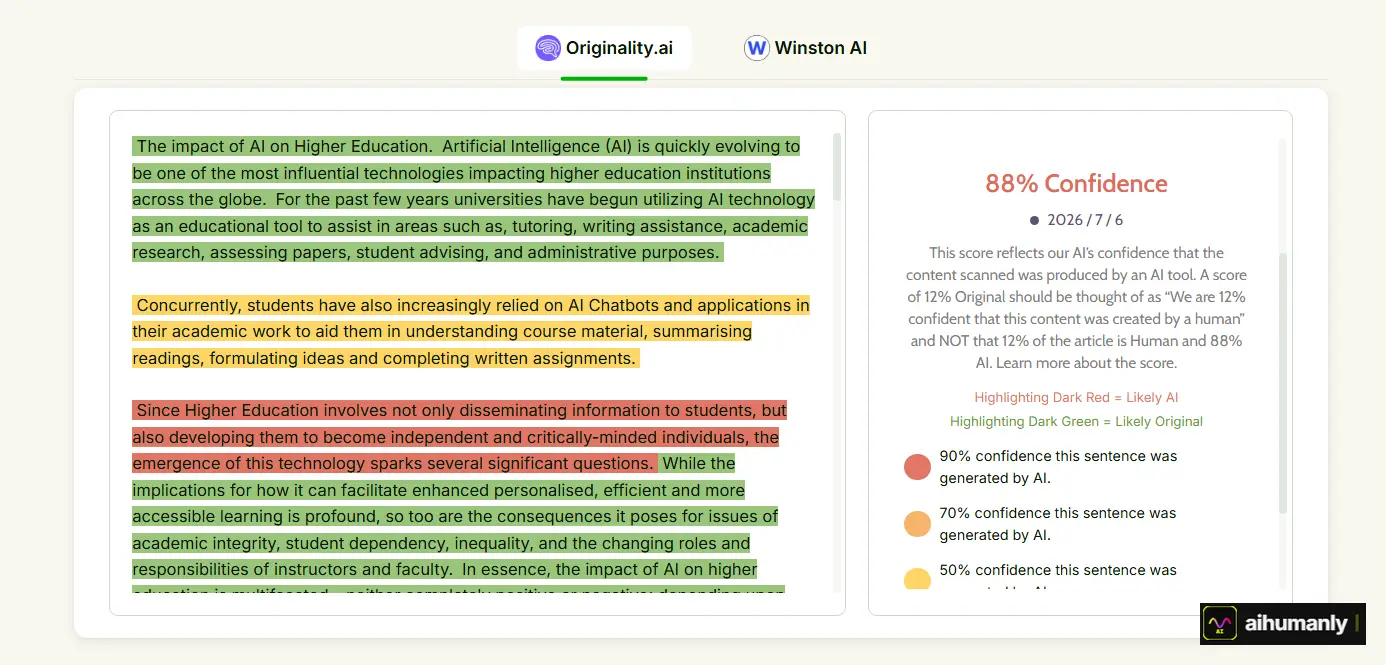
| Originality.ai | 88% | IA |
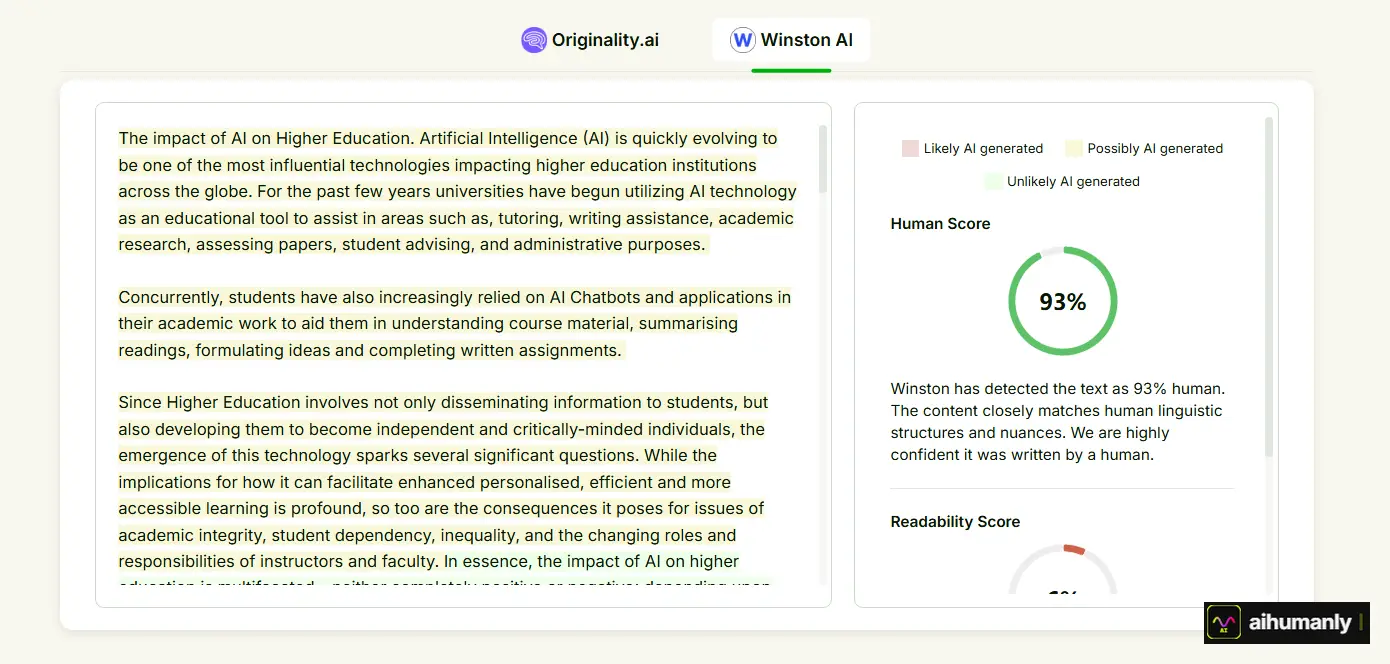
| Winston AI | 7% | Humano |
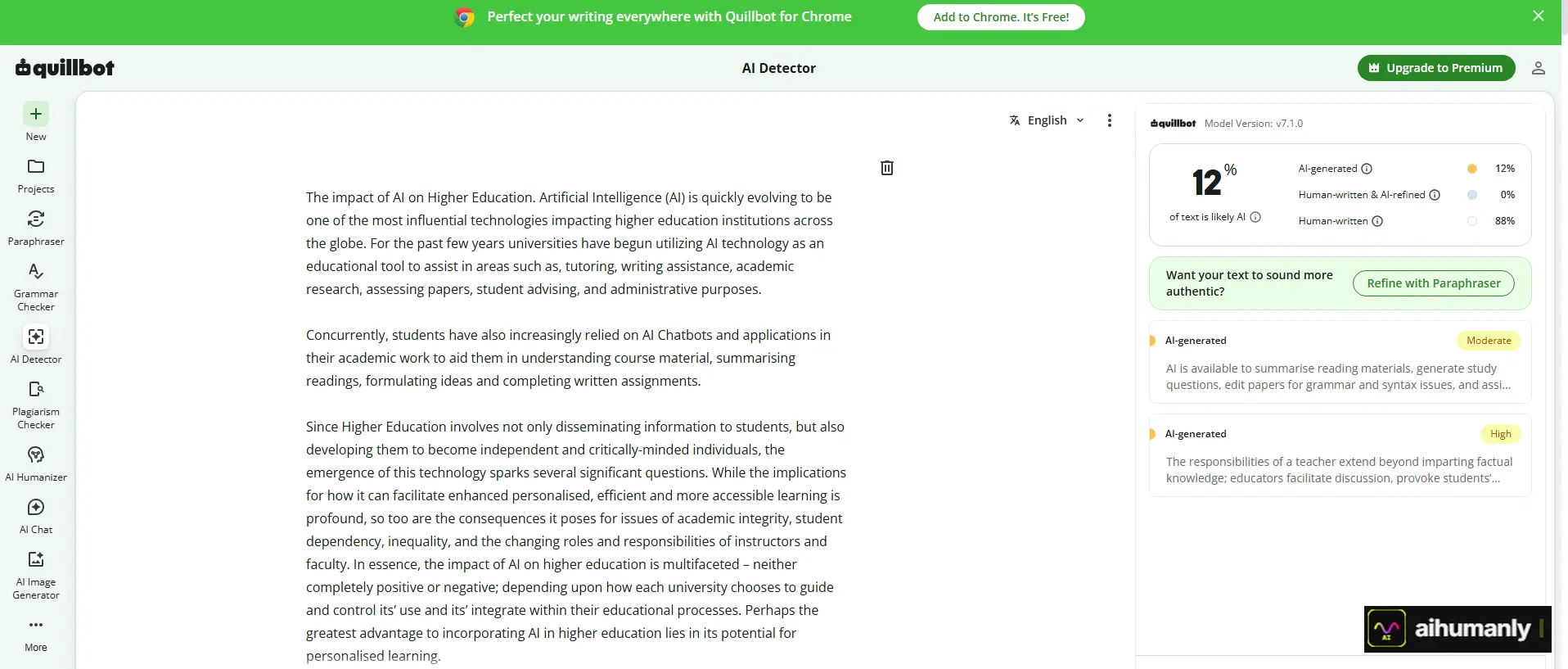
| QuillBot | 12% | Humano |
| Copyleaks | 0% | Humano |
Resultado: 5/6 detectores clasificaron el resultado como humano. Solo Originality.ai lo marcó como IA (88%). Este fue un resultado de detección fuerte.
Evaluación de la calidad de escritura
| Dimensión | Puntuación / 10 |
|---|---|
| Conservación del significado | 7 |
| Tono académico | 6 |
| Gramática y fluidez | 5 |
| Consistencia de formato | 4 |
| Promedio | 5.5 |
Resumen: SuperHumanizer produjo la calidad de escritura más débil para el Ensayo 1. Aunque superó la mayoría de los detectores, el texto tenía problemas significativos. El evaluador notó frecuentes errores de gramática y puntuación, uso de mayúsculas inconsistente ("Higher Education", "AI Chatbots"), falta de conclusión, párrafos fragmentados y frases incómodas. Errores específicos incluyeron "its' use", "its' integrate" (posesivo incorrecto), "may never fully grasping" (error de forma verbal), y la adición de un título no presente en el original. El evaluador concluyó que el texto "necesita una edición importante antes de ser adecuado para el uso académico en inglés".
Resultados para el Ensayo 2: Discusión de investigación de nivel de posgrado
Tema: El papel de la política de energía renovable en la aceleración del desarrollo económico sostenible
Fuente: Claude Opus 4.8
HumanizeAI.pro — Resultados del Ensayo 2
Modo: Estándar, Ultra Run
| Detector | Puntuación de IA | Veredicto |
|---|---|---|
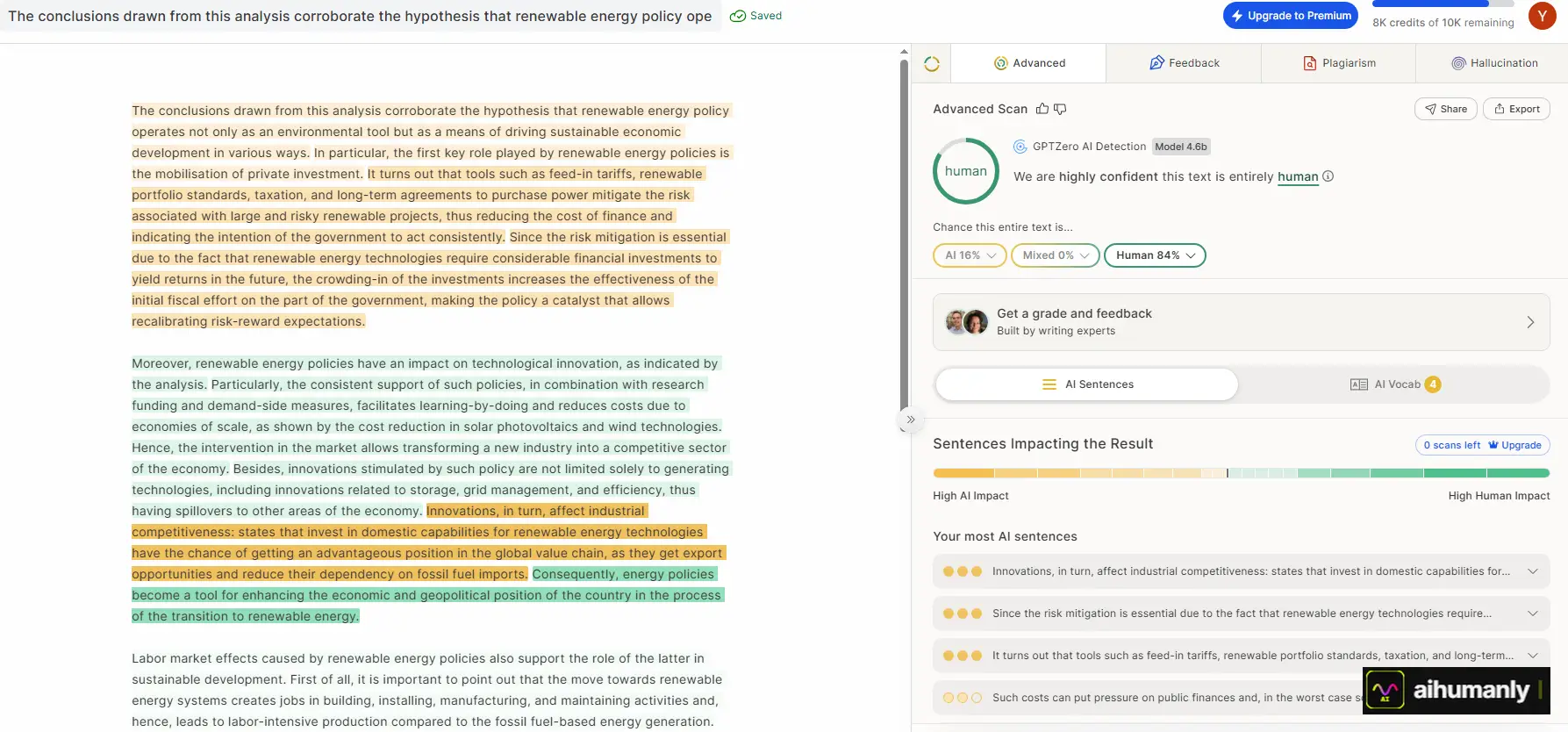
| GPTZero | 16% | Humano |
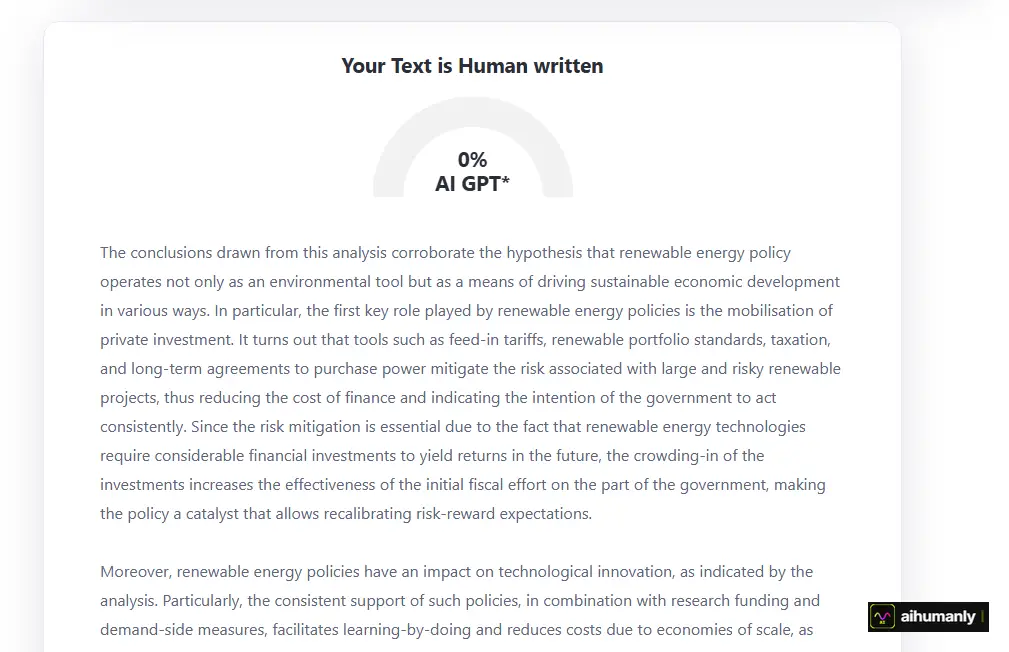
| ZeroGPT | 0% | Humano |
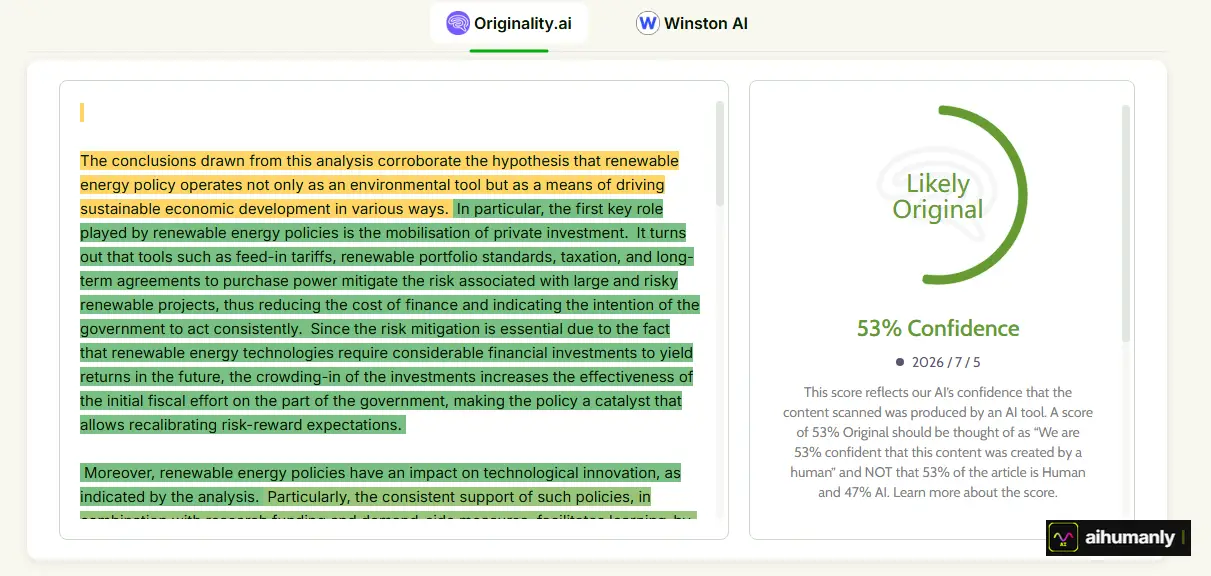
| Originality.ai | 47% | Humano |
| Winston AI | 0% | Humano |
| QuillBot | 3% | Humano |
| Copyleaks | 0% | Humano |
Resultado: 6/6 detectores clasificaron el resultado como humano. Evasión de detección perfecta en el ensayo de nivel de posgrado.
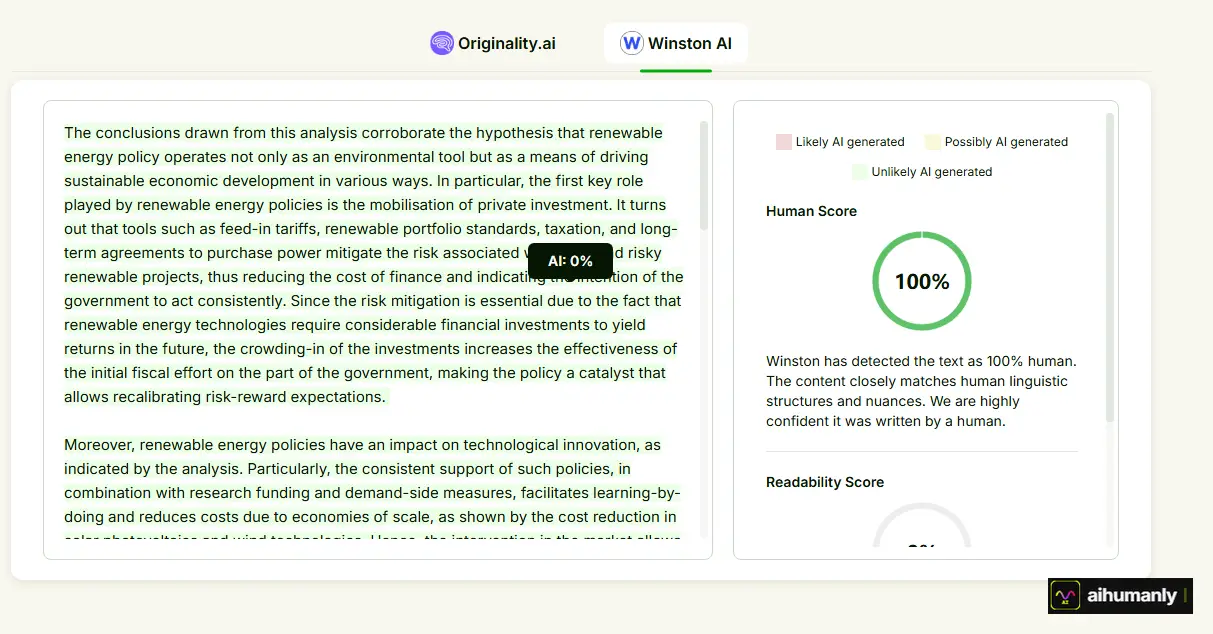
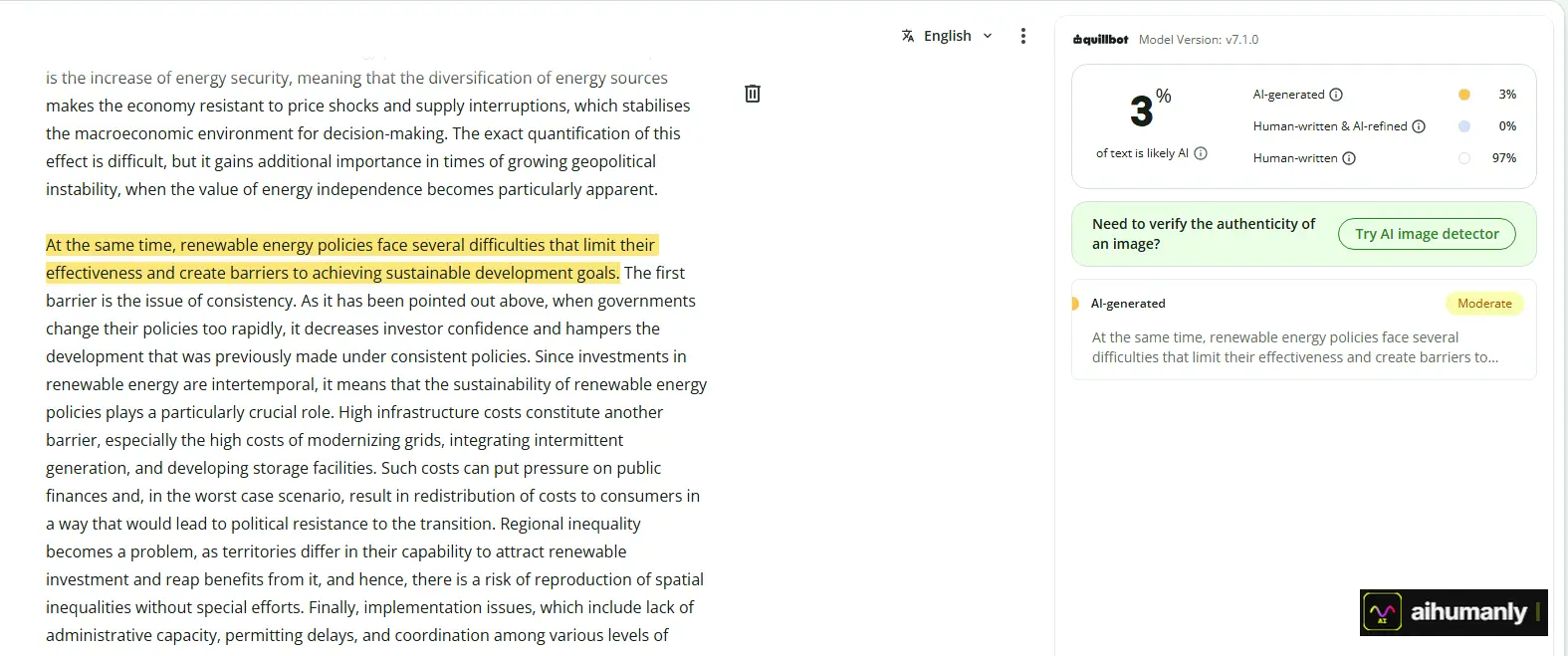
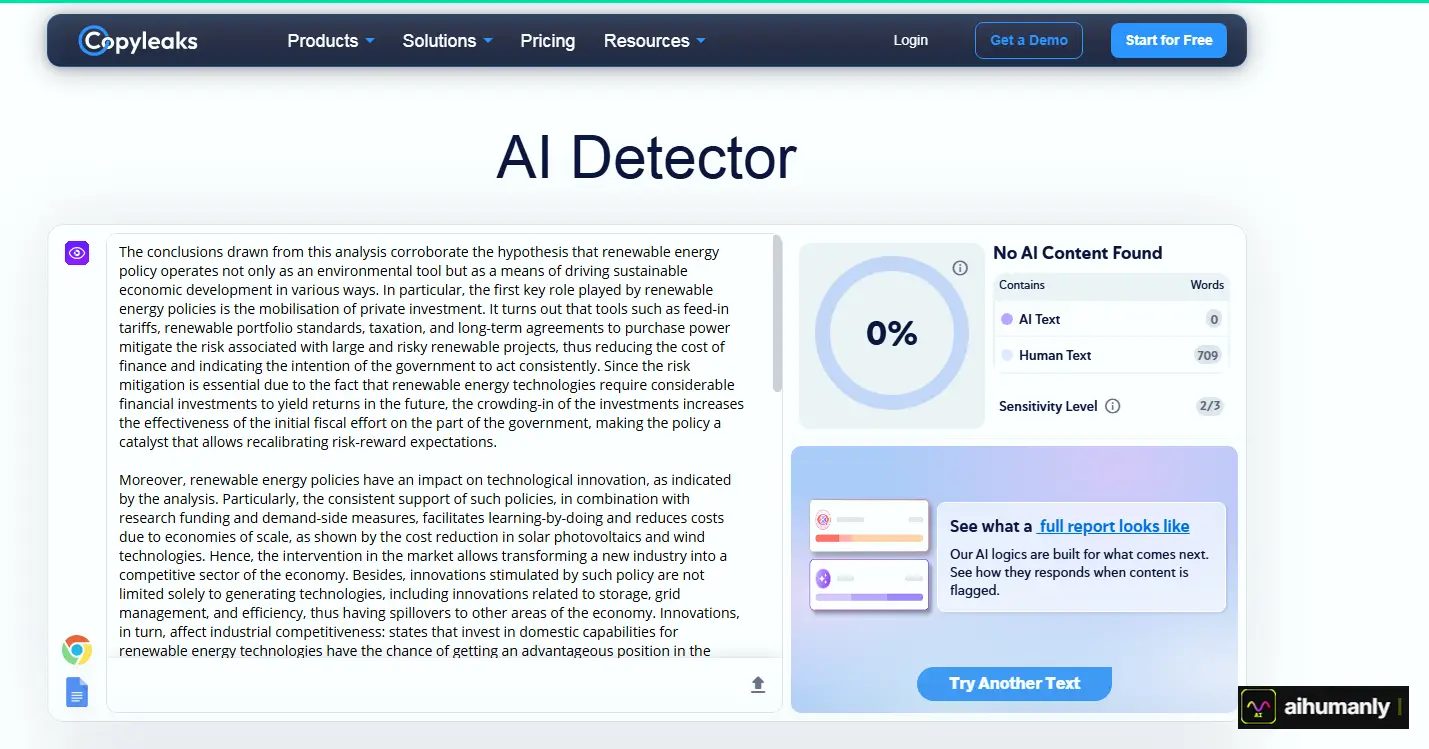
Evaluación de la calidad de escritura
| Dimensión | Puntuación / 10 |
|---|---|
| Conservación del significado | 7 |
| Tono académico | 7 |
| Gramática y fluidez | 7 |
| Consistencia de formato | 7 |
| Promedio | 7.0 |
Resumen: HumanizeAI.pro puntuó de manera consistente en las cuatro dimensiones (7/10 cada una). Conservó el argumento amplio, pero debilitó u omitió varias calificaciones importantes del original, incluida la discusión sobre la distribución geográfica del empleo y la conclusión condicional final. El evaluador notó frases informales como "It turns out that" y "First of all", que son menos adecuadas para la escritura académica de nivel de posgrado. El texto fusionó los dos últimos párrafos originales en uno, reduciendo ligeramente la claridad estructural.
MyDetector — Resultados del Ensayo 2
Modo: Escritura general, Base Model
| Detector | Puntuación de IA | Veredicto |
|---|---|---|
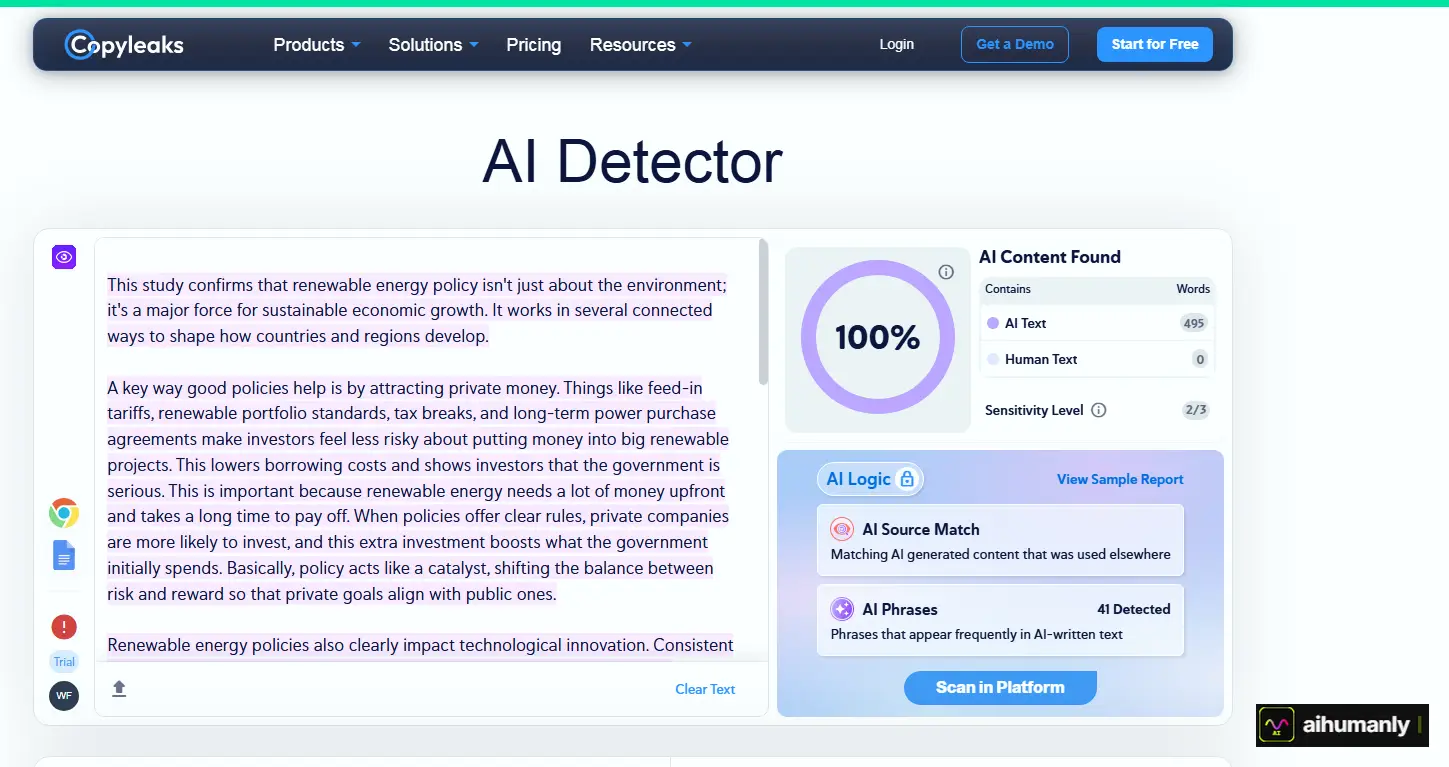
| GPTZero | 87% | IA |
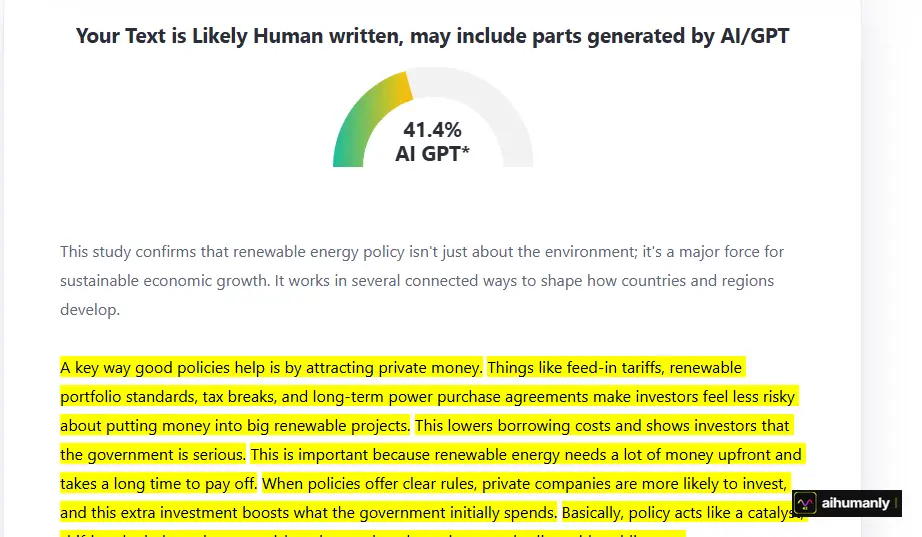
| ZeroGPT | 41.4% | Humano |
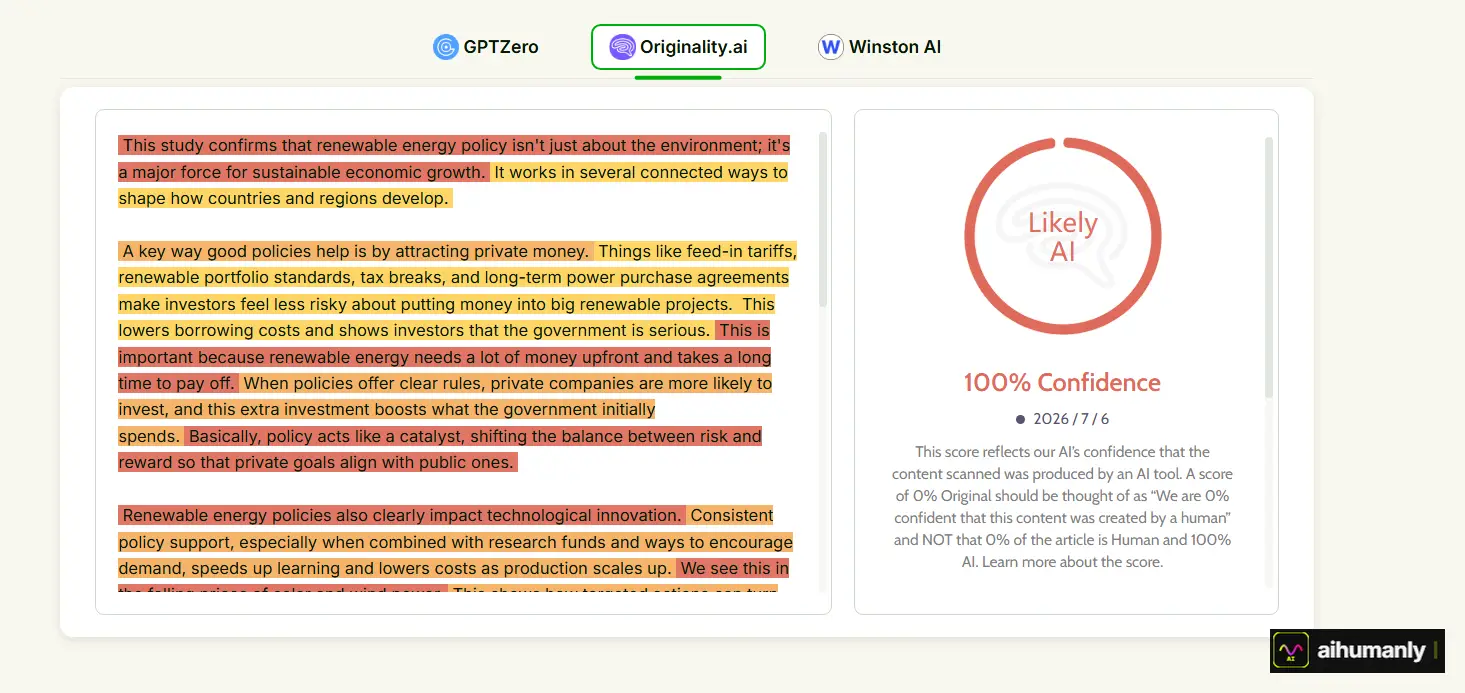
| Originality.ai | 100% | IA |
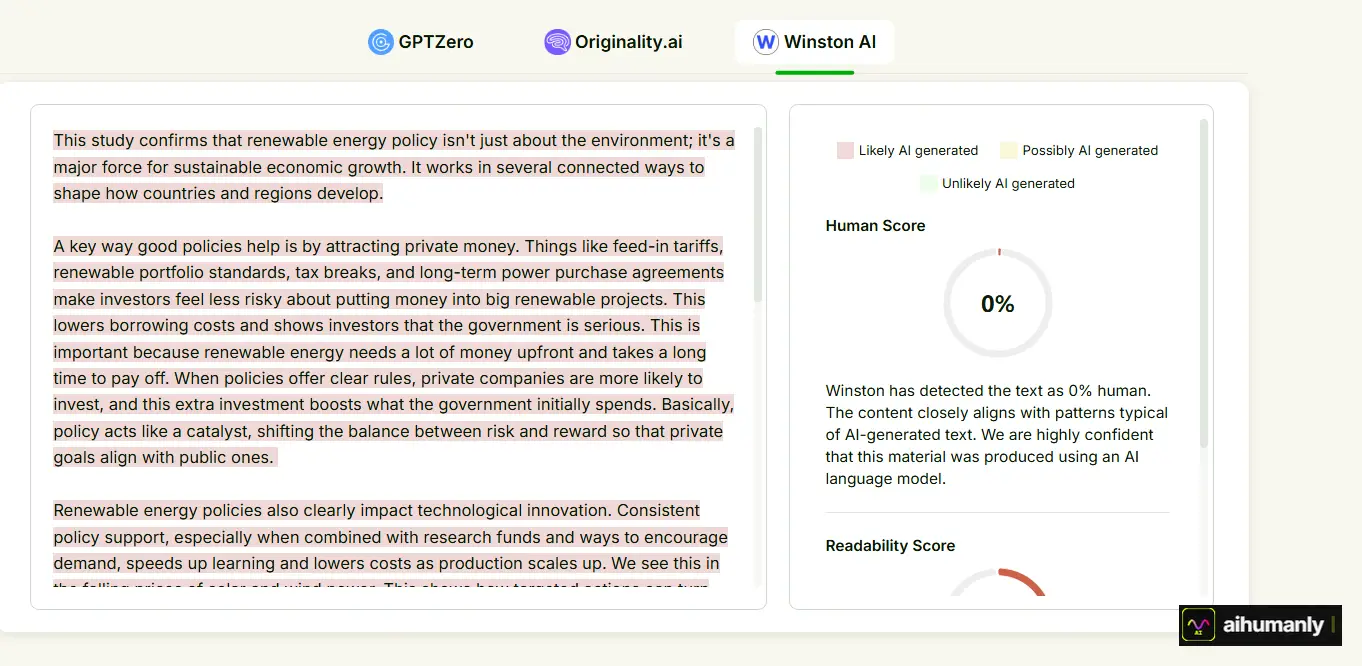
| Winston AI | 100% | IA |
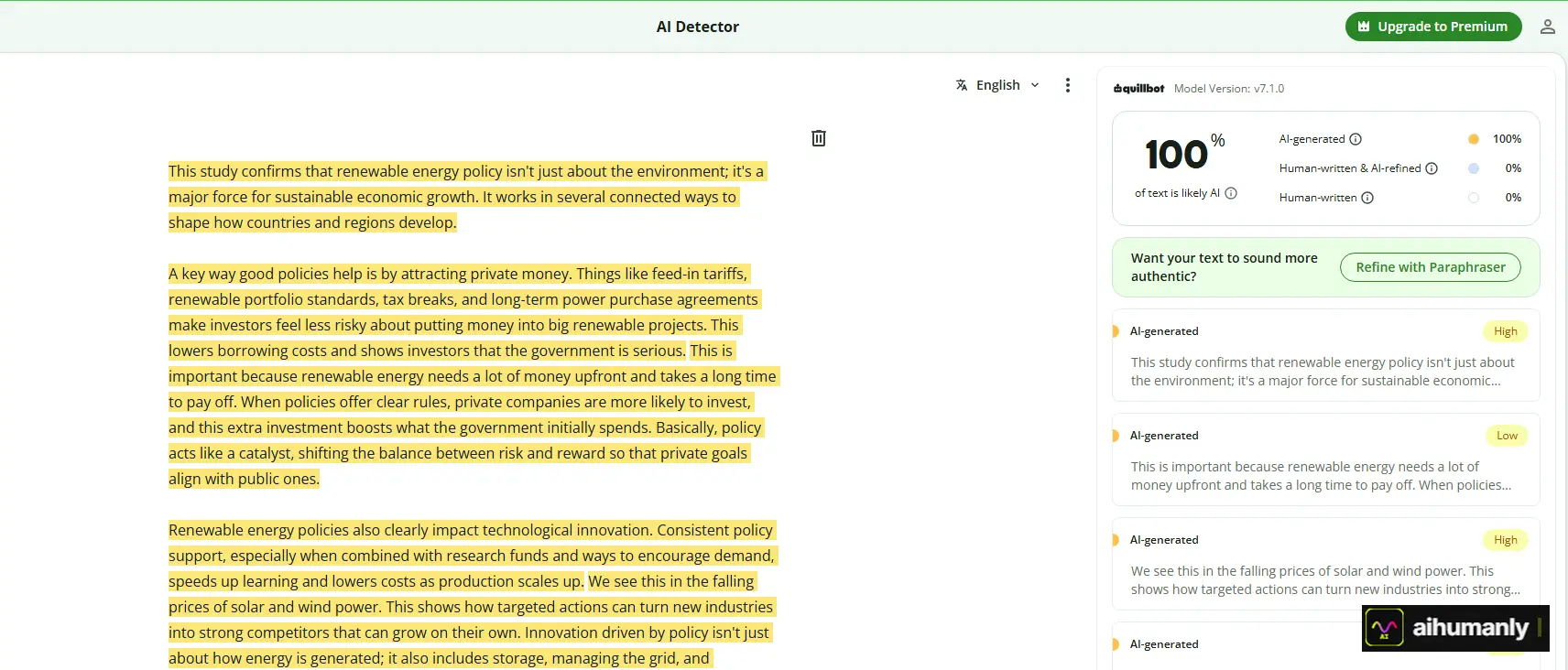
| QuillBot | 100% | IA |
| Copyleaks | 100% | IA |
Resultado: 5/6 detectores clasificaron el resultado como IA. Este fue el peor resultado de detección en las seis pruebas.
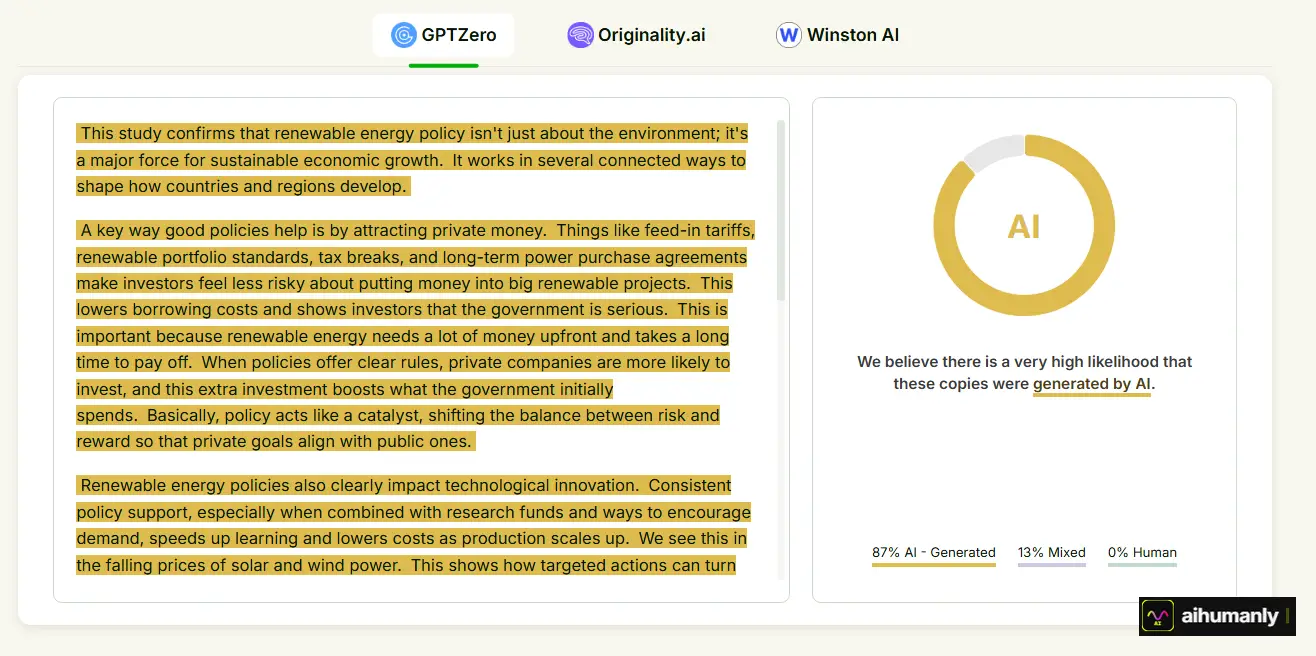
Evaluación de la calidad de escritura
| Dimensión | Puntuación / 10 |
|---|---|
| Conservación del significado | 6 |
| Tono académico | 6 |
| Gramática y fluidez | 7 |
| Consistencia de formato | 6 |
| Promedio | 6.25 |
Resumen: La configuración de Escritura general / Base Model de MyDetector produjo el resultado más débil para el Ensayo 2. Omitió por completo los dos últimos párrafos del original, que contenían la discusión crítica sobre las limitaciones de las políticas, los costos de infraestructura, la desigualdad regional y los desafíos de implementación. El evaluador notó que el tono era "demasiado conversacional para la escritura académica formal", con frases como "isn't just about the environment", "attracting private money", "Things like" y "Basically". Aunque es legible, el texto perdió un matiz académico significativo y se redujo de 6 párrafos a 4.
SuperHumanizer — Resultados del Ensayo 2
Modo: General, Super Ultra Model
| Detector | Puntuación de IA | Veredicto |
|---|---|---|
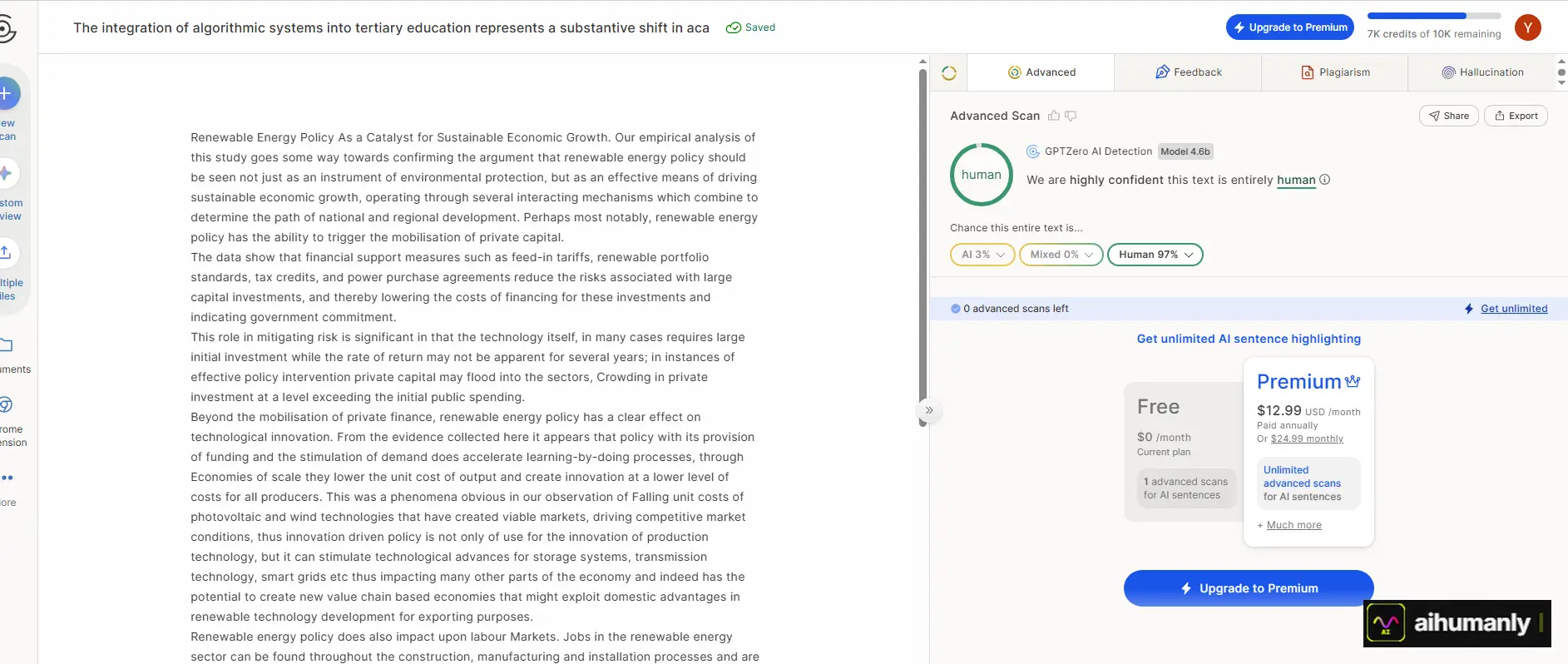
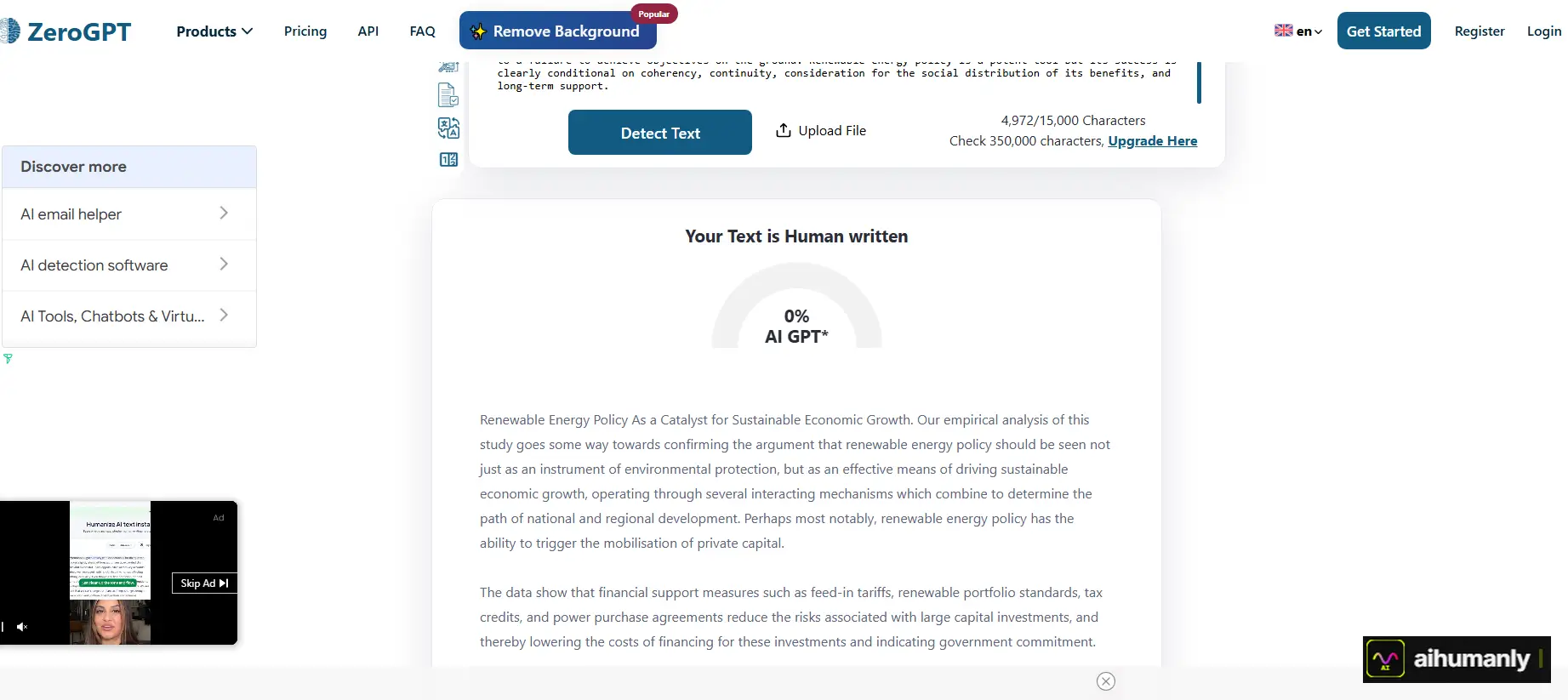
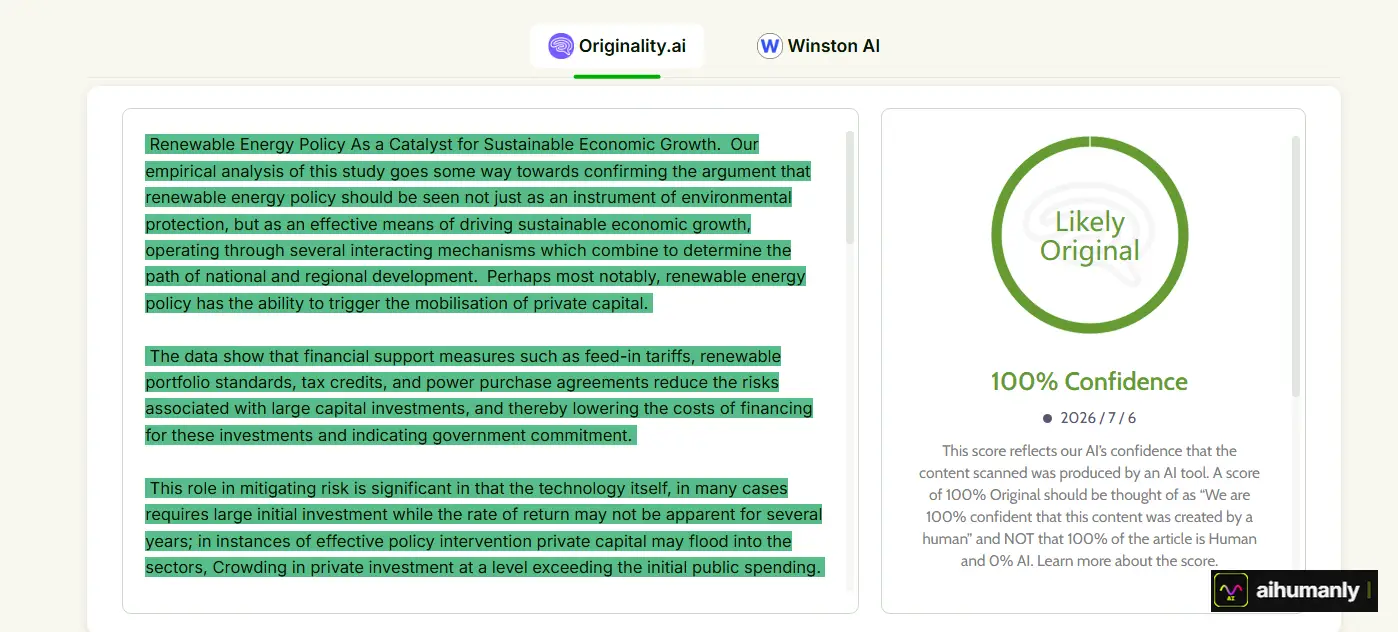
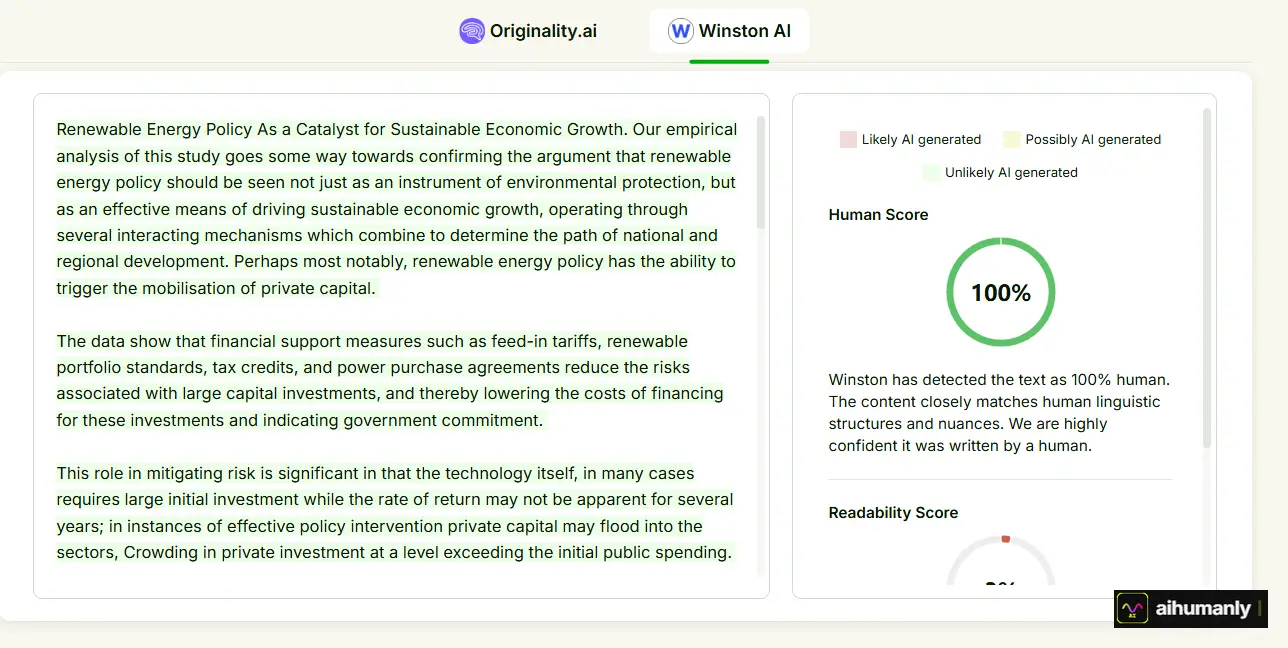
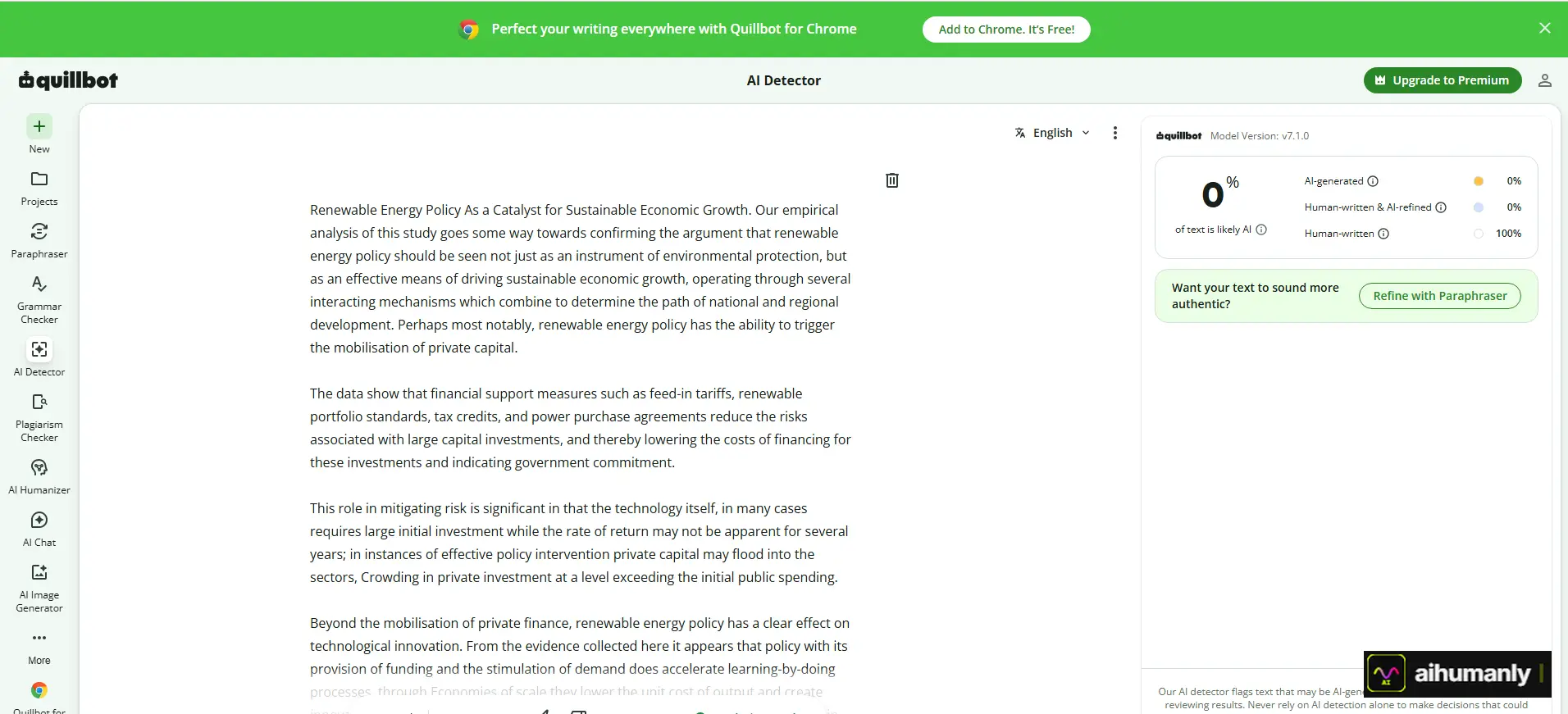
| GPTZero | 3% | Humano |
| ZeroGPT | 0% | Humano |
| Originality.ai | 0% | Humano |
| Winston AI | 0% | Humano |
| QuillBot | 0% | Humano |
| Copyleaks | 0% | Humano |
Resultado: 6/6 detectores clasificaron el resultado como humano con puntuaciones de IA del 0% en 5 de los 6 detectores. Este fue el resultado de detección más fuerte en toda la prueba.
Evaluación de la calidad de escritura
| Dimensión | Puntuación / 10 |
|---|---|
| Conservación del significado | 7 |
| Tono académico | 5 |
| Gramática y fluidez | 4 |
| Consistencia de formato | 6 |
| Promedio | 5.5 |
Resumen: SuperHumanizer logró la mejor evasión de detección pero la peor calidad de escritura para el Ensayo 2. El evaluador identificó frecuentes errores gramaticales, oraciones interminables, errores ortográficos ("geopoltical"), uso de mayúsculas inconsistente ("Policy", "Governments", "Economies", "Falling", "Markets", "Net") y espaciado incorrecto ("co- ordination"). Los ejemplos incluyen "This was a phenomena" (debería ser "phenomenon"), "through Economies of scale they lower the unit cost" (oración interminable con errores de mayúsculas) y "macro economic" en lugar de "macroeconomic". El texto añadió un título innecesario y utilizó frases en primera persona ("Our empirical analysis") no presentes en el original. El evaluador concluyó que el texto "necesita una edición importante".
Comparación lado a lado de las puntuaciones de detección de IA
Esta tabla reúne todos los resultados de detección de IA en una sola vista. Los porcentajes más bajos son mejores (menos probabilidad de ser detectado como IA).
| Versión del texto | GPTZero | ZeroGPT | Originality.ai | Winston AI | QuillBot | Copyleaks | Detectores superados |
|---|---|---|---|---|---|---|---|
| Ensayo 1 — HumanizeAI.pro | 33% H | 27.9% H | 41% H | 26% H | 4% H | 0% H | 6/6 |
| Ensayo 1 — MyDetector | 100% IA | 41.9% H | 100% IA | 100% IA | 100% IA | 0% H | 2/6 |
| Ensayo 1 — SuperHumanizer | 28% H | 11.5% H | 88% IA | 7% H | 12% H | 0% H | 5/6 |
| Ensayo 2 — HumanizeAI.pro | 16% H | 0% H | 47% H | 0% H | 3% H | 0% H | 6/6 |
| Ensayo 2 — MyDetector | 87% IA | 41.4% H | 100% IA | 100% IA | 100% IA | 100% IA | 1/6 |
| Ensayo 2 — SuperHumanizer | 3% H | 0% H | 0% H | 0% H | 0% H | 0% H | 6/6 |
Clave: H = clasificado como Humano, IA = clasificado como generado por IA
Comparación lado a lado de la calidad de escritura
Esta tabla compara la calidad de escritura de cada resultado humanizado, evaluada independientemente por GPT-5.5.
| Herramienta / Versión | Conservación del significado | Tono académico | Gramática y fluidez | Formato | Promedio |
|---|---|---|---|---|---|
| Ensayo 1 — HumanizeAI.pro | 8 | 7 | 7 | 10 | 8.0 |
| Ensayo 1 — MyDetector | 8 | 8 | 9 | 10 | 8.75 |
| Ensayo 1 — SuperHumanizer | 7 | 6 | 5 | 4 | 5.5 |
| Ensayo 2 — HumanizeAI.pro | 7 | 7 | 7 | 7 | 7.0 |
| Ensayo 2 — MyDetector | 6 | 6 | 7 | 6 | 6.25 |
| Ensayo 2 — SuperHumanizer | 7 | 5 | 4 | 6 | 5.5 |
¿Qué humanizador de IA tuvo el mejor rendimiento?
Mejor en general: HumanizeAI.pro
HumanizeAI.pro logró el rendimiento más equilibrado tanto en la evasión de detección como en la calidad de escritura:
- Detección: Superó 12/12 comprobaciones de detectores (6/6 en ambos ensayos)
- Calidad de escritura: Puntuaciones promedio de 8.0 (Ensayo 1) y 7.0 (Ensayo 2)
- Consistencia: Funcionó bien tanto en texto de nivel de pregrado como de posgrado
Es la única herramienta que superó todos y cada uno de los detectores manteniendo una calidad de escritura académica de aceptable a buena.
Mejor para reducir las puntuaciones de detección de IA: SuperHumanizer
SuperHumanizer produjo las puntuaciones de IA más bajas en general, logrando un 0% en 5/6 detectores para el Ensayo 2. Superó 11/12 comprobaciones de detectores en ambos ensayos. Sin embargo, esto tuvo un alto costo: su calidad de escritura fue la peor (promedio de 5.5, con puntuaciones de Gramática y fluidez de 4-5/10).
Mejor para la calidad de escritura: MyDetector (solo Ensayo 1)
La configuración Académico/Pro Model de MyDetector para el Ensayo 1 produjo las puntuaciones de calidad de escritura más altas (promedio de 8.75), con un 9/10 en Gramática y fluidez. El resultado fue gramaticalmente sólido, fluido y con buen formato. Desafortunadamente, este modo falló en 4/6 detectores, lo que significa que el texto pulido seguía siendo marcado fácilmente como IA.
Mejor para el tono académico: MyDetector (Ensayo 1, 8/10)
El Pro Model de MyDetector mantuvo el registro académico más constante, formal y preciso para el Ensayo 1. El evaluador elogió su vocabulario, objetividad y terminología apropiada para la disciplina. La contrapartida fue el fallo de detección en 4/6 detectores.
Más consistente en ambos ensayos: HumanizeAI.pro
HumanizeAI.pro fue la única herramienta que ofreció resultados respetables en ambos ensayos. SuperHumanizer tuvo problemas de calidad dramáticos en ambos ensayos. MyDetector funcionó bien en la calidad de escritura del Ensayo 1, pero colapsó en la detección del Ensayo 2 (5/6 marcas de IA).
Qué significan los resultados de la prueba
1. La evasión de detección y la calidad de escritura son inversamente proporcionales
Este fue el hallazgo más claro. SuperHumanizer produjo las puntuaciones de detección de IA más bajas pero la peor escritura. MyDetector produjo la mejor escritura (para el Ensayo 1) pero los peores resultados de detección. HumanizeAI.pro encontró el mejor punto medio.
2. Los detectores discrepan drásticamente
El mismo texto puede ser marcado como 100% IA por un detector y 0% IA por otro. Por ejemplo, el resultado del Ensayo 1 de MyDetector obtuvo un 100% de IA en GPTZero, Originality.ai, Winston AI y QuillBot, pero un 0% de IA en Copyleaks. Esta inconsistencia subraya por qué ningún detector único debe ser tratado como definitivo.
3. El texto de nivel de posgrado es más difícil de humanizar bien
Las tres herramientas puntuaron más bajo en calidad de escritura en el ensayo de nivel de posgrado (Ensayo 2) que en el ensayo de pregrado (Ensayo 1). Las estructuras de oraciones más complejas, las calificaciones matizadas y el registro académico formal del texto generado por Claude fueron más difíciles de reescribir sin perder significado o introducir errores.
4. Copyleaks fue el detector más indulgente
Copyleaks clasificó 5/6 de los resultados humanizados como humanos (0% IA), marcando solo el resultado del Ensayo 2 de MyDetector. Esto sugiere que Copyleaks puede ser más fácil de superar que otros detectores en este conjunto.
5. Originality.ai y Winston AI fueron los más estrictos
Estos dos detectores marcaron más resultados como IA que cualquier otro. Originality.ai clasificó 4/6 de los resultados como IA (incluyendo el Ensayo 1 de SuperHumanizer con un 88%). Winston AI marcó a MyDetector en ambos ensayos con un 100%.
Limitaciones de esta reseña de humanizadores de IA
- Solo inglés. Los resultados para otros idiomas pueden diferir.
- Dos muestras de texto. La escritura académica abarca muchos estilos; dos ensayos no pueden representar todos los casos de uso.
- Los algoritmos de los detectores se actualizan. Los detectores de IA cambian con el tiempo; los resultados de julio de 2026 pueden no mantenerse indefinidamente.
- Dependiente del modo. Cada herramienta ofrece diferentes modos y configuraciones. Probamos combinaciones específicas; otras configuraciones pueden producir diferentes resultados.
- Una sola ejecución de evaluación. La evaluación de calidad de escritura de GPT-5.5 se realizó una vez por resultado. Múltiples ejecuciones de evaluación podrían proporcionar puntuaciones de calidad más robustas.
- Sin prueba directa de Turnitin. No probamos a través de una cuenta institucional de Turnitin. Los resultados a través de los canales oficiales pueden diferir.
Nota ética sobre los humanizadores de IA y la escritura académica
Esta reseña se realiza únicamente con fines de investigación, transparencia y evaluación de herramientas.
Los estudiantes deben seguir las políticas de integridad académica de su institución. Presentar texto generado por IA o humanizado por IA como un trabajo completamente original puede violar los códigos de honor, incluso si el texto supera los detectores de IA. Las herramientas de IA deben apoyar el aprendizaje, no reemplazar el pensamiento crítico, la investigación original y las prácticas de citación adecuadas.
El propósito de esta prueba es comprender cómo funcionan estas herramientas, no fomentar la mala conducta académica.
Veredicto final
Probamos HumanizeAI.pro, MyDetector AI Humanizer y SuperHumanizer en dos ensayos académicos en inglés utilizando siete detectores de IA y una evaluación independiente de la calidad de escritura. Esto es lo que encontramos:
HumanizeAI.pro es la mejor opción en general. Superó el 100% de las comprobaciones de detectores (12/12) manteniendo una calidad de escritura académica aceptable (promedio de 7.0-8.0). Sus resultados necesitan una edición menor para la gramática y el tono académico, pero el significado y la estructura están bien conservados.
MyDetector produce la prosa académica más pulida en su Pro Model (promedio de 8.75 para el Ensayo 1), pero su evasión de detección es inconsistente. Solo superó 3/12 comprobaciones de detectores en general, lo que lo hace poco fiable si el objetivo principal es reducir las puntuaciones de detección de IA.
SuperHumanizer es el más eficaz para evadir la detección — logrando puntuaciones de IA del 0% en 5/6 detectores para el Ensayo 2 — pero la calidad de escritura es pobre (promedio de 5.5). Los resultados contienen frecuentes errores gramaticales, frases incómodas, formato inconsistente y contenido faltante. Se requeriría una edición manual importante antes de su uso académico.
En conclusión: Si necesitas una herramienta que equilibre la evasión de detección con la calidad de escritura, HumanizeAI.pro es el claro ganador. Si priorizas la prosa académica pulida y te preocupan menos los detectores, el Pro Model de MyDetector vale la pena considerarlo. Si la evasión de detección es tu única preocupación y estás dispuesto a editar mucho el resultado, SuperHumanizer puede funcionar, pero espera pasar mucho tiempo arreglando el texto.
Appendix
Appendix A: Prompts Used to Generate the Test Texts
Prompt 1: Undergraduate Argumentative Essay (GPT-5.5)
Write an English undergraduate argumentative essay of approximately 650-800 words on the topic: "The Impact of Artificial Intelligence on Higher Education."The essay should sound like a real university student's academic assignment for a general education or education technology course. Use a clear introduction, thesis statement, body paragraphs, and conclusion. The tone should be formal but not overly advanced.Discuss both the benefits and challenges of AI in higher education, including personalized learning, academic integrity, student dependency, equal access, and the changing role of teachers.Do not include citations, footnotes, or a reference list. Do not use bullet points or section headings. Write in continuous academic prose with clear paragraph structure.Prompt 2: Graduate-Level Research Discussion (Claude Opus 4.8)
Write an English graduate-level research discussion section of approximately 750-900 words on the topic: "The Role of Renewable Energy Policy in Accelerating Sustainable Economic Development."The writing should resemble the discussion section of a master's-level research paper. Use a formal academic tone, analytical reasoning, and complex but readable sentence structures.Discuss how renewable energy policy can influence private investment, technological innovation, labor markets, energy security, industrial competitiveness, and long-term sustainable economic growth. Also address possible limitations, including policy inconsistency, infrastructure costs, regional inequality, and implementation challenges.Do not include citations, footnotes, or a reference list. Do not use bullet points or headings. Write as continuous academic prose and make it realistic for graduate-level academic writing.Appendix B: Original AI-Generated Text for Essay 1
Generated by: GPT-5.5
Artificial intelligence is becoming one of the most influential technologies in higher education. In recent years, universities have started using AI tools for tutoring, writing support, research assistance, grading, student advising, and administrative tasks. At the same time, students are increasingly using AI chatbots and other applications to help them study, summarize readings, generate ideas, and complete assignments. Because higher education is meant not only to deliver information but also to develop independent thinking, the growth of AI raises important questions. AI can make learning more personalized, efficient, and accessible, but it can also create problems related to academic integrity, student dependency, inequality, and the changing role of teachers. Therefore, the impact of AI on higher education is neither entirely positive nor entirely negative; it depends on how universities choose to regulate, teach, and integrate it.
One of the most important benefits of AI in higher education is personalized learning. In traditional university classrooms, one instructor may teach dozens or even hundreds of students at the same time. This makes it difficult to meet every student's individual needs. Some students may understand the material quickly, while others may need more explanation or practice. AI tools can help by adapting to a student's level and learning pace. For example, an AI tutoring program can provide extra exercises in areas where a student is struggling, explain a concept in different ways, or give immediate feedback on a practice question. This kind of support can be especially useful outside classroom hours, when professors or teaching assistants may not be available. In this way, AI has the potential to make higher education more responsive to individual learners.
AI can also support students by helping them manage the large amount of information they encounter in university. Many students have to read long articles, prepare for exams, and organize complex ideas across several courses. AI tools can assist with summarizing texts, creating study questions, checking grammar, or suggesting ways to structure an essay. When used responsibly, these tools can help students become more efficient and confident. For students who are learning in a second language, AI writing and translation tools may reduce some barriers and allow them to participate more fully in academic work. Similarly, students with disabilities may benefit from speech-to-text tools, text-to-speech programs, or AI systems that help organize notes and tasks. These examples show that AI can improve access to learning when it is used as a supportive tool rather than a replacement for effort.
However, AI also creates serious challenges for academic integrity. Universities rely on the idea that students should submit work that reflects their own understanding and abilities. AI tools make it easier for students to generate essays, solve problems, or complete assignments without doing the required learning. This does not only create unfairness between students; it also weakens the value of education itself. If a student uses AI to write an entire paper, the student may receive a grade but lose the opportunity to practice research, analysis, and argumentation. In response, universities need clear policies that define acceptable and unacceptable uses of AI. At the same time, instructors may need to redesign assignments so that they focus more on process, reflection, oral explanation, and original application rather than only final written products.
Another concern is student dependency. While AI can help students learn, it can also make them less willing to struggle with difficult tasks. Learning often requires confusion, trial and error, and persistence. If students immediately ask an AI tool for answers whenever they face difficulty, they may not develop the problem-solving skills that higher education is supposed to build. For example, a student who always uses AI to outline essays may never learn how to organize an argument independently. A student who uses AI to solve every math problem may not understand the reasoning behind the solution. This does not mean that AI should be banned, but students need to be taught how to use it critically. They should learn to question AI responses, check for errors, and treat AI as a guide rather than an authority.
Equal access is another major issue. Although AI is often presented as a tool that can make education more inclusive, access to AI technologies is not equal. Some students can afford paid versions of advanced tools, high-speed internet, and newer devices, while others cannot. Universities with larger budgets may be able to purchase powerful AI systems and train faculty to use them, while underfunded institutions may fall behind. This could increase existing inequalities in higher education. If AI becomes a major part of learning, then access to reliable AI tools may become almost as important as access to textbooks or libraries. Universities and governments should therefore consider how to provide fair access, protect student data, and prevent AI from becoming another source of educational privilege.
The role of teachers is also changing because of AI. Some people fear that AI will replace professors, but this view misunderstands the deeper purpose of teaching. AI can deliver information and provide quick feedback, but it cannot fully replace human judgment, mentorship, empathy, and classroom discussion. Teachers do more than explain content; they encourage students, challenge assumptions, evaluate complex thinking, and create learning communities. However, AI may change what teachers spend their time doing. Instead of focusing mainly on delivering basic information, instructors may spend more time guiding discussions, designing meaningful assessments, and helping students evaluate information critically. In this sense, AI should not replace teachers but push universities to rethink teaching in a more interactive and reflective way.
In conclusion, artificial intelligence is reshaping higher education in significant ways. It offers valuable opportunities for personalized learning, academic support, accessibility, and efficiency. At the same time, it raises difficult concerns about cheating, overreliance, unequal access, and the future role of teachers. The central issue is not whether AI will be used in universities, because it is already becoming part of academic life. The real question is how it should be used. Higher education institutions should develop clear guidelines, teach students responsible AI literacy, and ensure that technology supports rather than weakens learning. If used thoughtfully, AI can become a powerful educational tool. If used carelessly, it may damage the very skills and values that universities are meant to protect.
Appendix C: Humanized Versions of Essay 1
HumanizeAI.pro — Academic Mode
Artificial intelligence is gaining prominence as a technology within higher education. In recent years, universities started using AI software to assist in tutoring, writing, researching, grading, advising, and other administrative processes. Moreover, students are increasingly using AI chatbots and other applications to help them learn, summarize texts, generate ideas, and complete assignments. Considering that the purpose of higher education is not only to teach people certain knowledge but also foster critical thinking and independence, the development of AI brings forward some serious issues. AI can make the process of learning more personalized, efficient, and accessible, but there are some concerns associated with the integrity of education, student dependency, inequality, and changing roles of the educator. Thus, the influence of AI on higher education is ambiguous and depends on how this technology will be regulated, taught, and integrated into learning.
One of the most obvious advantages of AI in higher education is the possibility of personalized learning. In traditional university settings, one instructor can teach dozens or even hundreds of students at a time. This makes it impossible to tailor education to the needs of each student as some can learn quickly and some require more explanation and practice. An AI system can adjust to the individual student's level and speed by providing additional practice in areas of difficulty, suggesting alternative explanations or giving feedback on the practice problems. Such kind of help can be especially useful after classes when instructors or teaching assistants are unavailable. In this way, AI can help to make higher education more personalized.
Moreover, AI can help students deal with the vast amount of information encountered at university. Students have to read long articles, prepare for exams, and organize their thoughts on multiple subjects. With the help of an AI tool, one can summarize texts, generate study questions, check grammar and give advice on how to organize an essay. The proper use of this technology can increase the efficiency and boost confidence of students. For those who study in a second language, AI writing and translating tools can reduce possible barriers and allow for full participation in education. Furthermore, students with disabilities can get the help of speech-to-text and text-to-speech technologies, as well as AI systems that can take notes and organize tasks. Thus, AI can make learning more accessible when used as an assisting tool and not a replacement for efforts.
However, AI brings some considerable threats to the integrity of education. The concept of universities presupposes that students submit their works showing their own understanding of the material. With the help of AI technology, one can easily produce essays, solutions to problems, or other assignments without having learned the necessary material. This creates an imbalance among students and diminishes the significance of education. Therefore, universities have to establish clear policies of using AI in terms of what is allowed and what is not. Besides, instructors may have to reconsider the assignments and design them in such a way that would stress process and reflection, oral presentation, and application of knowledge, not just a written product.
Student dependency is another issue created by AI technology. Though it can assist in learning process, it can also make students less willing to struggle with difficulties. Learning is usually associated with confusion, trial and error, and persistence. When a student always turns to the help of an AI tool when encountering difficulties, he or she does not develop such skills as problem-solving which are important in higher education. For instance, a student relying on an AI tool to create an outline of an essay does not learn to organize his or her thoughts on his own; a student using AI solutions to all mathematical problems does not learn the logic behind them. However, it does not mean that AI should be forbidden, but it means that students should learn to use AI critically by questioning its responses, checking them for mistakes, and treating it not as a source of answers but as a guide.
The issue of equity of access to AI technologies is quite significant as well. Even though AI is often seen as a tool that allows for better inclusion, access to AI technologies is unequal as some students can afford paid versions of advanced tools, fast internet, and new devices while some do not have access to such services. Colleges and universities with larger budgets can purchase advanced AI technologies and train the staff to use them while those with smaller budgets can lag behind, thus aggravating existing inequalities in higher education. If AI becomes a part of the learning process, access to AI tools will become as important as access to textbooks or libraries. Hence, universities and governments have to think of the measures for fair access and protection of student data as well as preventing AI from becoming a tool that causes further inequality in education.
Furthermore, the role of educators is also changing under the influence of AI. Some fear that AI will replace professors, but this assumption is based on misunderstanding of the purposes of education. AI is able to disseminate information and give feedback instantly, but it can never replace human judgment, mentoring, empathy, and class discussion. The job of educators is much more than information dissemination as they inspire students, challenge their opinions, evaluate complex thinking, and help to develop learning communities. However, AI might change the allocation of teachers' time making them spend more time facilitating discussions, designing quality assessments, and helping students to analyze information critically. In this way, AI should not replace educators but force them to rethink pedagogical approaches focusing on interaction and reflection.
To sum up, artificial intelligence changes higher education significantly. AI provides students with an opportunity for personalized learning, assistance, accessibility, and efficiency; however, it also creates some serious concerns associated with cheating, overdependence, inequality, and changing roles of educators. The main problem here is not whether AI will be used in universities - it is already a part of education - but how it should be used. Higher education institutions have to establish some guidelines for using AI, teach students to use AI responsibly and make sure that technology assists in learning, not obstructs it. If used wisely, AI can become an excellent educational tool, otherwise, it will spoil the skills and values preserved in education.
MyDetector — Academic, Pro Model
The integration of algorithmic systems into tertiary education represents a substantive shift in academic practice. Universities increasingly rely on these computational tools for administrative workflows, research assistance, and pedagogical support, while students frequently engage automated applications to synthesize literature or draft assignments. Given the mandate of academic institutions to foster autonomous reasoning alongside knowledge transmission, this technological embedding prompts critical inquiry. The deployment of artificial intelligence offers avenues for individualized instruction but introduces complications regarding scholarly integrity, cognitive reliance, and structural disparity. Consequently, the trajectory of this adoption relies heavily on institutional frameworks for regulation and pedagogical adaptation.
Traditional instructional models often struggle to address the diverse cognitive cadences within a single cohort. When a singular faculty member oversees vast student populations, providing individualized attention becomes structurally constrained. Algorithmic tutoring systems present a mechanism to calibrate instructional delivery by adjusting to specific learning trajectories. Through adaptive feedback and targeted supplementary exercises during non-instructional hours, these platforms provide scaffolding where conventional support mechanisms may be unavailable. This capability suggests a gradual shift toward instructional models that are more responsive to individual learner profiles.
The navigation of dense academic material presents a significant cognitive load. Computational tools offer utility in managing this volume by extracting core arguments from extensive literature or providing structural frameworks for initial drafting. Such mechanisms, when applied judiciously, can reduce operational friction for learners. For individuals managing specific learning disabilities or operating in a secondary language, the mediation provided by translation algorithms and speech-recognition software can lower traditional barriers to academic engagement. In these contexts, the technology operates as cognitive scaffolding rather than an operational substitute for foundational effort.
Conversely, the ease with which these models generate coherent academic output complicates established frameworks of scholarly assessment. The foundational premise of university evaluation rests on work reflecting individual cognitive effort. Utilizing generative systems to bypass initial learning processes distorts evaluative metrics and undermines the broader pedagogical objective. A reliance on automated text generation deprives learners of the iterative struggle necessary for developing analytical acuity. Addressing this vulnerability requires institutions to articulate precise boundaries of acceptable use and reconsider assessment designs, shifting focus toward methodological processes, oral defense, and real-time application rather than relying exclusively on final written artifacts.
Beyond immediate integrity concerns, prolonged reliance on computational assistance may induce a broader cognitive dependency. Intellectual maturation inherently requires friction, uncertainty, and persistent problem-solving. A paradigm wherein learners immediately defer to algorithmic output when encountering difficulty risks atrophying the very analytical capacities higher education seeks to cultivate. Outsourcing structural organization or mathematical reasoning to automated systems obscures the underlying logic required for conceptual mastery. Cultivating digital literacy is thus essential. Students must be trained to interrogate algorithmic outputs, recognizing them as probabilistic models rather than definitive intellectual authorities.
The integration of these tools also intersects with existing socioeconomic stratifications. While frequently framed as a democratizing force, the distribution of advanced computational resources remains uneven. Access to sophisticated models, necessary hardware, and reliable infrastructure frequently requires financial capital. Institutions possessing substantial endowments can readily incorporate advanced systems and provide requisite faculty training, whereas under-resourced entities may struggle to keep pace. To mitigate the risk of algorithmic tools exacerbating educational disparities, strategic interventions at the policy level are required to ensure equitable distribution of technological resources.
The proliferation of these technologies further necessitates a recalibration of faculty roles. While algorithmic systems excel at information dissemination and rapid formative assessment, they lack the capacity for empathetic mentorship and complex evaluative judgment. Faculty effort can subsequently pivot away from the rudimentary transmission of foundational concepts toward the facilitation of critical discourse and the design of nuanced evaluative frameworks. The technology functions not as a replacement for human instruction but as a catalyst for refining pedagogical focus.
The embedding of computational algorithms into academic environments introduces mechanisms for enhanced accessibility and customized support while simultaneously surfacing vulnerabilities related to academic misconduct and resource inequality. The presence of these tools within academic ecosystems is an established reality. The imperative now lies in formulating robust regulatory paradigms and instructional strategies. Through deliberate integration, these systems can function as vital instruments for intellectual development, provided their deployment remains aligned with the core objectives of higher learning.
SuperHumanizer — Academic, Super Ultra Model
The impact of AI on Higher Education. Artificial Intelligence (AI) is quickly evolving to be one of the most influential technologies impacting higher education institutions across the globe. For the past few years universities have begun utilizing AI technology as an educational tool to assist in areas such as, tutoring, writing assistance, academic research, assessing papers, student advising, and administrative purposes.
Concurrently, students have also increasingly relied on AI Chatbots and applications in their academic work to aid them in understanding course material, summarising readings, formulating ideas and completing written assignments.
Since Higher Education involves not only disseminating information to students, but also developing them to become independent and critically-minded individuals, the emergence of this technology sparks several significant questions. While the implications for how it can facilitate enhanced personalised, efficient and more accessible learning is profound, so too are the consequences it poses for issues of academic integrity, student dependency, inequality, and the changing roles and responsibilities of instructors and faculty. In essence, the impact of AI on higher education is multifaceted - neither completely positive or negative; depending upon how each university chooses to guide and control its' use and its' integrate within their educational processes. Perhaps the greatest advantage to incorporating AI in higher education lies in its potential for personalised learning.
Typically, a traditional lecture will contain dozens or even hundreds of students and therefore a single instructor is unlikely to be able to accommodate the diverse learning styles and speeds of each individual.
Some students may master a concept quickly, whilst others will require further clarification and practice. AI technologies can supplement a course by adjusting the course material based on the learner's existing level of knowledge and pacing, offering supplementary materials in topics they struggle with, presenting concepts in a variety of ways, and providing instant feedback on practice problems. This support is particularly valuable in times when professors or teaching assistants are unavailable.
AI could truly allow higher education to become more attuned to individual student needs. Furthermore, a key benefit to AI tools for university students is the ability to manage the massive quantities of information they are exposed to. A student studying multiple courses must read long academic papers, research for exams, and comprehend various complex ideas simultaneously.
AI is available to summarise reading materials, generate study questions, edit papers for grammar and syntax issues, and assist with formatting an essay.
This technology can enable students to become more productive and increase their confidence in their academic output, provided it is used thoughtfully. This can provide invaluable support for students who may experience barriers when writing or learning in their second language by providing a more inclusive learning experience. Likewise, students with a learning disability can utilize speech-to-text technology, a screen reader or an AI assistant to organise notes and assignments. It is these applications that provide the proof of AI's positive contribution to the accessibility of learning, when utilised as supplementary technology to traditional means.
There are, however, serious ethical and academic integrity challenges created by the proliferation of AI in higher education institutions.
One of the foundational principles of universities is to ensure students produce their own work that accurately reflect their abilities and their understanding of the course material. With AI applications enabling easy access to automatically generated papers, assignments, and answers, students have an unprecedented opportunity to cheat in academic work. Not only does this render the assessment processes and students' academic output inequitable between learners; it diminishes the value of the entire educational process itself.
In such a scenario where a student purchases an AI generated paper, their only achievement is the grade they receive - they miss the opportunities to undertake rigorous research, analyse information, and develop strong arguments. Universities must consequently implement and regulate clear policies concerning AI usage within an educational environment and consider reframing course assessments to focus less on end-of-term output and more on the learning journey and development process including reflective assignments or oral defenses. There is a risk of students becoming overly reliant on the ease of access to solutions AI provides.
Learning frequently involves ambiguity and requires trial-and-error; therefore, the immediate appeal of seeking a solution from AI instead of persisting with the challenging work of understanding and overcoming academic difficulties may stifle students' ability to develop critical and independent thought.
A student who uses AI to prepare an essay structure may not learn to organize a thesis in their own right, while one who consistently uses AI to solve their math problems may never fully grasping the underlying methodology. Such tools are obviously not inherently negative but require a teaching of their judicious use; students should be educated to question the data AI provides, identify its flaws, and engage with it as a supportive tool rather than an unquestionable oracle. Access is another fundamental aspect which AI in education raises concerns about. It's common for people to frame AI as the equaliser of opportunity, however the reality is quite stark.
Higher education institutions or individuals who can afford paid, advanced AI tools and have reliable high-speed internet access have a clear advantage over those that cannot afford such luxuries or maintain necessary technical infrastructure.
Institutions with limited budgets may lack the funds to invest in cutting-edge AI technology and adequately train faculty on its use and thus may lag behind their better-resourced counterparts in its utilisation. If AI is integral to the learning process at a later date, this technology may well serve as yet another gateway to exacerbating inequalities in higher education. As AI systems gain an increasing role in teaching and learning, it is imperative that governing bodies address the equitable distribution of this technology, the ethical utilisation and ownership of data gathered by it, and that access to qualityAI is afforded in an inclusive manner rather than becoming another element of institutional privilege.
One aspect where the influence of AI on Higher education appears to be most pronounced is the altering of the role of teachers. The concern that AI would wholly replace educators is one borne from an incomplete understanding of teaching's essential role. Although AI may excel at information transmission and offer swift feedback on a student's work, it is incapable of fully replacing human judgment, pedagogical mentoring, interpersonal understanding, classroom discussion, or the emotional support and inspiration a human educator provides.
The responsibilities of a teacher extend beyond imparting factual knowledge; educators facilitate discussion, provoke students' assumptions, challenge students' thinking, and build communities of learning.
However, the tasks educators dedicate their time to may shift with AI integration; rather than focussing solely on delivering standard information to large groups, they may find themselves engaged more in guiding discussions, developing creative and meaningful assignments, and helping students critically evaluate complex and vast amounts of information. AI is not necessarily a replacement but a catalyst for rethinking the nature of teaching in a more collaborative and reflective direction.
Appendix D: Original AI-Generated Text for Essay 2
Generated by: Claude Opus 4.8
The findings of this study reinforce the proposition that renewable energy policy functions not merely as an environmental instrument but as a substantive driver of sustainable economic development, operating through several interrelated channels that collectively shape the trajectory of national and regional growth. Central among these is the capacity of well-designed policy frameworks to mobilise private investment. The evidence suggests that instruments such as feed-in tariffs, renewable portfolio standards, tax incentives, and long-term power purchase agreements reduce the perceived risk associated with capital-intensive renewable projects, thereby lowering the cost of financing and signalling credible governmental commitment to investors. This risk-mitigation function is particularly significant because renewable energy technologies typically demand substantial upfront capital while yielding returns over extended time horizons. Where policy provides regulatory certainty, private actors appear more willing to commit resources, and the resulting crowding-in of investment amplifies the initial fiscal outlay of the state. In this sense, policy operates as a catalyst that recalibrates the expected balance between risk and reward, aligning private incentives with public objectives.
Beyond investment, renewable energy policy exerts a discernible influence on technological innovation. The analysis indicates that sustained policy support, especially when coupled with research funding and demand-side measures, accelerates learning-by-doing and drives down unit costs through economies of scale. This dynamic, frequently observed in the declining cost curves of solar photovoltaic and wind technologies, illustrates how targeted intervention can transform nascent industries into competitive sectors capable of self-sustaining growth. Importantly, innovation induced by policy is not confined to generation technologies alone but extends to storage, grid management, and efficiency solutions, thereby generating spillover effects across the broader economy. Such innovation carries implications for industrial competitiveness, as early movers in renewable manufacturing and deployment may secure advantageous positions in emerging global value chains. The strategic dimension of energy policy therefore becomes apparent: states that cultivate domestic capabilities in renewable technologies stand to benefit from export opportunities and reduced dependence on imported fossil fuels, thereby strengthening both their economic resilience and their geopolitical standing.
The labour market implications of renewable energy policy further substantiate its developmental role. The transition towards renewable systems tends to generate employment across construction, installation, manufacturing, and maintenance activities, and these positions are often more labour-intensive per unit of energy produced than their fossil-fuel counterparts. Nevertheless, the aggregate employment effect must be interpreted with caution, since job creation in renewable sectors may be partially offset by contraction in extractive and conventional energy industries. The net outcome depends substantially upon the pace of transition, the availability of retraining programmes, and the geographic distribution of new and displaced employment. This observation gestures towards one of the more persistent tensions within renewable energy policy, namely the challenge of ensuring that the benefits of transition are equitably distributed rather than concentrated among regions and populations already advantaged by existing economic structures.
Energy security represents an additional channel through which policy contributes to sustainable growth. By diversifying the energy mix and reducing reliance on volatile fossil-fuel markets, renewable deployment insulates economies from price shocks and supply disruptions, thereby stabilising the macroeconomic environment in which longer-term investment decisions are made. This stabilising function is difficult to quantify precisely, yet its significance is amplified in an era of heightened geopolitical uncertainty, where the strategic value of domestically generated energy has become increasingly apparent.
Despite these promising channels, the evidence also compels a measured acknowledgement of the limitations and constraints that attend renewable energy policy. Foremost among these is the problem of policy inconsistency. Where governments alter or withdraw support prematurely, investor confidence erodes, and the resulting uncertainty can stall or reverse progress achieved during periods of stable commitment. The intertemporal nature of renewable investment renders it acutely vulnerable to political cycles and shifting priorities, suggesting that the durability of policy is as consequential as its initial design. Infrastructure costs constitute a further impediment, particularly the substantial expenditure required to modernise grids, integrate intermittent generation, and develop adequate storage capacity. These costs may strain public finances and, in the absence of careful management, could be transferred to consumers in ways that provoke political resistance and undermine the social legitimacy of the transition.
Regional inequality further complicates the picture, as the capacity to attract renewable investment and to absorb its benefits is unevenly distributed across territories with differing resource endowments, institutional capacities, and levels of development. Without deliberate corrective measures, renewable energy policy risks reproducing or exacerbating existing spatial disparities. Finally, implementation challenges, encompassing administrative capacity, permitting delays, and coordination failures among governance levels, frequently constrain the translation of ambitious policy objectives into tangible outcomes. These considerations do not negate the developmental potential of renewable energy policy but rather delineate the conditions under which that potential may be realised. Taken together, the findings suggest that renewable energy policy can accelerate sustainable economic development, yet its efficacy is contingent upon coherence, credibility, distributional sensitivity, and sustained institutional commitment over time.
Appendix E: Humanized Versions of Essay 2
HumanizeAI.pro — Standard, Ultra Run
The conclusions drawn from this analysis corroborate the hypothesis that renewable energy policy operates not only as an environmental tool but as a means of driving sustainable economic development in various ways. In particular, the first key role played by renewable energy policies is the mobilisation of private investment. It turns out that tools such as feed-in tariffs, renewable portfolio standards, taxation, and long-term agreements to purchase power mitigate the risk associated with large and risky renewable projects, thus reducing the cost of finance and indicating the intention of the government to act consistently. Since the risk mitigation is essential due to the fact that renewable energy technologies require considerable financial investments to yield returns in the future, the crowding-in of the investments increases the effectiveness of the initial fiscal effort on the part of the government, making the policy a catalyst that allows recalibrating risk-reward expectations.
Moreover, renewable energy policies have an impact on technological innovation, as indicated by the analysis. Particularly, the consistent support of such policies, in combination with research funding and demand-side measures, facilitates learning-by-doing and reduces costs due to economies of scale, as shown by the cost reduction in solar photovoltaics and wind technologies. Hence, the intervention in the market allows transforming a new industry into a competitive sector of the economy. Besides, innovations stimulated by such policy are not limited solely to generating technologies, including innovations related to storage, grid management, and efficiency, thus having spillovers to other areas of the economy. Innovations, in turn, affect industrial competitiveness: states that invest in domestic capabilities for renewable energy technologies have the chance of getting an advantageous position in the global value chain, as they get export opportunities and reduce their dependency on fossil fuel imports. Consequently, energy policies become a tool for enhancing the economic and geopolitical position of the country in the process of the transition to renewable energy.
Labor market effects caused by renewable energy policies also support the role of the latter in sustainable development. First of all, it is important to point out that the move towards renewable energy systems creates jobs in building, installing, manufacturing, and maintaining activities and, hence, leads to labor-intensive production compared to the fossil fuel-based energy generation. However, the overall employment effect of renewable energy policies should be evaluated carefully, as the emergence of jobs in the new industry is partially offset by job losses in the extractive and conventional energy industry. Therefore, the net effect depends on the speed of the transition and retraining programmes. This observation highlights one of the main problems related to the implementation of renewable energy policies, namely the problem of equitable distribution of the benefits of transition.
Another channel via which renewable energy policies facilitate sustainable development is the increase of energy security, meaning that the diversification of energy sources makes the economy resistant to price shocks and supply interruptions, which stabilises the macroeconomic environment for decision-making. The exact quantification of this effect is difficult, but it gains additional importance in times of growing geopolitical instability, when the value of energy independence becomes particularly apparent.
At the same time, renewable energy policies face several difficulties that limit their effectiveness and create barriers to achieving sustainable development goals. The first barrier is the issue of consistency. As it has been pointed out above, when governments change their policies too rapidly, it decreases investor confidence and hampers the development that was previously made under consistent policies. Since investments in renewable energy are intertemporal, it means that the sustainability of renewable energy policies plays a particularly crucial role. High infrastructure costs constitute another barrier, especially the high costs of modernizing grids, integrating intermittent generation, and developing storage facilities. Such costs can put pressure on public finances and, in the worst case scenario, result in redistribution of costs to consumers in a way that would lead to political resistance to the transition. Regional inequality becomes a problem, as territories differ in their capability to attract renewable investment and reap benefits from it, and hence, there is a risk of reproduction of spatial inequalities without special efforts. Finally, implementation issues, which include lack of administrative capacity, permitting delays, and coordination among various levels of governance, sometimes prevent the transformation of ambitious goals into results.
MyDetector — General Writing, Base Model
This study confirms that renewable energy policy isn't just about the environment; it's a major force for sustainable economic growth. It works in several connected ways to shape how countries and regions develop.
A key way good policies help is by attracting private money. Things like feed-in tariffs, renewable portfolio standards, tax breaks, and long-term power purchase agreements make investors feel less risky about putting money into big renewable projects. This lowers borrowing costs and shows investors that the government is serious. This is important because renewable energy needs a lot of money upfront and takes a long time to pay off. When policies offer clear rules, private companies are more likely to invest, and this extra investment boosts what the government initially spends. Basically, policy acts like a catalyst, shifting the balance between risk and reward so that private goals align with public ones.
Renewable energy policies also clearly impact technological innovation. Consistent policy support, especially when combined with research funds and ways to encourage demand, speeds up learning and lowers costs as production scales up. We see this in the falling prices of solar and wind power. This shows how targeted actions can turn new industries into strong competitors that can grow on their own. Innovation driven by policy isn't just about how energy is generated; it also includes storage, managing the grid, and improving efficiency, which benefits the wider economy. Companies that are early leaders in making and using renewable technology can gain an advantage in global markets. This highlights the strategic side of energy policy: countries that develop their own renewable technology capabilities can benefit from exports and rely less on imported fossil fuels, making them more economically stable and improving their global standing.
The effects on jobs also show how renewable energy policy contributes to development. The shift to renewable systems creates jobs in building, installing, manufacturing, and maintaining these systems. These jobs often require more workers per unit of energy produced compared to fossil fuels. However, we need to be careful about the overall job numbers, as new jobs in renewables might be balanced out by job losses in mining and traditional energy sectors. The final impact depends a lot on how quickly the transition happens, whether there are training programs available, and where the new and lost jobs are located. This points to a constant challenge with renewable energy policy: making sure the benefits of this shift are shared fairly and don't just go to regions and people who are already well-off.
Energy security is another area where policy helps sustainable growth. By diversifying our energy sources and depending less on unpredictable fossil fuel markets, renewable energy shields economies from sudden price changes and supply problems. This stabilizes the economy, which is crucial for making long-term investment decisions. It's hard to put an exact number on this benefit, but it's increasingly important in times of global uncertainty when the value of locally produced energy is becoming more obvious.
SuperHumanizer — General, Super Ultra Model
Renewable Energy Policy As a Catalyst for Sustainable Economic Growth. Our empirical analysis of this study goes some way towards confirming the argument that renewable energy policy should be seen not just as an instrument of environmental protection, but as an effective means of driving sustainable economic growth, operating through several interacting mechanisms which combine to determine the path of national and regional development. Perhaps most notably, renewable energy policy has the ability to trigger the mobilisation of private capital.
The data show that financial support measures such as feed-in tariffs, renewable portfolio standards, tax credits, and power purchase agreements reduce the risks associated with large capital investments, and thereby lowering the costs of financing for these investments and indicating government commitment.
This role in mitigating risk is significant in that the technology itself, in many cases requires large initial investment while the rate of return may not be apparent for several years; in instances of effective policy intervention private capital may flood into the sectors, Crowding in private investment at a level exceeding the initial public spending.
Beyond the mobilisation of private finance, renewable energy policy has a clear effect on technological innovation. From the evidence collected here it appears that policy with its provision of funding and the stimulation of demand does accelerate learning-by-doing processes, through Economies of scale they lower the unit cost of output and create innovation at a lower level of costs for all producers. This was a phenomena obvious in our observation of Falling unit costs of photovoltaic and wind technologies that have created viable markets, driving competitive market conditions, thus innovation driven policy is not only of use for the innovation of production technology, but it can stimulate technological advances for storage systems, transmission technology, smart grids etc thus impacting many other parts of the economy and indeed has the potential to create new value chain based economies that might exploit domestic advantages in renewable technology development for exporting purposes.
Renewable energy policy does also impact upon labour Markets. Jobs in the renewable energy sector can be found throughout the construction, manufacturing and installation processes and are typically more labor-intensive per unit of output produced than those found in conventional energy sectors. It is important, however, to view job creation as a Net positive impact: since jobs will be lost from existing, conventional energy sectors and as total net employment gains might be only limited to overall size of the sector, it may vary depending on the pace and structure of this transition. This points to an often contentious debate within the renewables sphere regarding equitable redistribution of jobs and the impact of job losses and creation between various communities across different parts of regions.
A key contribution to sustainable economic growth, derived through this policy, comes in the form of energy security. By fostering a more diverse range of domestically produced, alternative forms of energy renewable policy may thus help protect economies against price volatilities in global fossil fuel markets. This helps contribute to a stable macro economic environment in which longer term investments can be more assured, and this becomes increasingly important in our increasingly turbulent geopoltical climate.
While the above demonstrate the considerable potential of renewable energy policy to stimulate and support economic growth, we must also concede limitations, and constrain policy effectiveness. Inconsistencies in Policy will cause investment and development to stall. If Governments move their support and/or policies without adequate notice this uncertainty undermines the certainty needed for such large, long-term investment projects, leading to delays or cancellations.
Infrastructure costs can also be significant - large investments to update the transmission and distribution grid and to provide storage to accommodate intermittency could impose large costs on both Government and consumers and be politically damaging to governments.
The unequal distribution of opportunity between regions, the capacity to attract renewable investment being higher in some than in others is another constraint to policy. The need to consider and manage spatial distribution inequalities throughout the policy process becomes evident. Implementation can often be a challenge, where lack of administrative capacity and co- ordination failures between levels of governance lead to a failure to achieve objectives on the ground. Renewable energy policy is a potent tool but its success is clearly conditional on coherency, continuity, consideration for the social distribution of its benefits, and long-term support.