AI Humanizer Tools vs Turnitin AI Detection: HumanizeAIText, Grammarly AI Humanizer, and CleverHumanizer

AI humanizer tools are everywhere now. Every week, a new tool launches claiming to "bypass all AI detectors" and "make AI text undetectable." But when you actually test them with real academic essays and real detectors, the results vary dramatically.
In this review, we put three popular AI humanizer tools to the test:
- CleverHumanizer (cleverhumanizer.ai) — A dedicated AI humanizer with Normal and Advanced modes
- HumanizeAIText (humanizeaitext.co) — A text-focused humanizer tool
- Grammarly AI Humanizer (grammarly.com/ai-humanizer) — Grammarly's entry into the AI humanizer space
We used the same two academic essays generated by AI (one from GPT-5.5, one from Claude Opus 4.8), ran each through all three tools, and then checked every output against six different AI detectors: GPTZero, ZeroGPT, Originality.ai, Winston AI, QuillBot AI Detector, and Copyleaks.
Every result below comes from actual testing with screenshots. No marketing claims — just data.
Quick Summary: AI Humanizer Test Results
| Tool | Essay 1 (6 Detectors) | Essay 2 (6 Detectors) | Total Pass Rate | Verdict |
|---|---|---|---|---|
| CleverHumanizer | 5/6 passed | 2/6 passed | 7/12 (58%) | Best overall |
| HumanizeAIText | 2/6 passed | 1/6 passed | 3/12 (25%) | Moderate |
| Grammarly | 0/6 passed | 0/6 passed | 0/12 (0%) | Failed |
Key finding: CleverHumanizer was the clear winner, passing 7 out of 12 detector tests (58%). It passed 5/6 detectors on Essay 1 and still managed 2/6 on the more challenging Essay 2. HumanizeAIText showed moderate results (25% pass rate), while Grammarly's AI Humanizer failed almost completely.
Why We Tested These Three Tools
These three tools represent very different approaches to AI humanization:
- CleverHumanizer is a purpose-built AI humanizer with multiple modes (Normal, Advanced). It's designed specifically for rewriting AI text to bypass detection.
- HumanizeAIText is another dedicated humanizer that focuses on transforming AI-generated content into "human-like" text.
- Grammarly is the wildcard. It's one of the world's most popular writing tools, and recently added an AI humanizer feature. But is a writing assistant's humanizer as effective as dedicated tools?
The question we wanted to answer: Do dedicated AI humanizer tools actually outperform mainstream writing tools like Grammarly when it comes to bypassing AI detection?
Tools Overview
CleverHumanizer
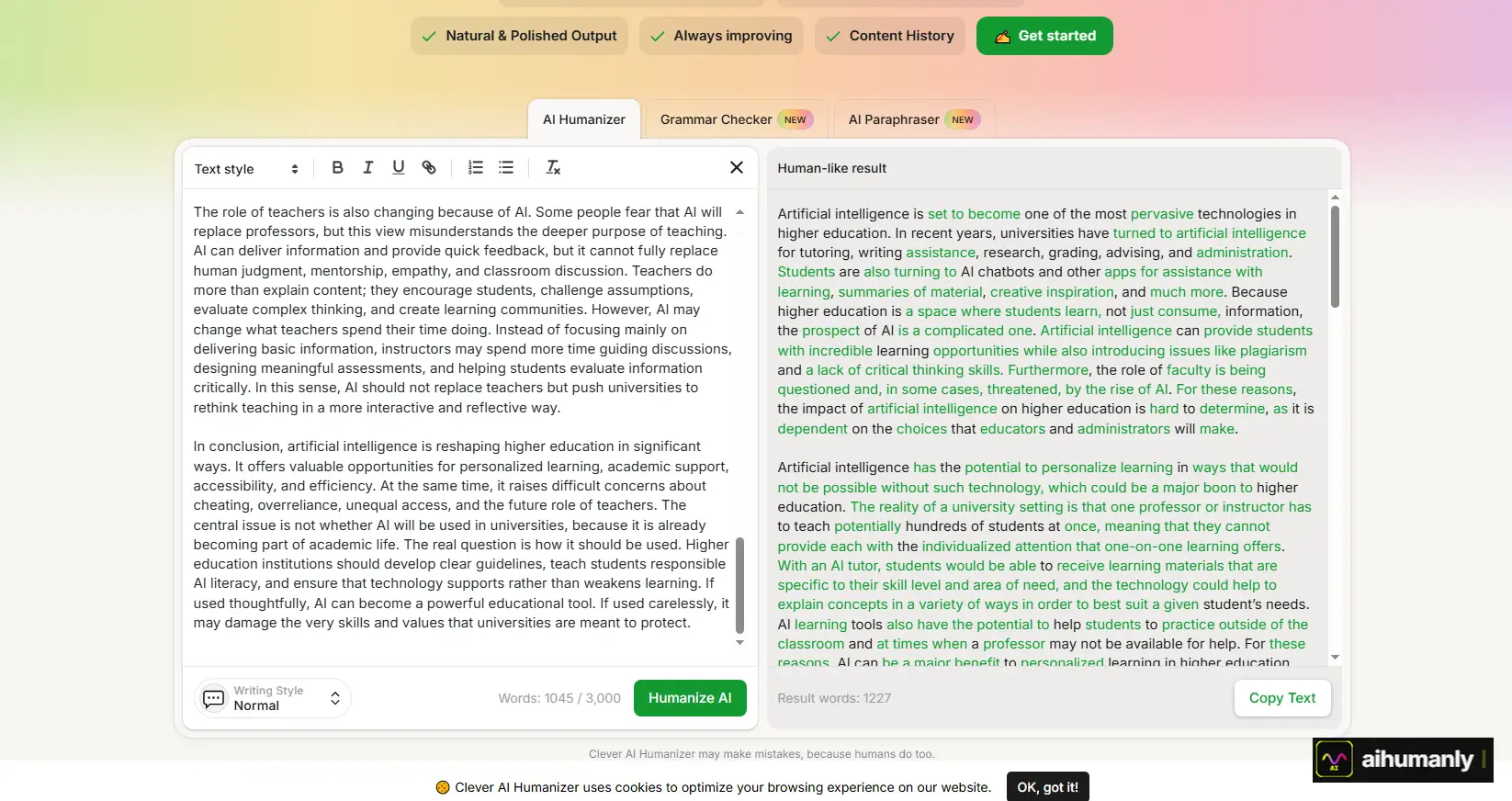
Website: cleverhumanizer.ai
CleverHumanizer is a dedicated AI text humanizer that offers Normal and Advanced rewriting modes. In our test, we used the Normal mode for both essays. The tool is straightforward — paste your text, select a mode, and get humanized output.
HumanizeAIText
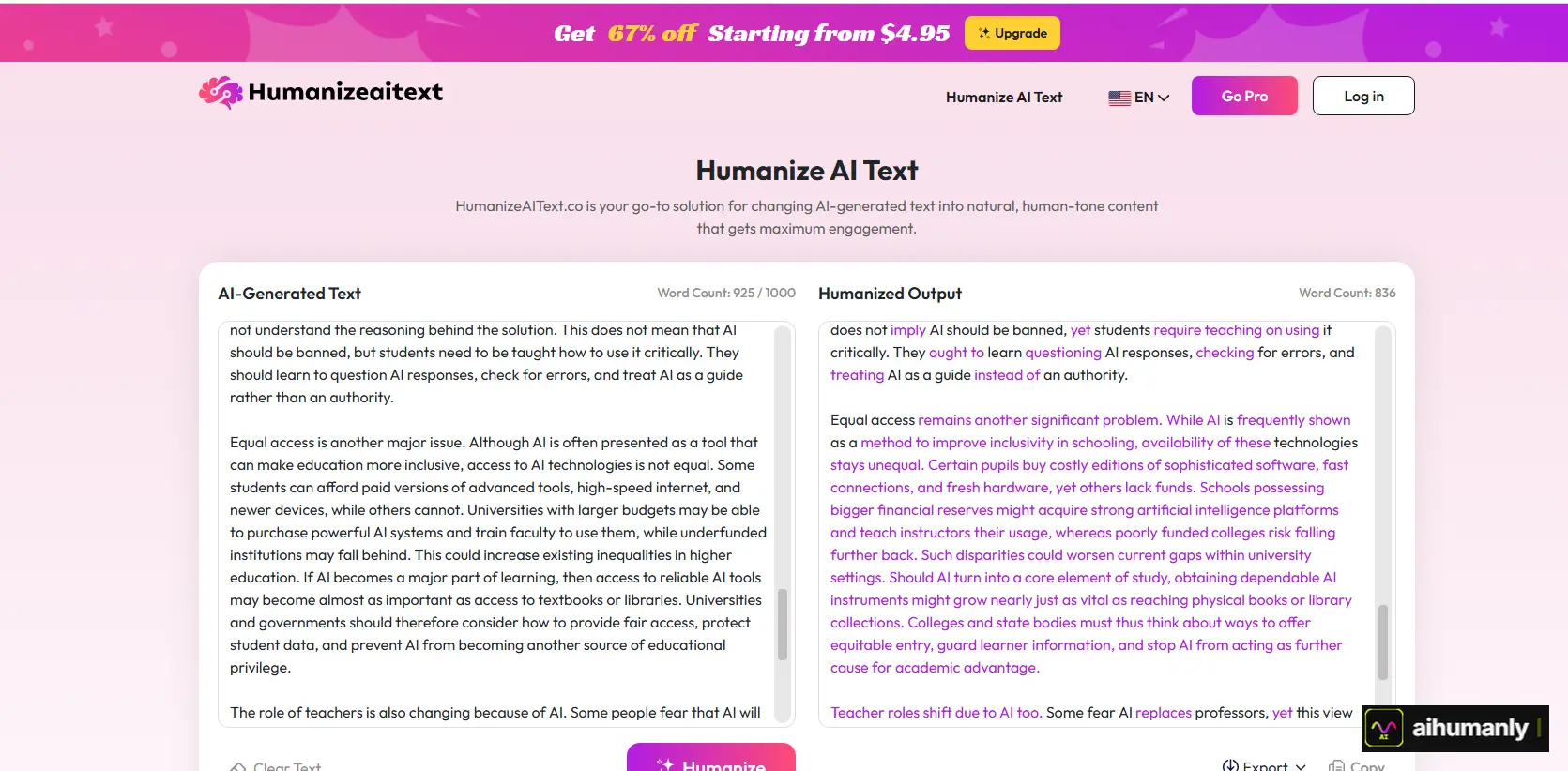
Website: humanizeaitext.co
HumanizeAIText focuses specifically on converting AI-generated text into human-readable content. The interface is simple and direct, with minimal configuration options.
Grammarly AI Humanizer
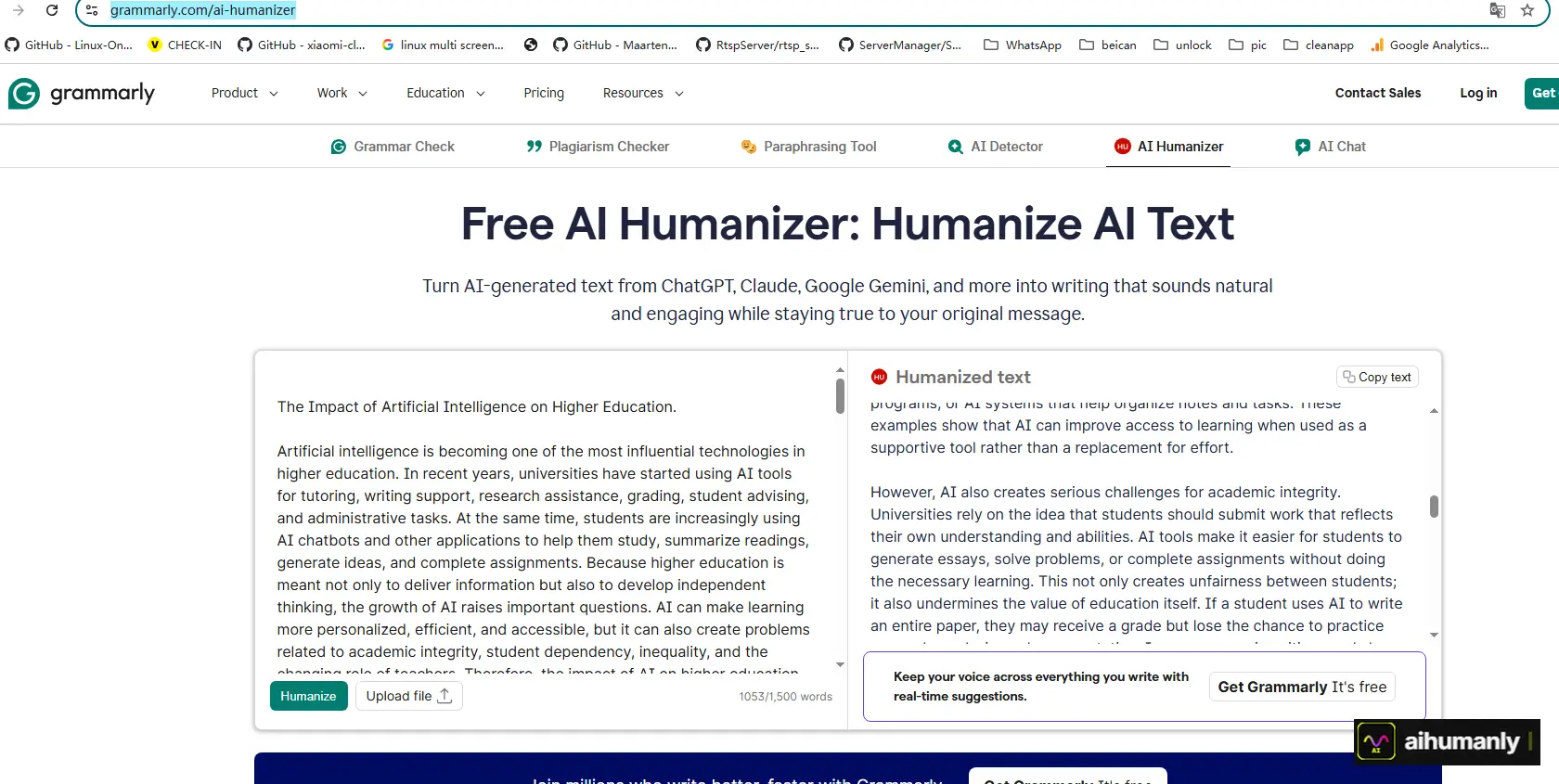
Website: grammarly.com/ai-humanizer
Grammarly needs no introduction — it's one of the most widely used writing tools globally. Their AI Humanizer is a newer feature that aims to reduce AI detection signals in text. Given Grammarly's reputation for writing quality, we were curious to see how their humanizer would perform.
Test Methodology
Source Texts
Essay 1: "The Impact of Artificial Intelligence on Higher Education"
- Generated by: GPT-5.5
- Type: Academic argumentative essay (~1,500 words)
- Topics: Personalized learning, academic integrity, student dependency, equal access, teacher roles
Essay 2: "The Role of Renewable Energy Policy in Accelerating Sustainable Economic Development"
- Generated by: Claude Opus 4.8
- Type: Research discussion (~1,200 words)
- Topics: Private investment, technological innovation, labor markets, energy security, policy limitations
AI Detectors Used
We tested every humanized output against six AI detectors:
- GPTZero — One of the most popular AI detectors, widely used in education
- ZeroGPT — Free AI detection tool
- Originality.ai — Premium AI detector, popular with publishers
- Winston AI — AI detection tool used by educators
- QuillBot AI Detector — Detector from the popular writing tool
- Copyleaks — Enterprise-grade AI and plagiarism detection
Pass/Fail Criteria
- Pass: Detector identifies the text as primarily "Human" (AI score below typical detection threshold)
- Fail: Detector identifies the text as primarily "AI" (AI score above detection threshold)
Test Results: Essay 1 — "The Impact of AI on Higher Education"
CleverHumanizer Results (Essay 1)
| Detector | Result | AI Score | Verdict |
|---|---|---|---|
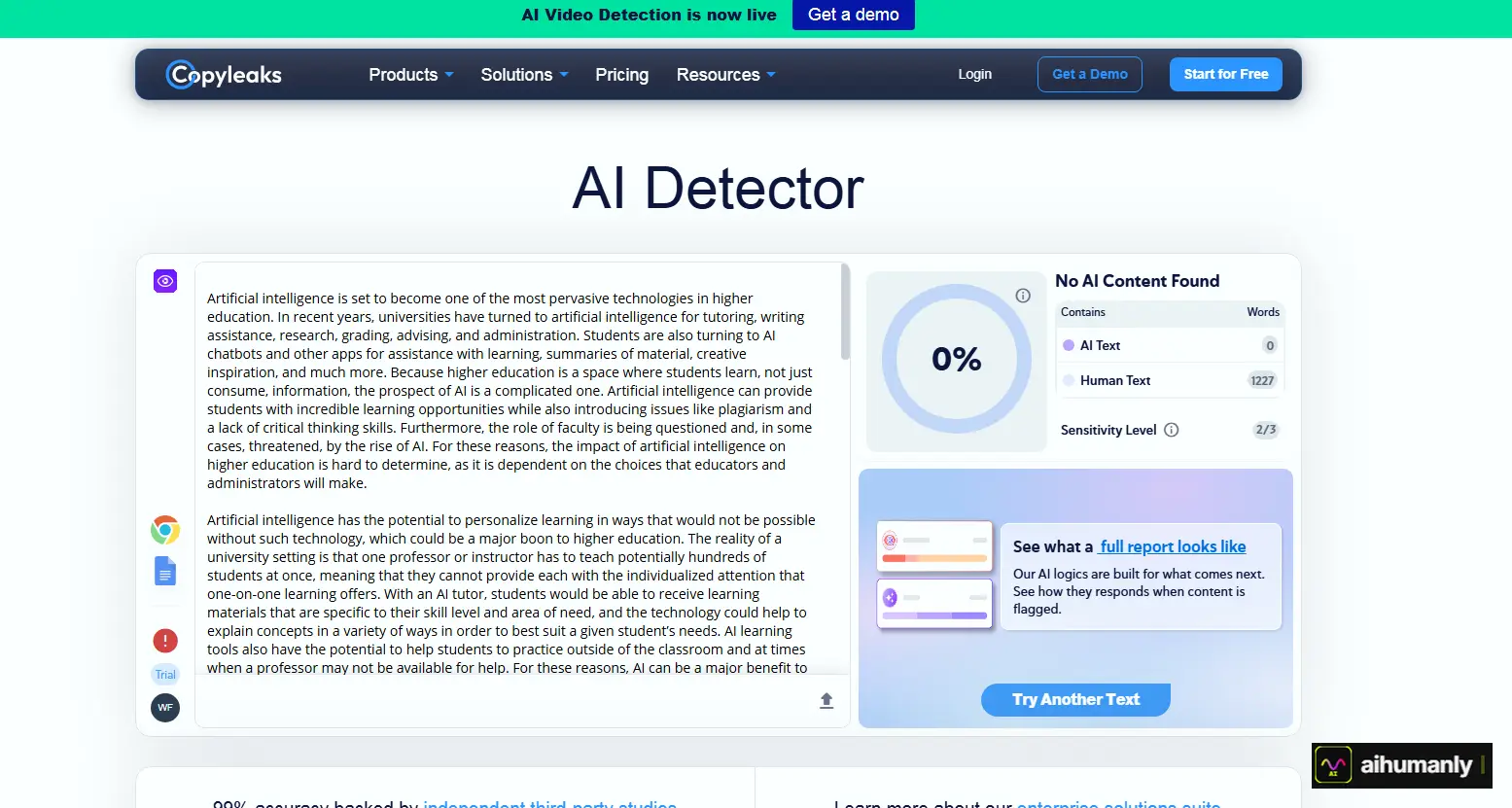
| GPTZero | Human | 0% AI | ✅ Pass |
| ZeroGPT | Human | 29% AI | ✅ Pass |
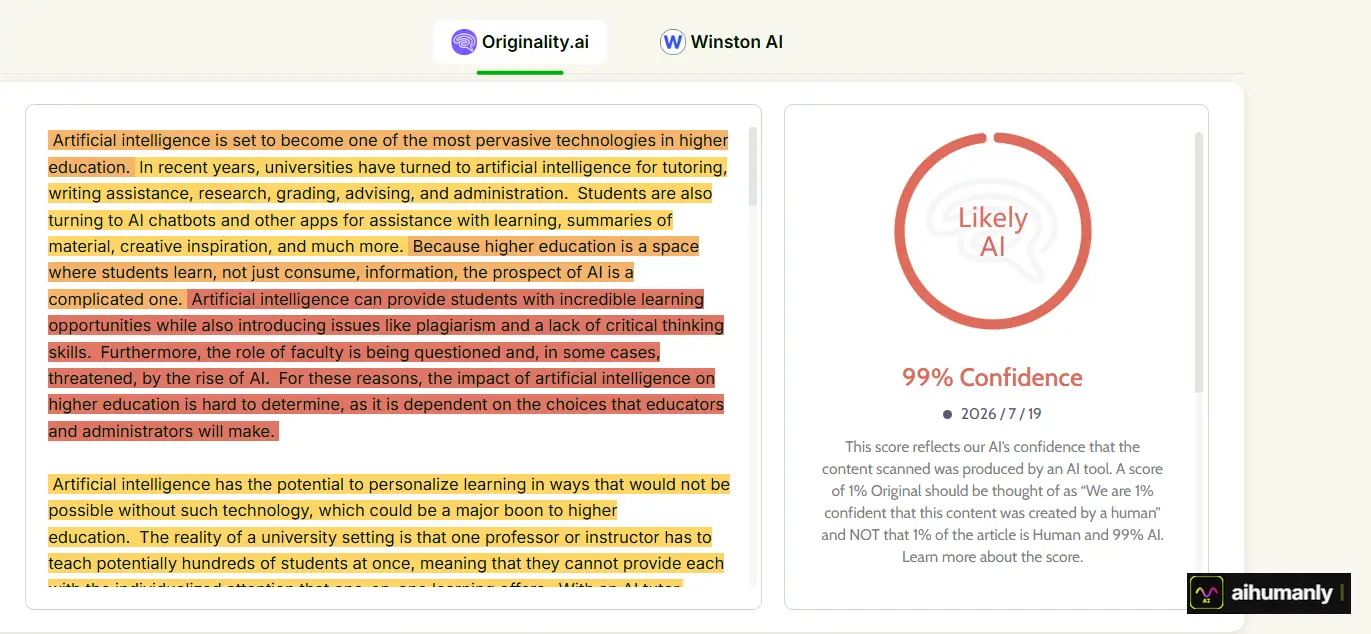
| Originality.ai | AI | 99% AI | ❌ Fail |
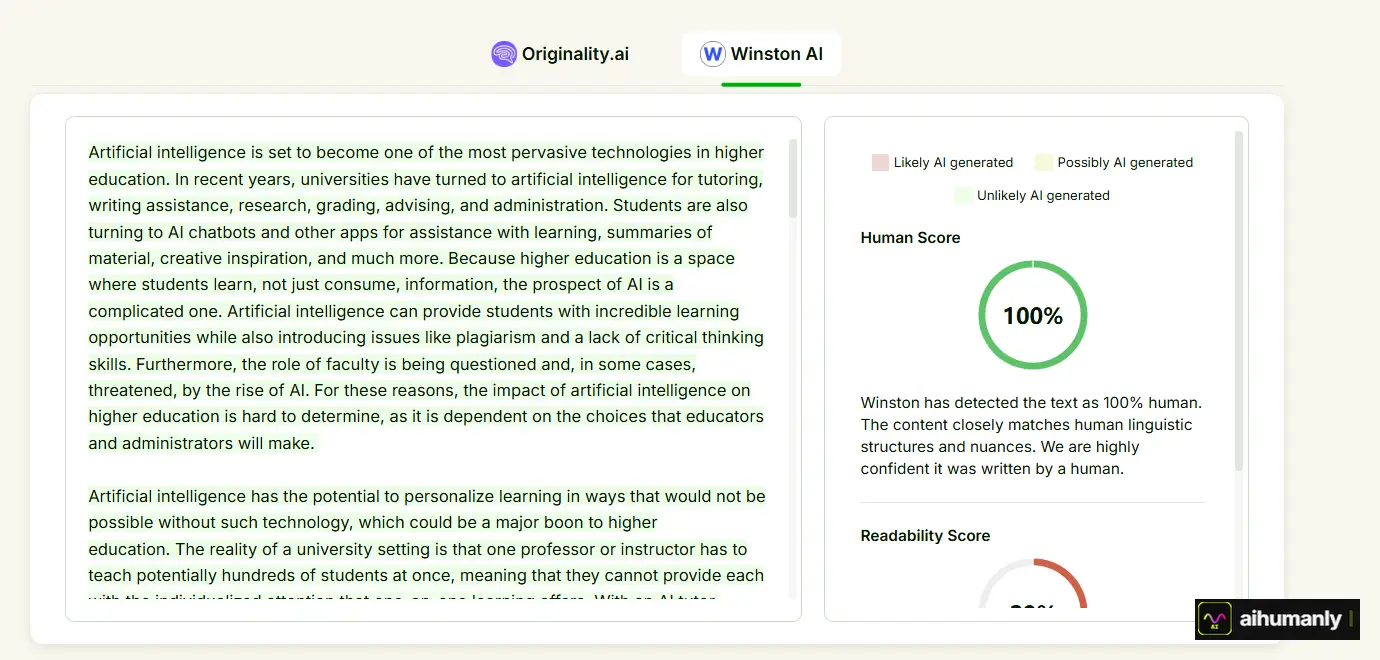
| Winston AI | Human | 0% AI | ✅ Pass |
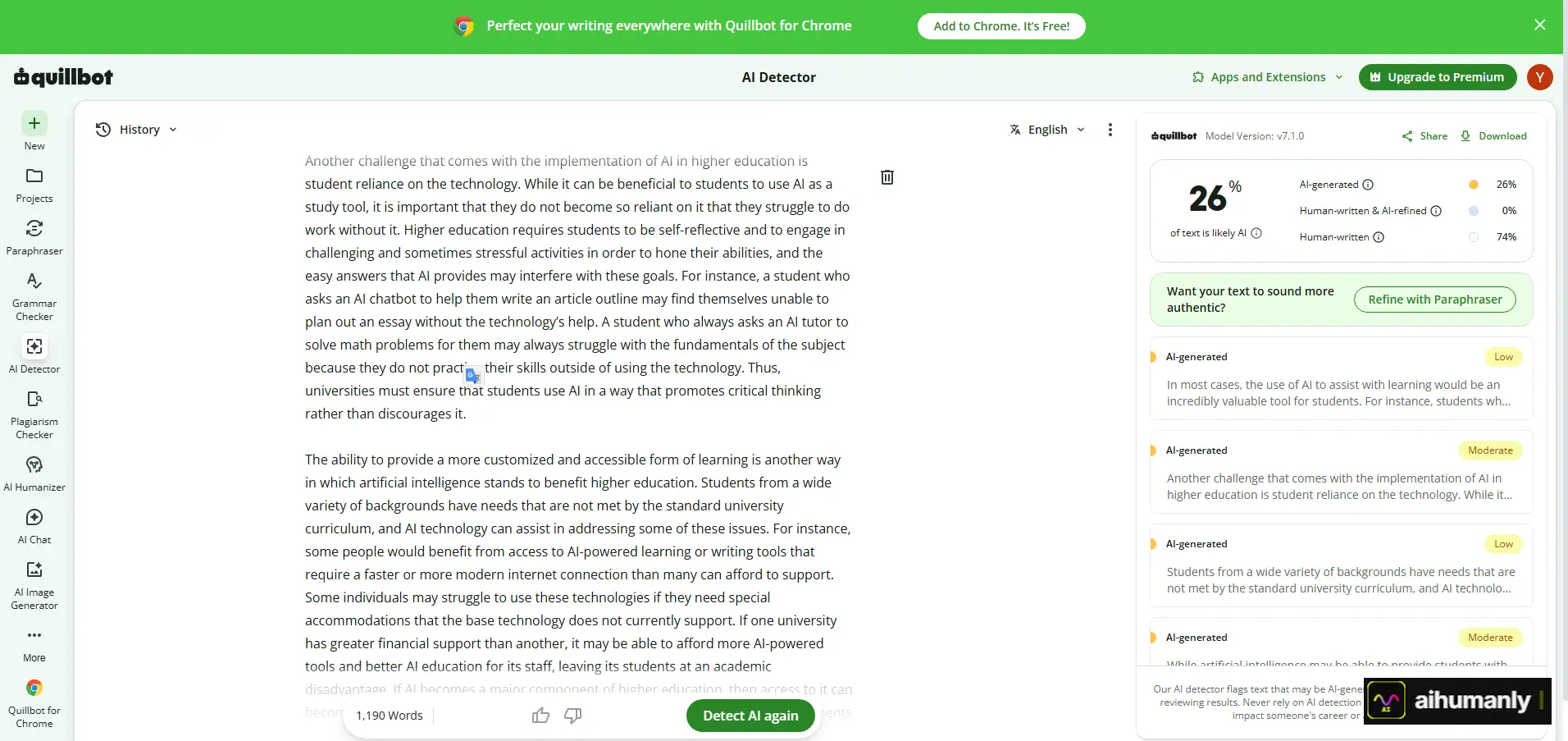
| QuillBot | Human | 26% AI | ✅ Pass |
| Copyleaks | Human | 0% AI | ✅ Pass |
Score: 5/6 passed
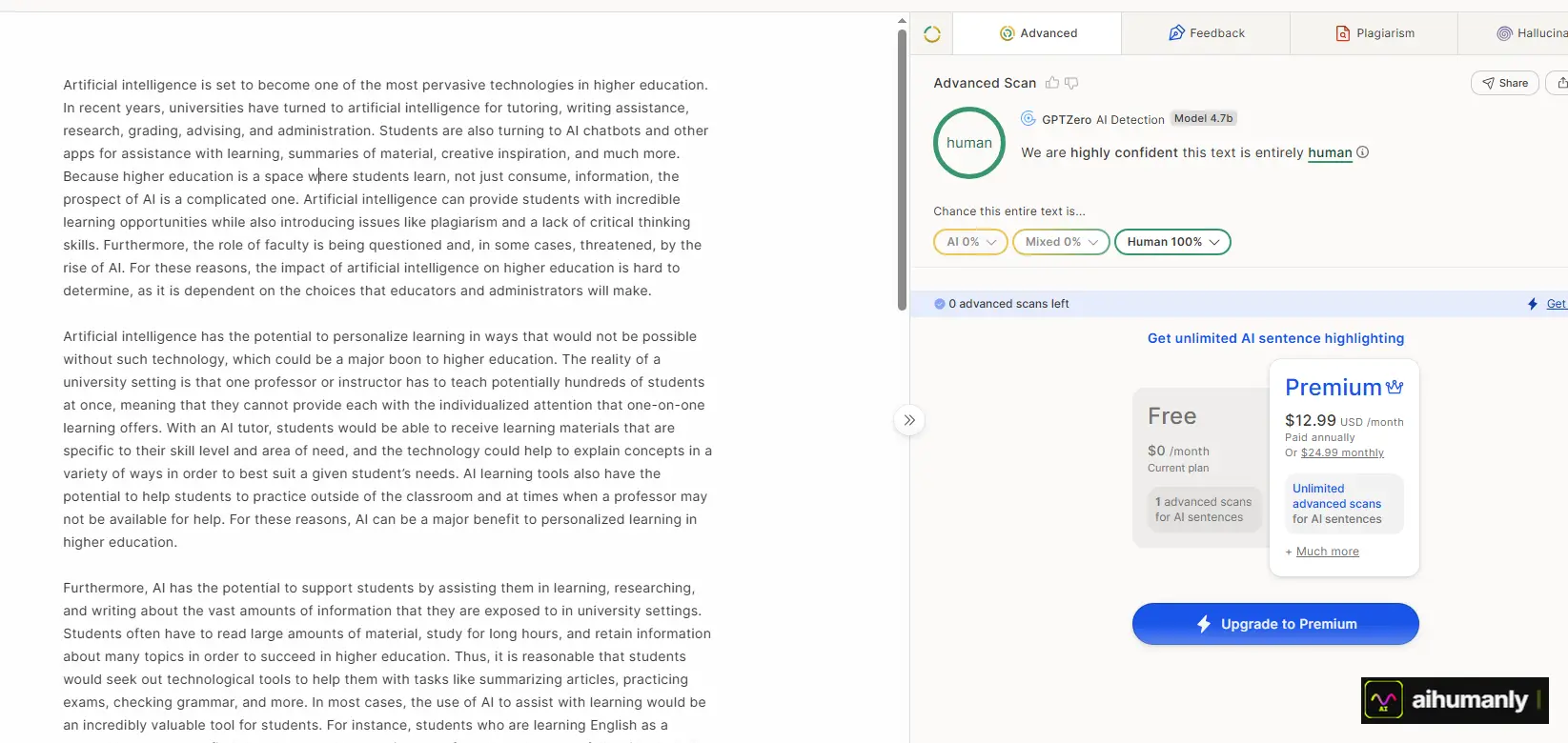
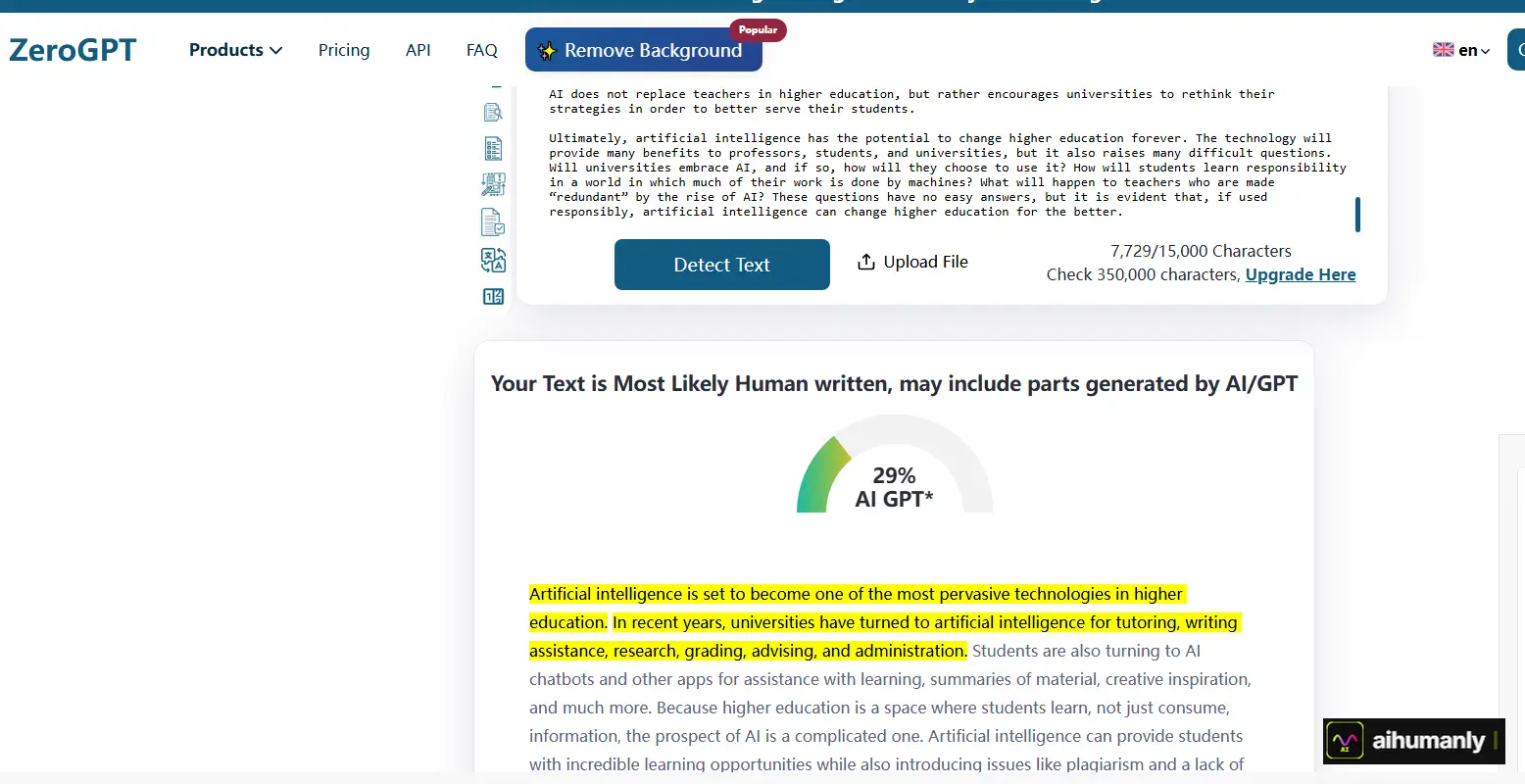
CleverHumanizer performed impressively on Essay 1. Five out of six detectors classified the text as human-written. Only Originality.ai still detected it as AI (99%), which shows that Originality.ai has particularly sophisticated detection algorithms.
HumanizeAIText Results (Essay 1)
| Detector | Result | AI Score | Verdict |
|---|---|---|---|
| GPTZero | Human | 45% AI | ✅ Pass |
| ZeroGPT | Human | 15.2% AI | ✅ Pass |
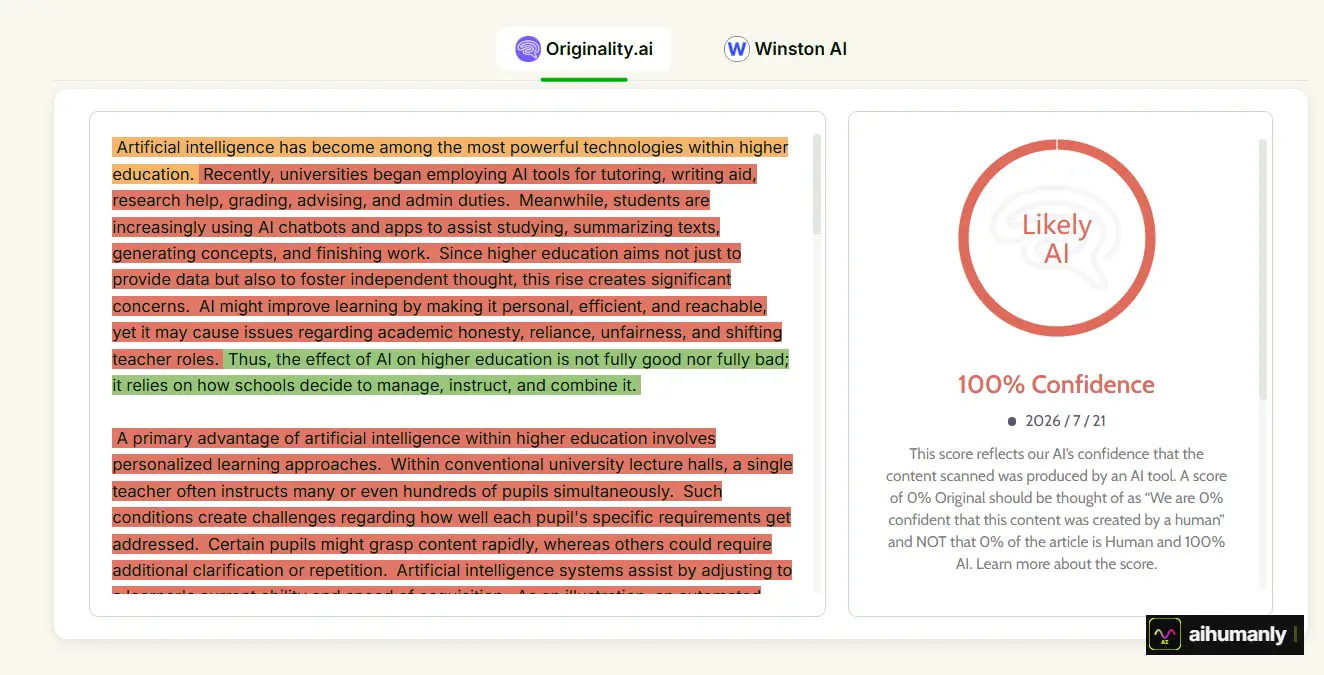
| Originality.ai | AI | 100% AI | ❌ Fail |
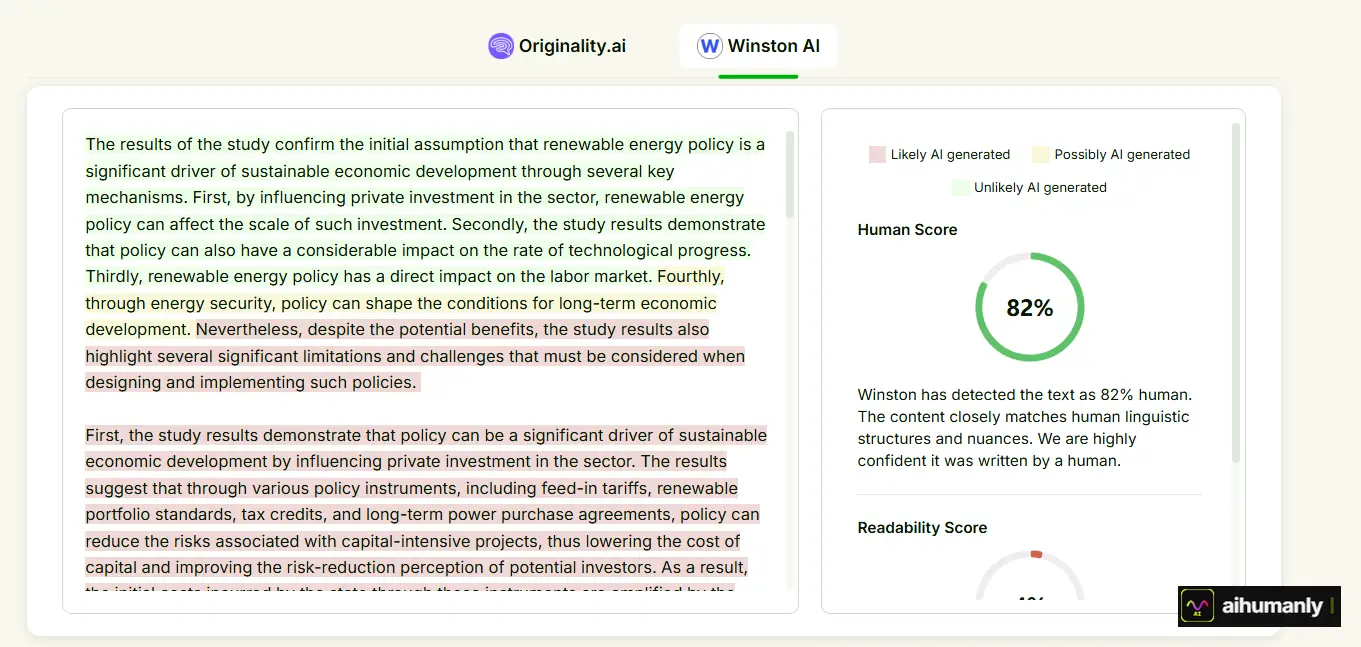
| Winston AI | AI | 100% AI | ❌ Fail |
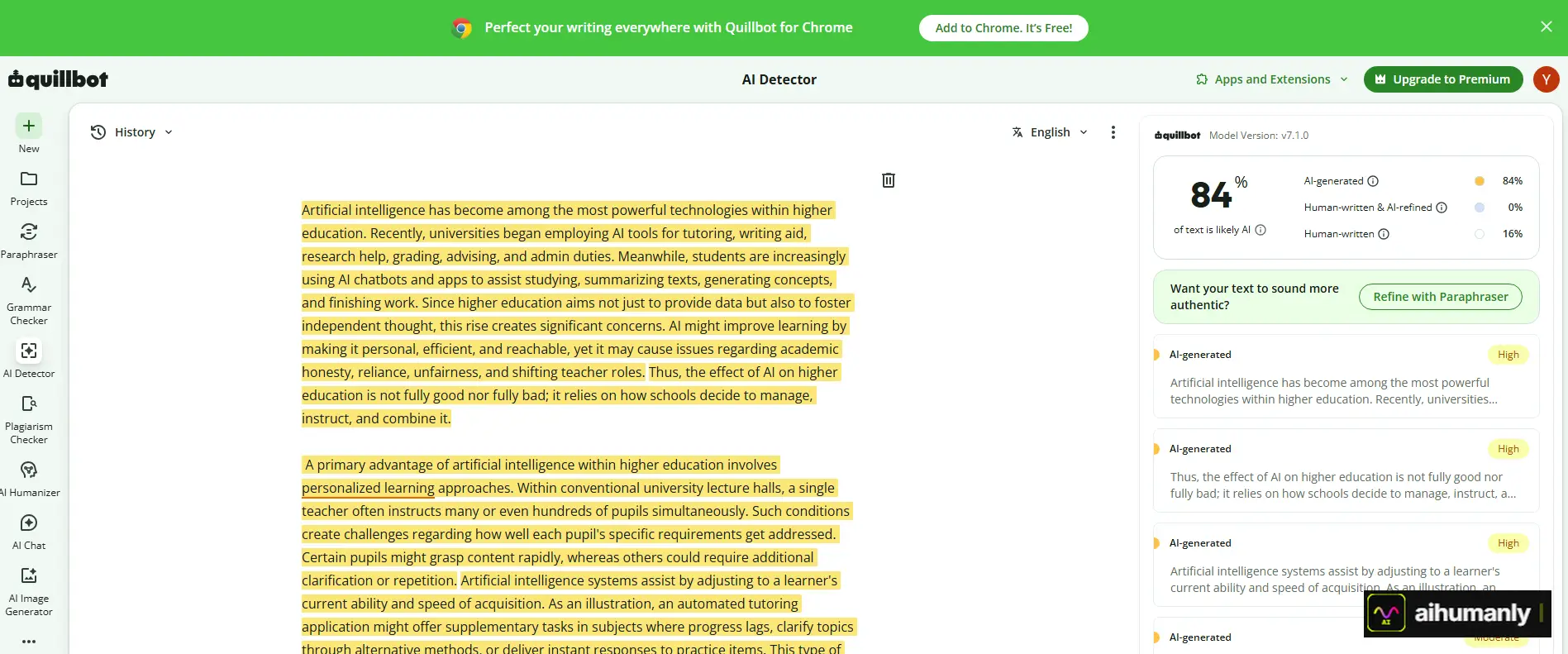
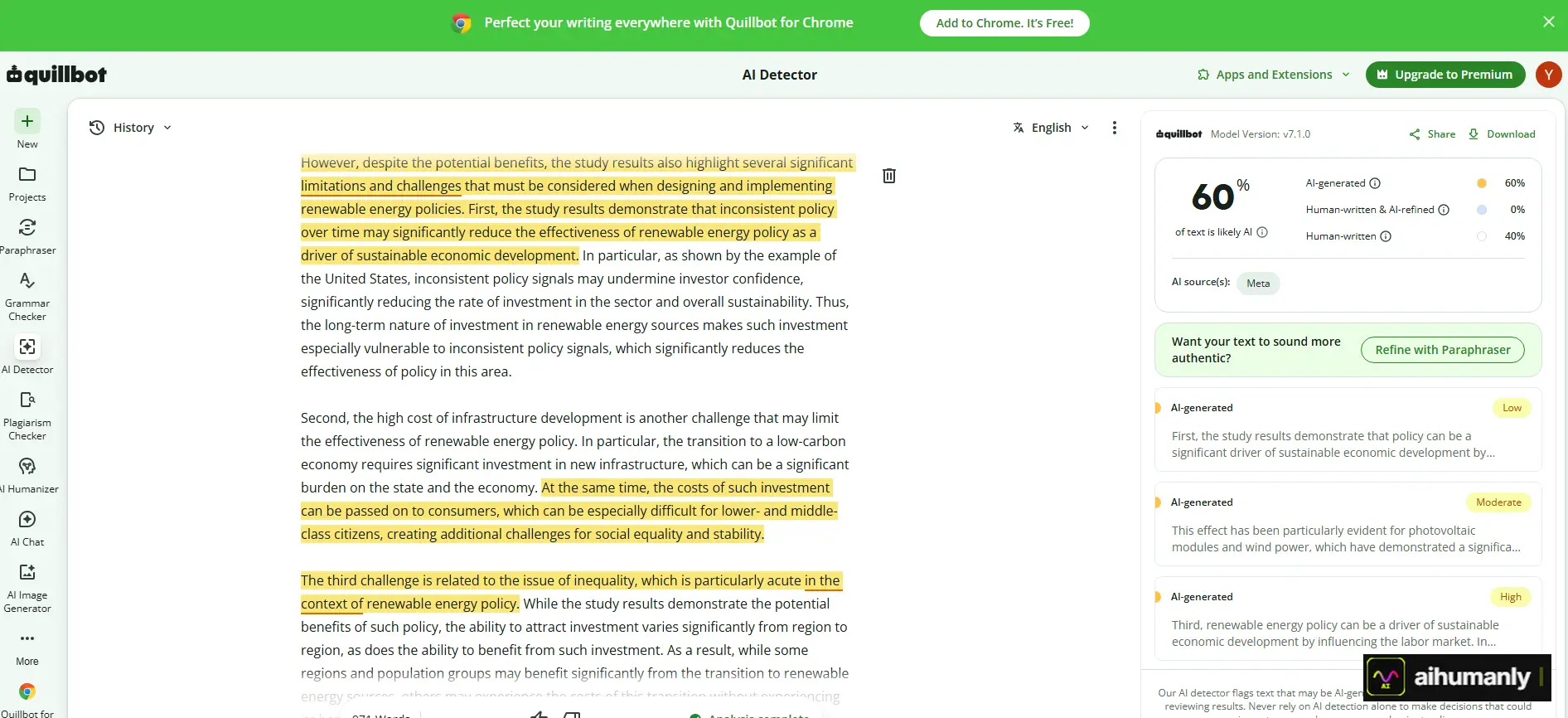
| QuillBot | AI | 84% AI | ❌ Fail |
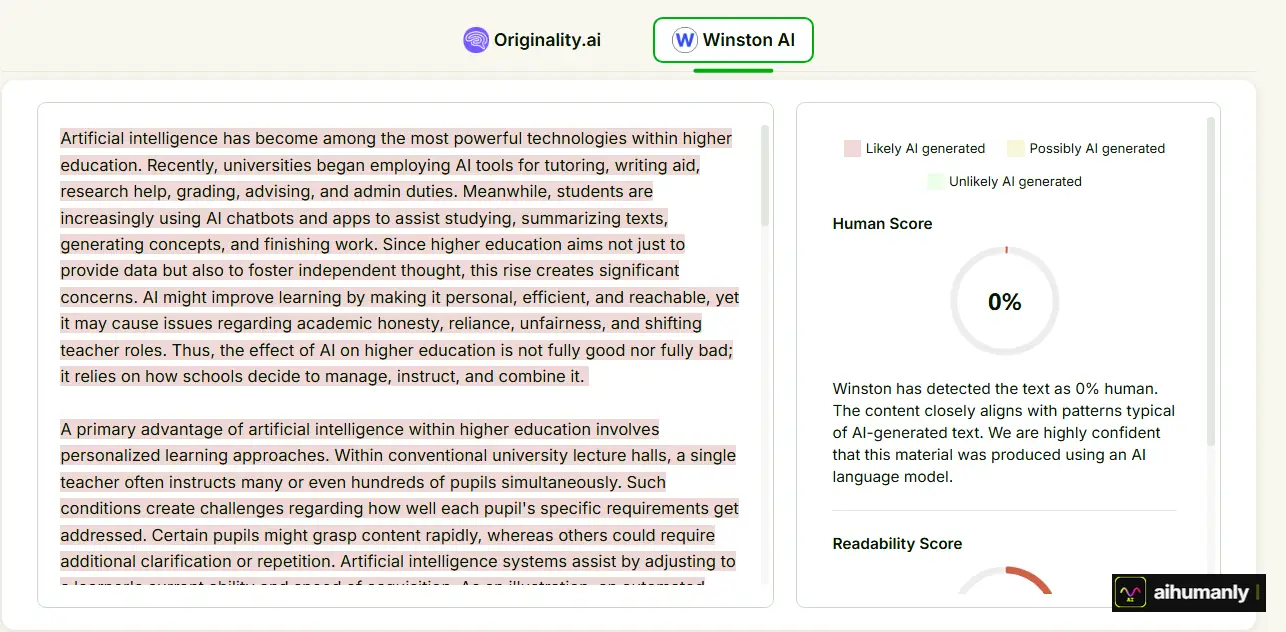
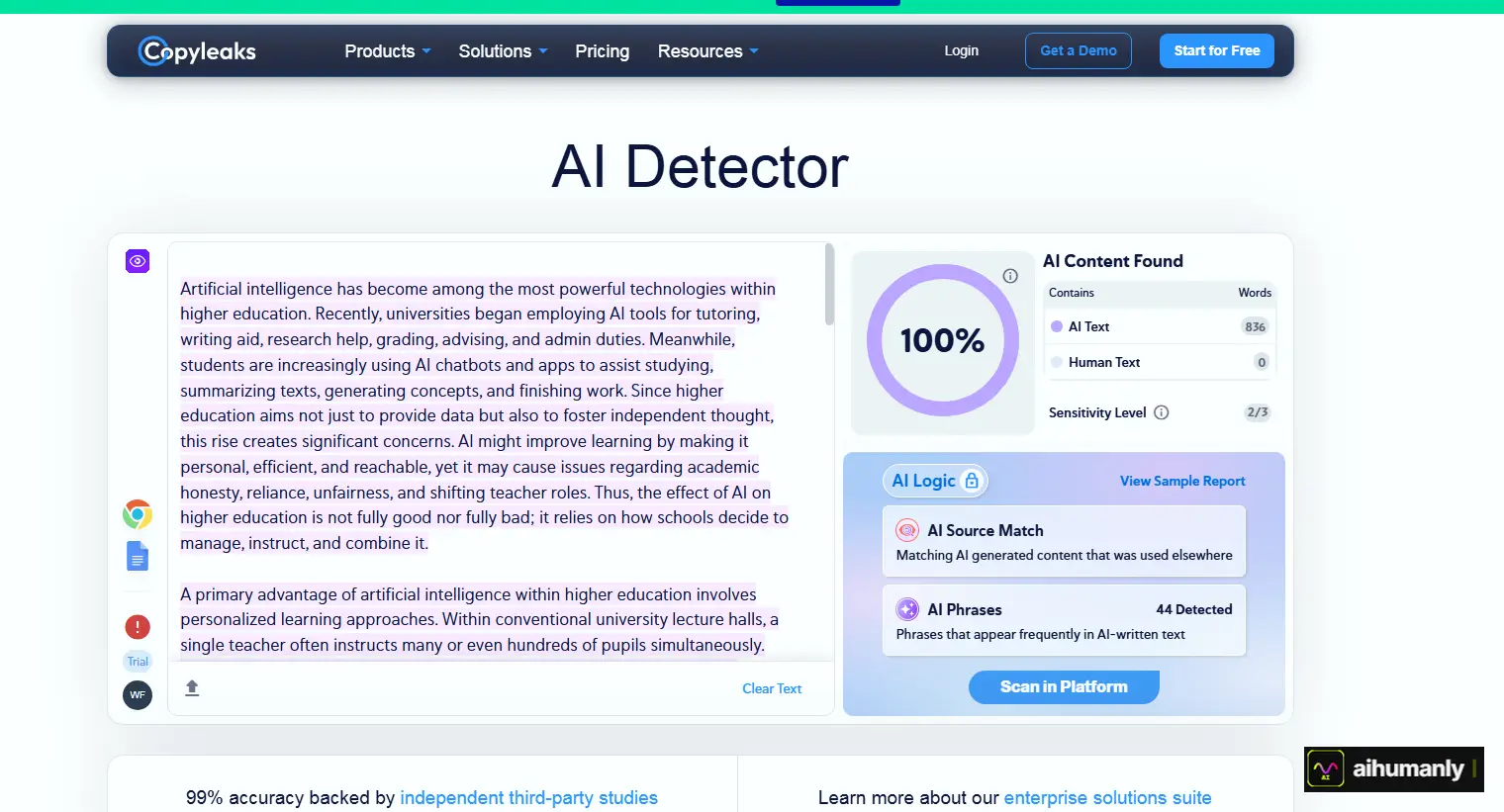
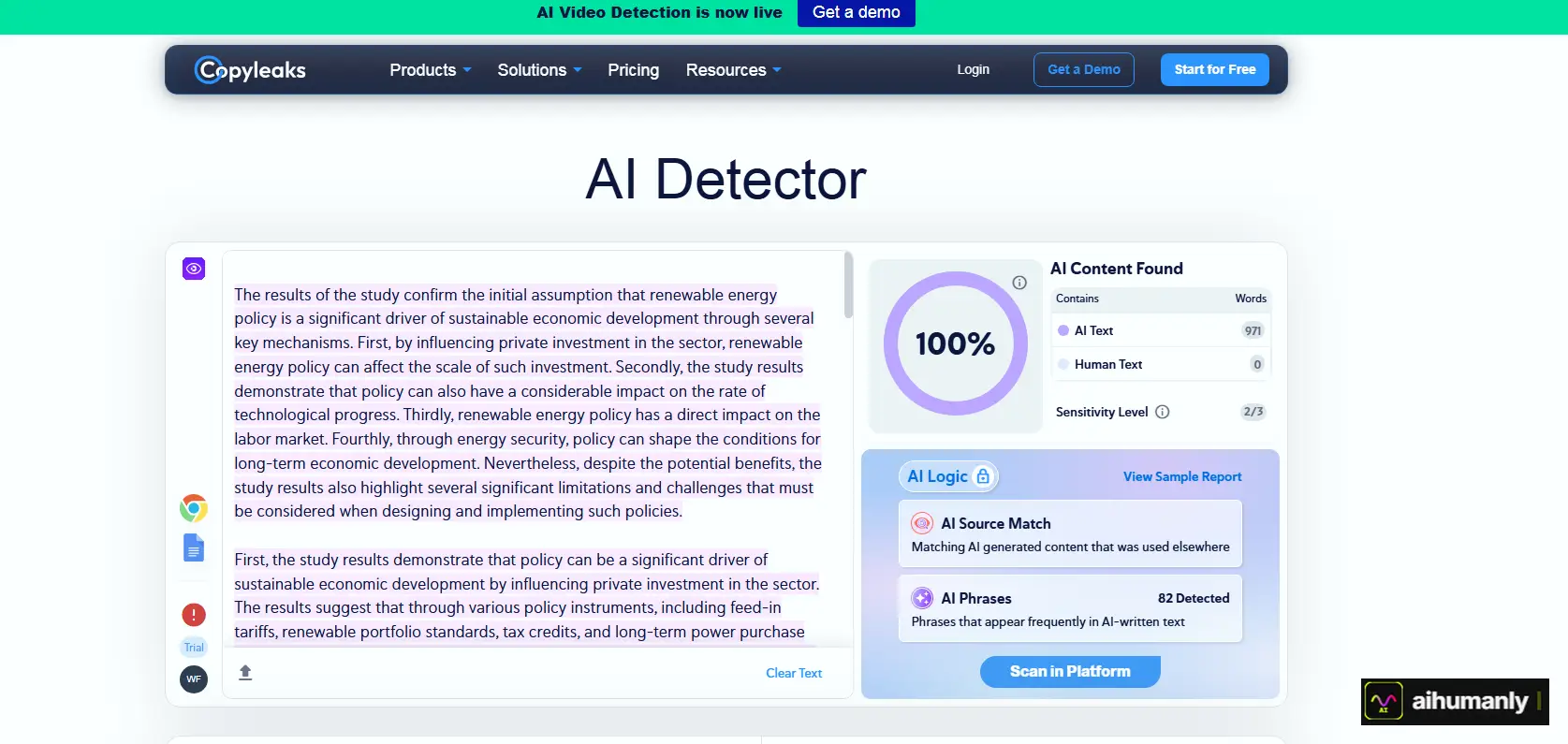
| Copyleaks | AI | 100% AI | ❌ Fail |
Score: 2/6 passed (GPTZero and ZeroGPT classified as Human)
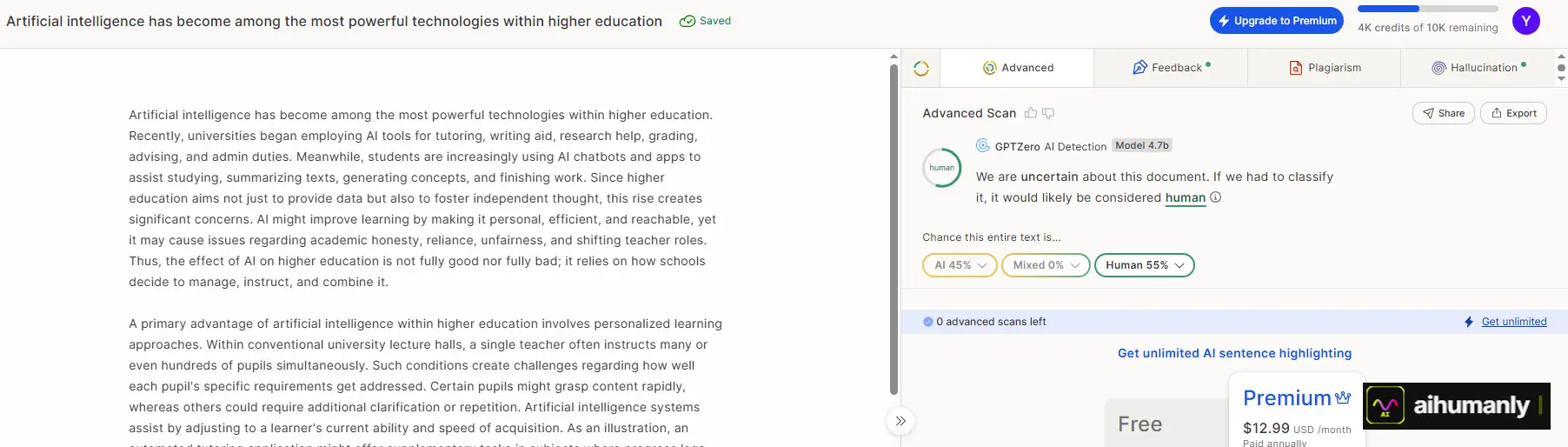
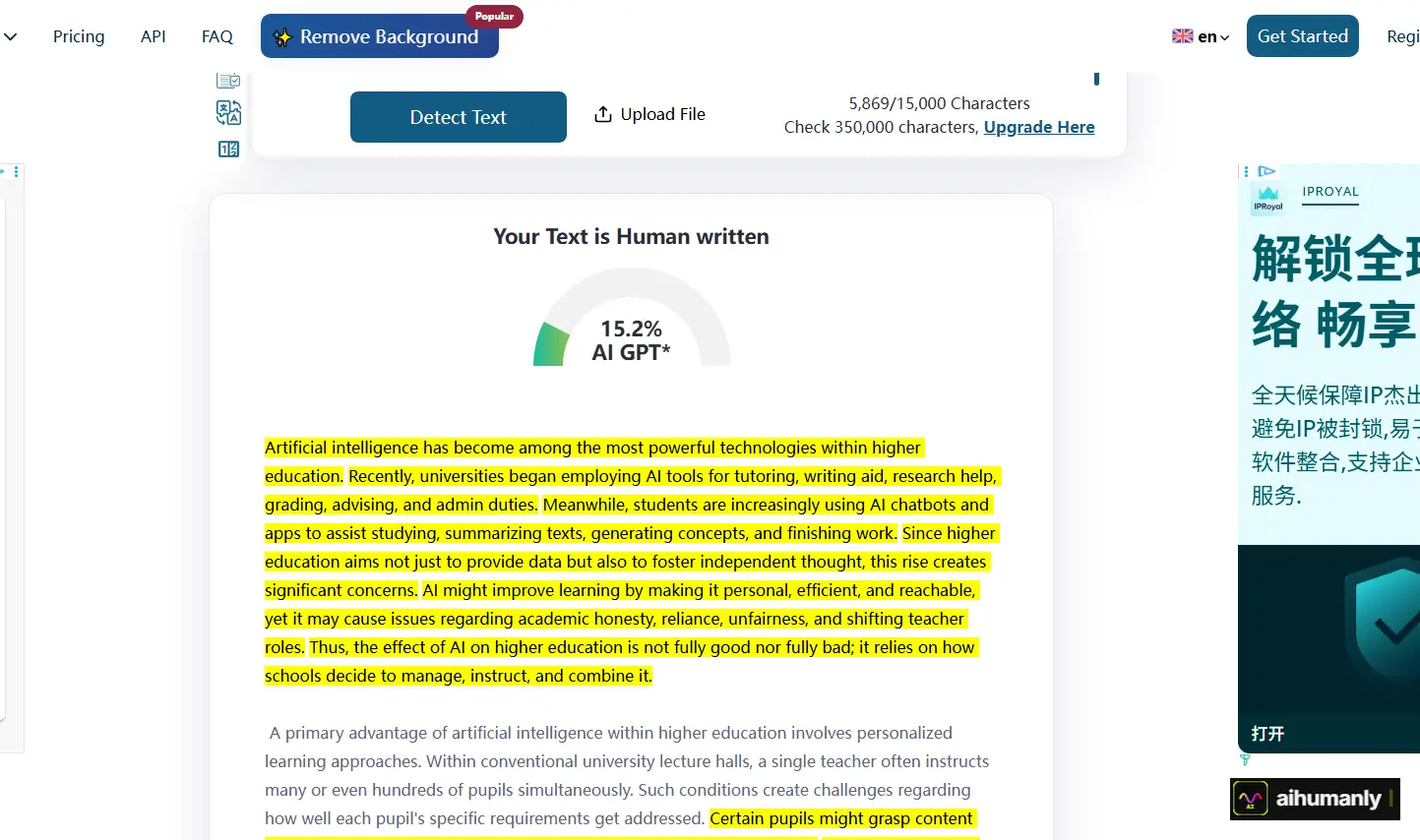
HumanizeAIText managed to pass GPTZero (45% AI) and ZeroGPT (15.2% AI), but failed against the other four detectors. Originality.ai, Winston AI, QuillBot, and Copyleaks all identified the text as AI-generated with high confidence (84-100%).
Grammarly AI Humanizer Results (Essay 1)
| Detector | Result | AI Score | Verdict |
|---|---|---|---|
| GPTZero | AI | 100% AI | ❌ Fail |
| ZeroGPT | AI | 99.5% AI | ❌ Fail |
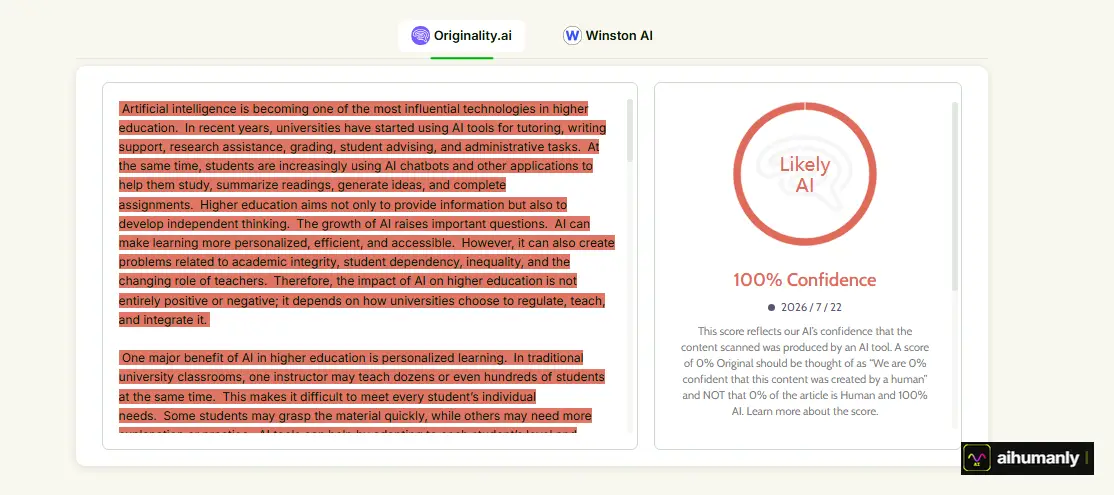
| Originality.ai | AI | 100% AI | ❌ Fail |
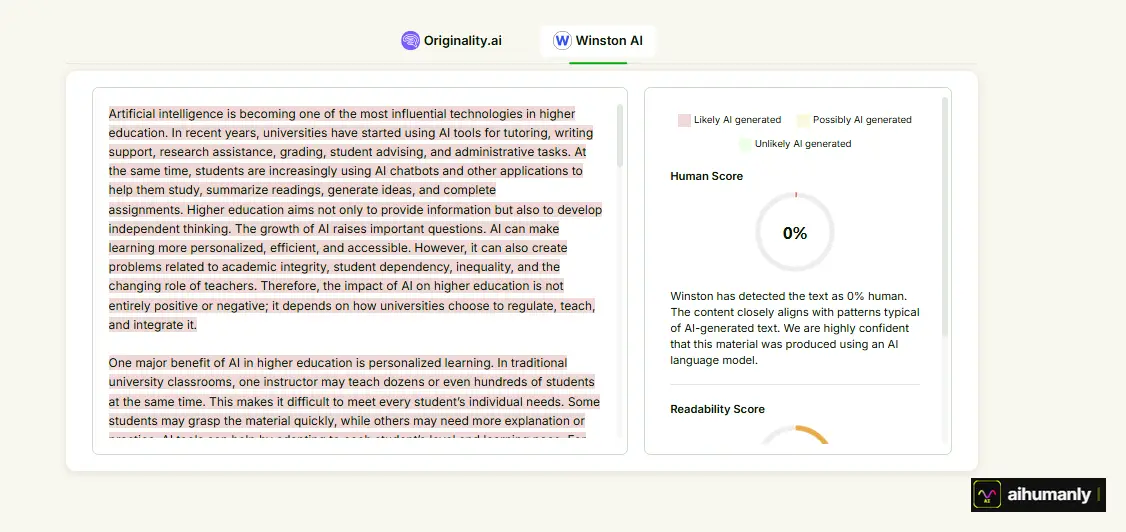
| Winston AI | AI | 100% AI | ❌ Fail |
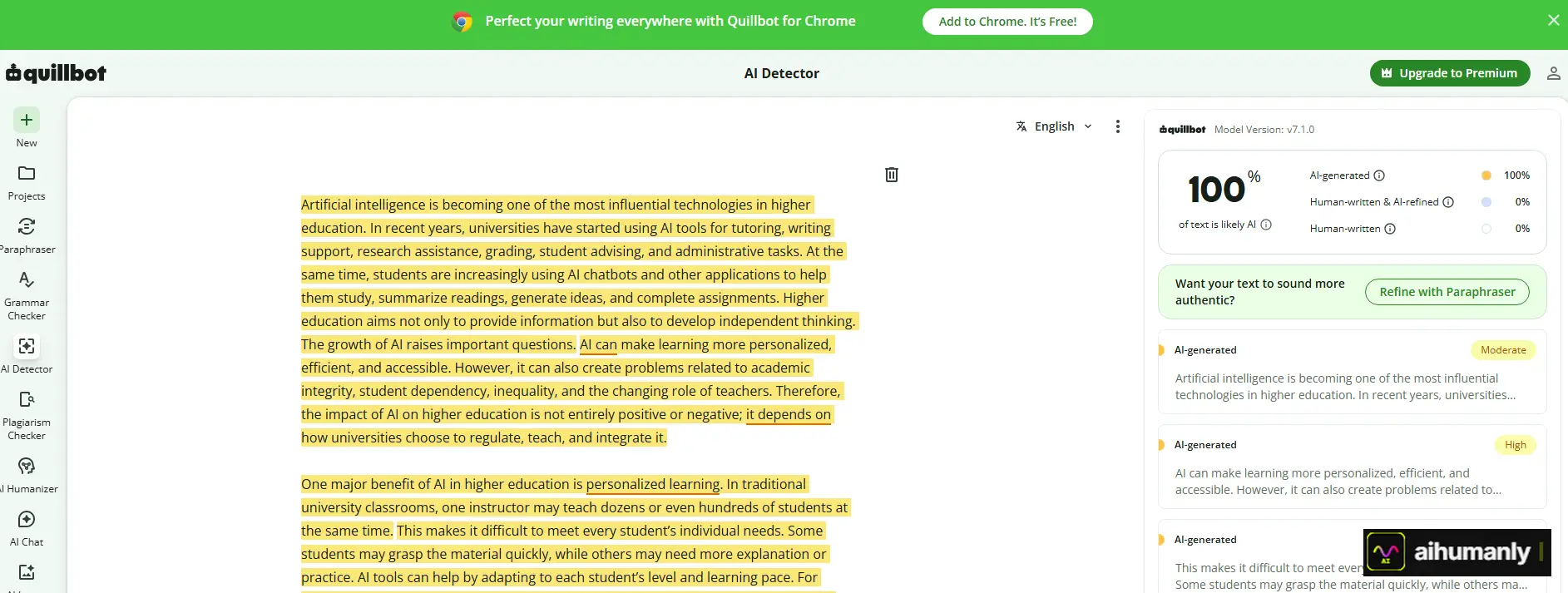
| QuillBot | AI | 100% AI | ❌ Fail |
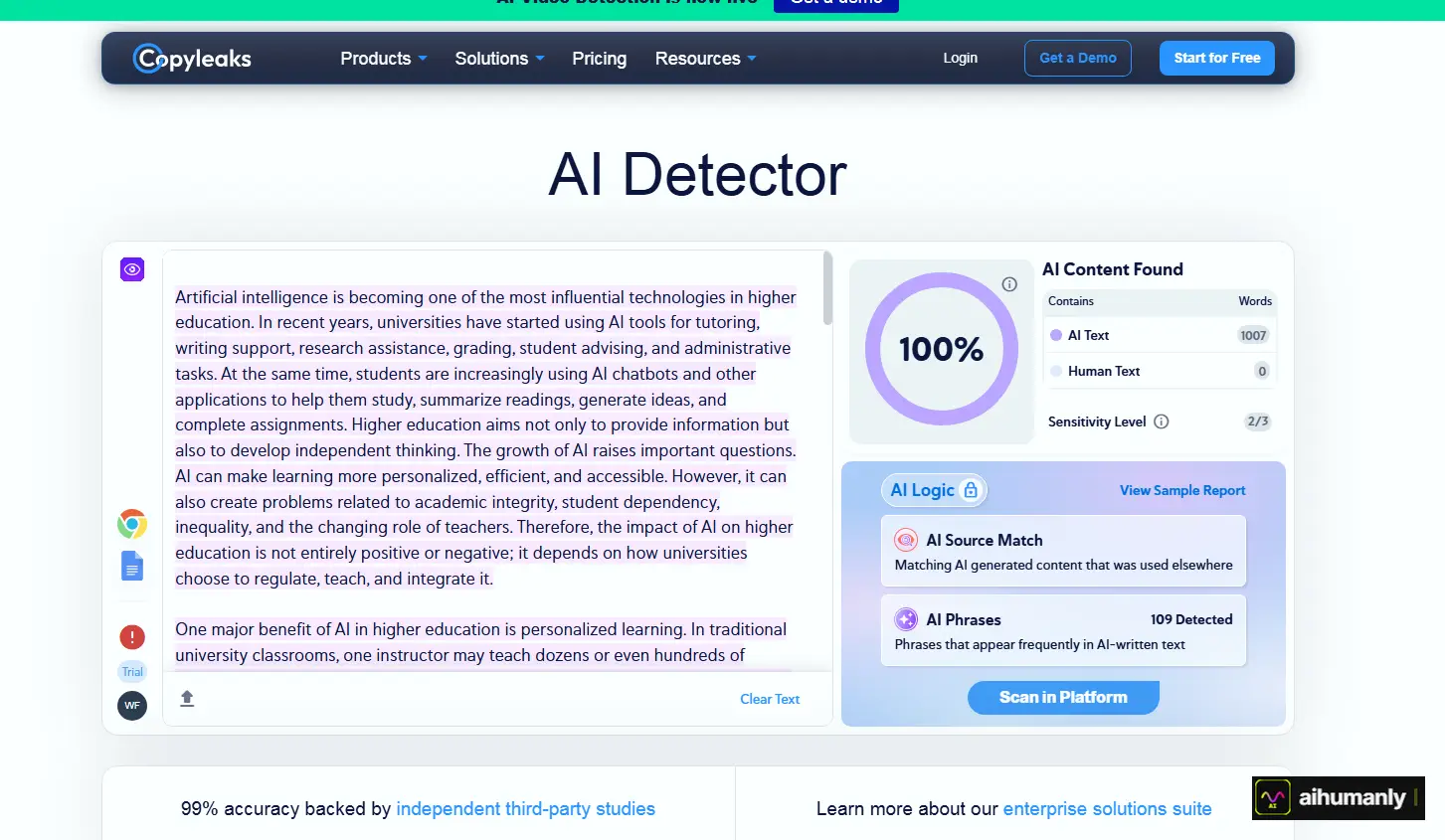
| Copyleaks | AI | 100% AI | ❌ Fail |
Score: 0/6 passed
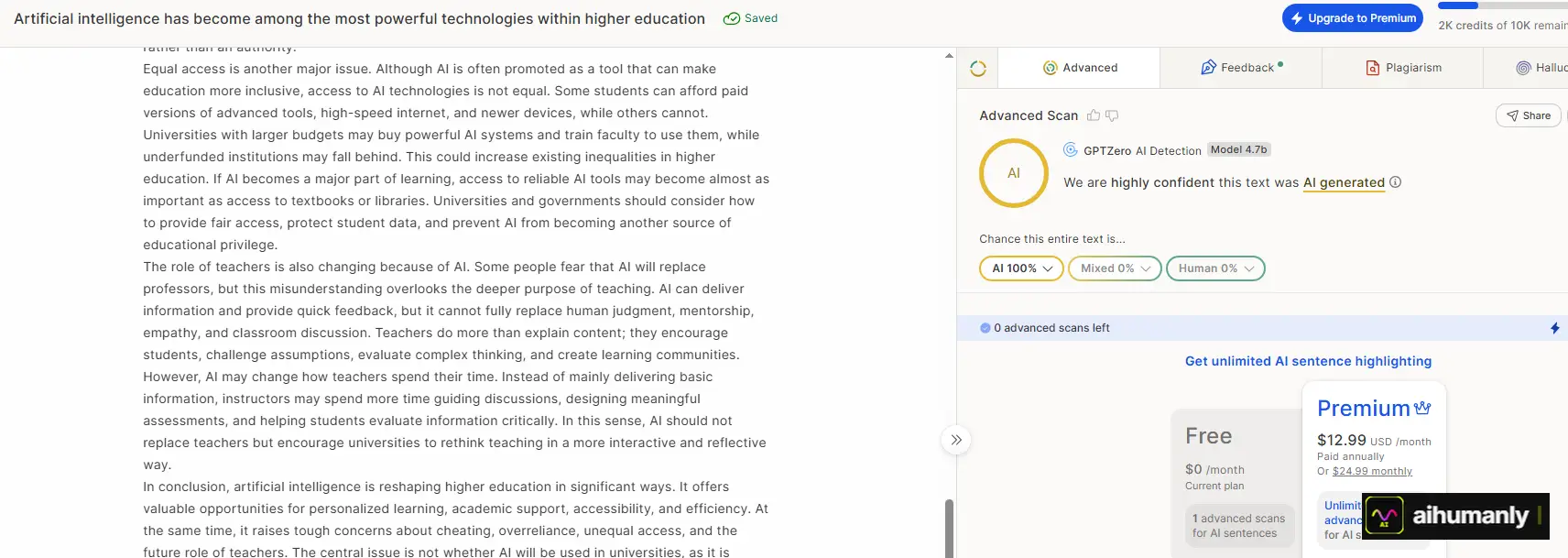
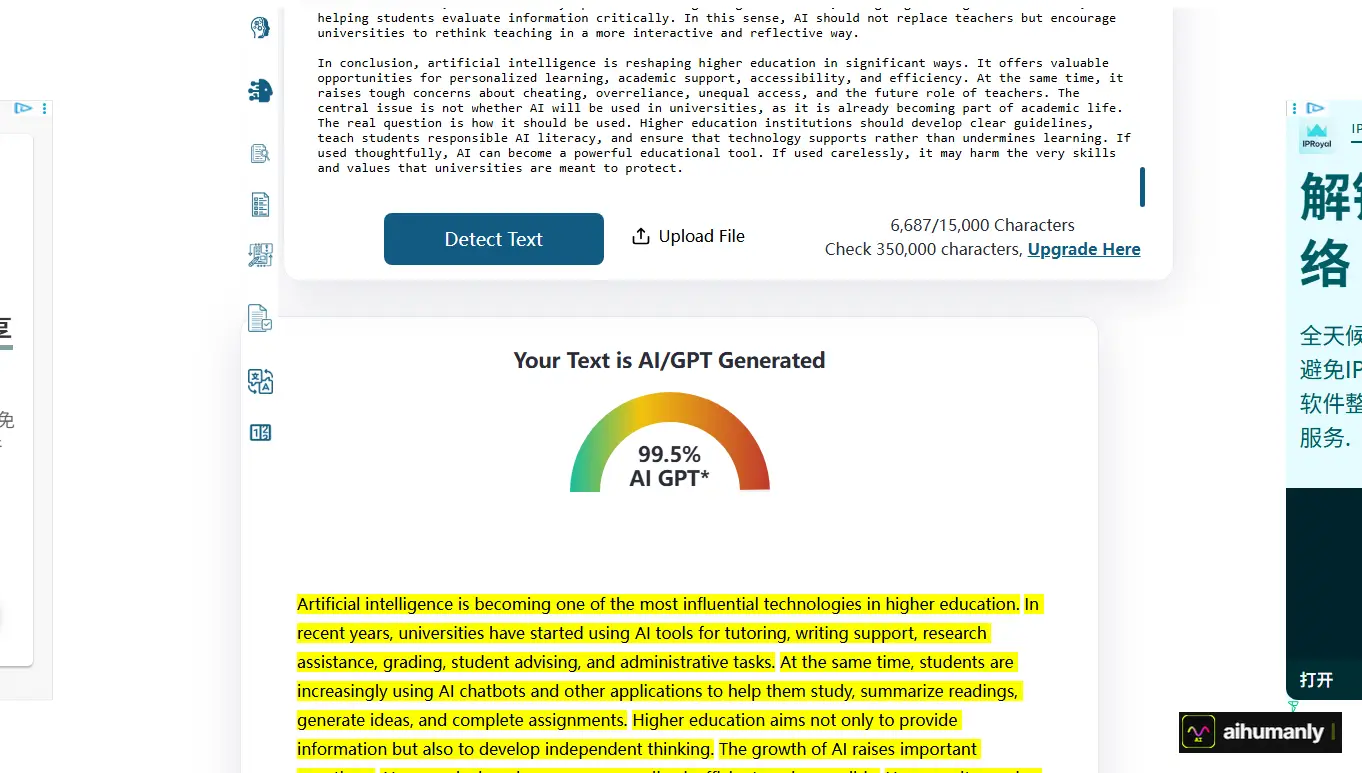
Grammarly's AI Humanizer was a clear disappointment. Looking at the output text, Grammarly barely changed the original AI content — it made minor wording adjustments but kept the same sentence structures and patterns. Every detector except Winston AI flagged it as 100% AI.
Test Results: Essay 2 — "The Role of Renewable Energy Policy"
Essay 2 was more challenging for all tools. This text was generated by Claude Opus 4.8 and uses sophisticated academic language with complex sentence structures — exactly the kind of writing that AI detectors are designed to catch.
CleverHumanizer Results (Essay 2)
| Detector | Result | AI Score | Verdict |
|---|---|---|---|
| GPTZero | AI | 100% AI | ❌ Fail |
| ZeroGPT | Human | 0% AI | ✅ Pass |
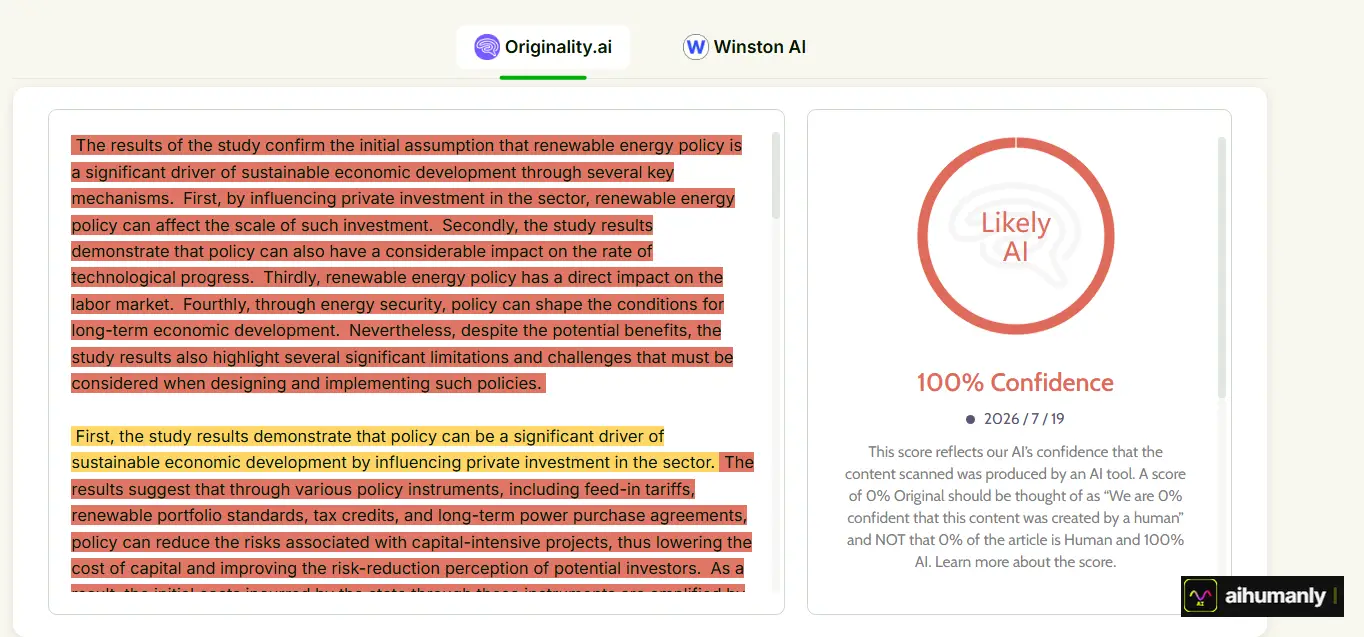
| Originality.ai | AI | 100% AI | ❌ Fail |
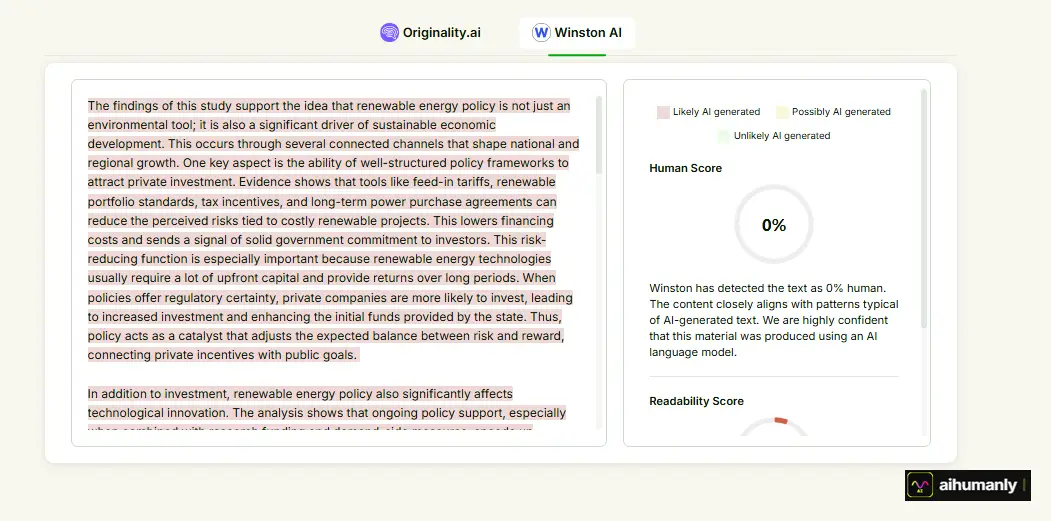
| Winston AI | Human | 18% AI | ✅ Pass |
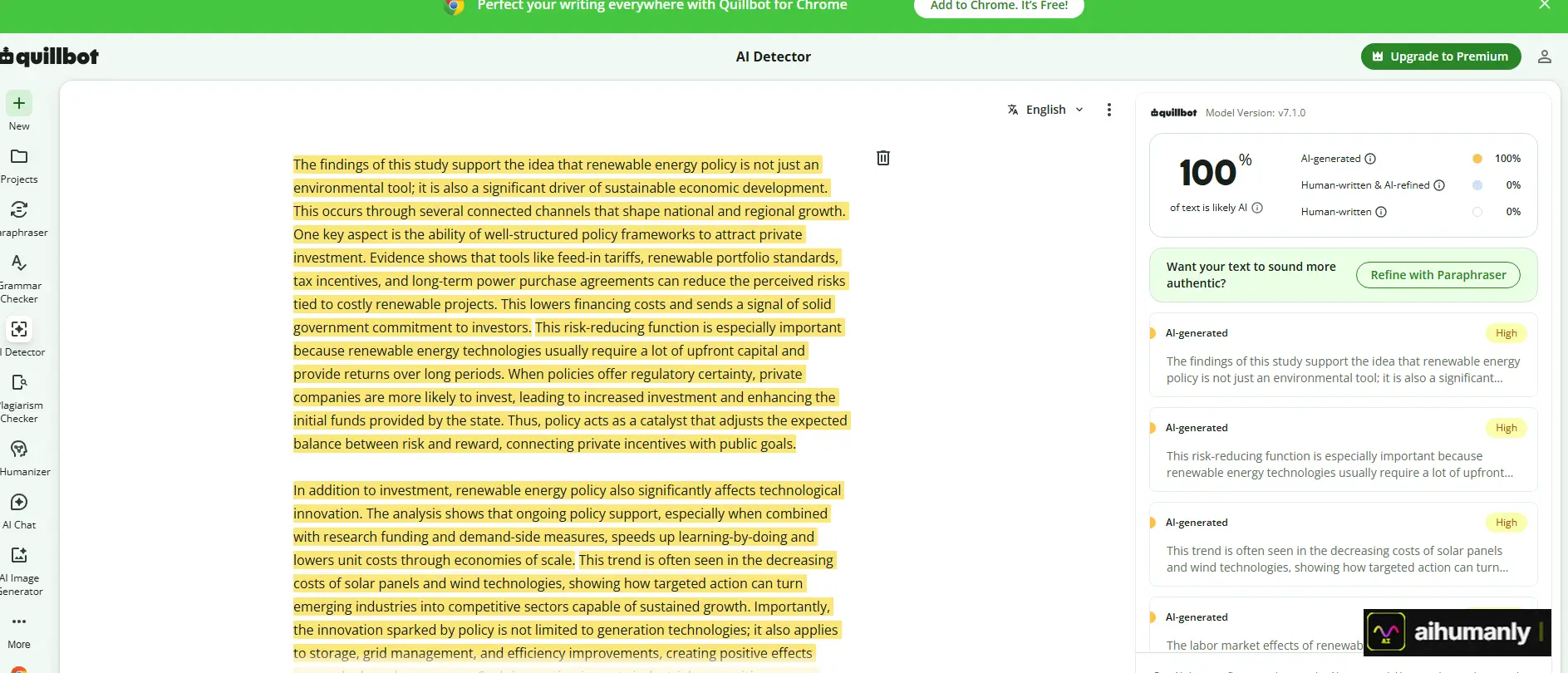
| QuillBot | AI | 60% AI | ❌ Fail |
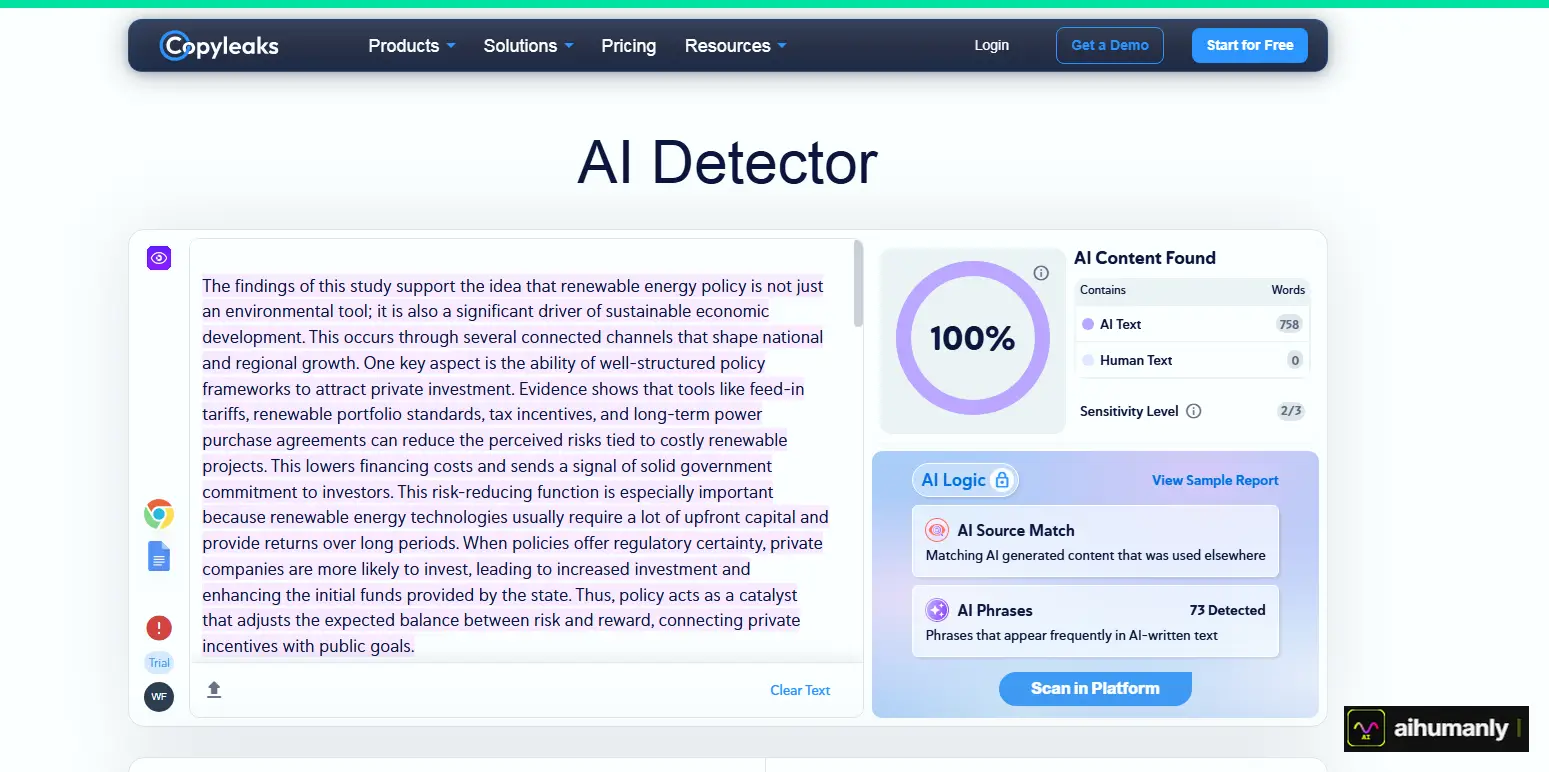
| Copyleaks | AI | 100% AI | ❌ Fail |
Score: 2/6 passed
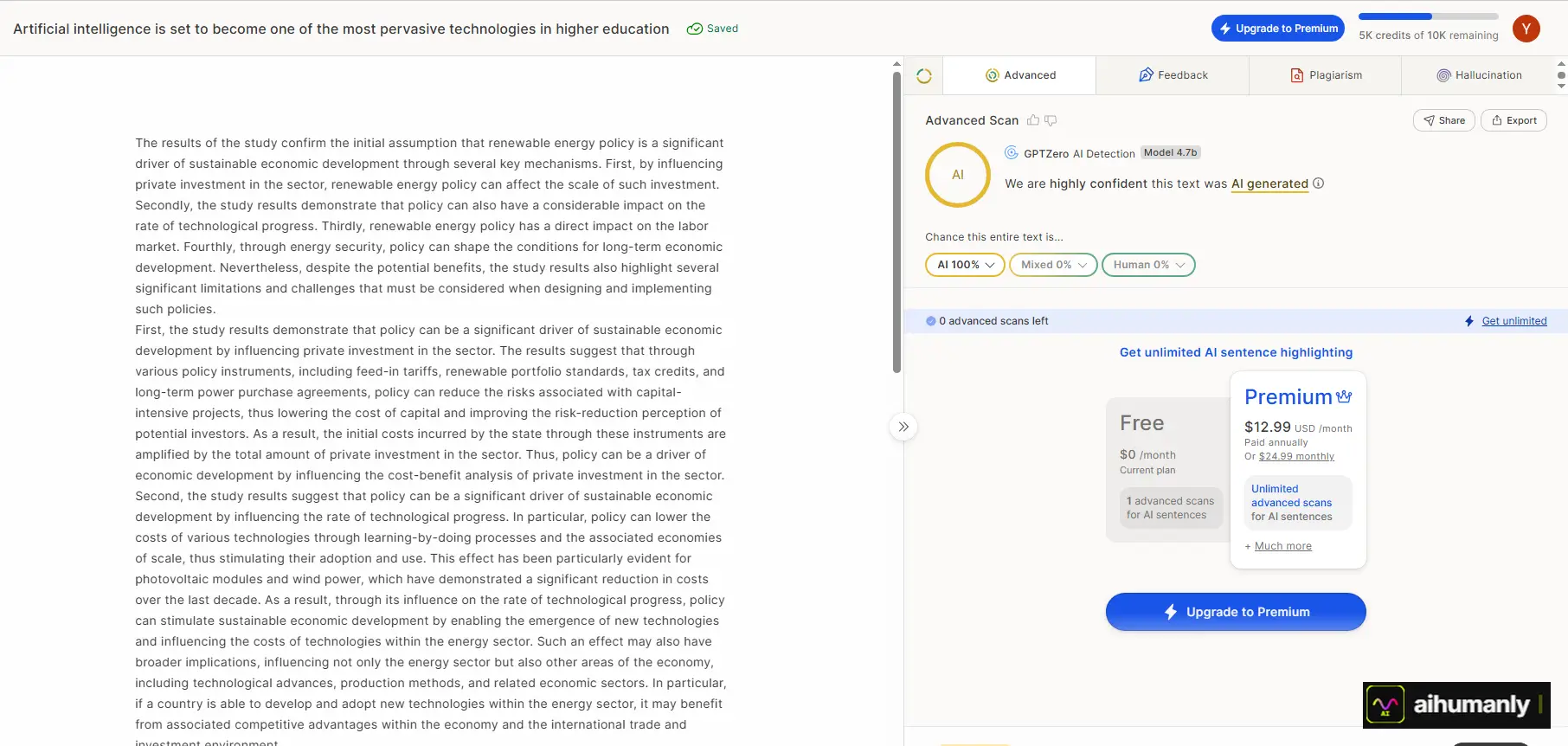
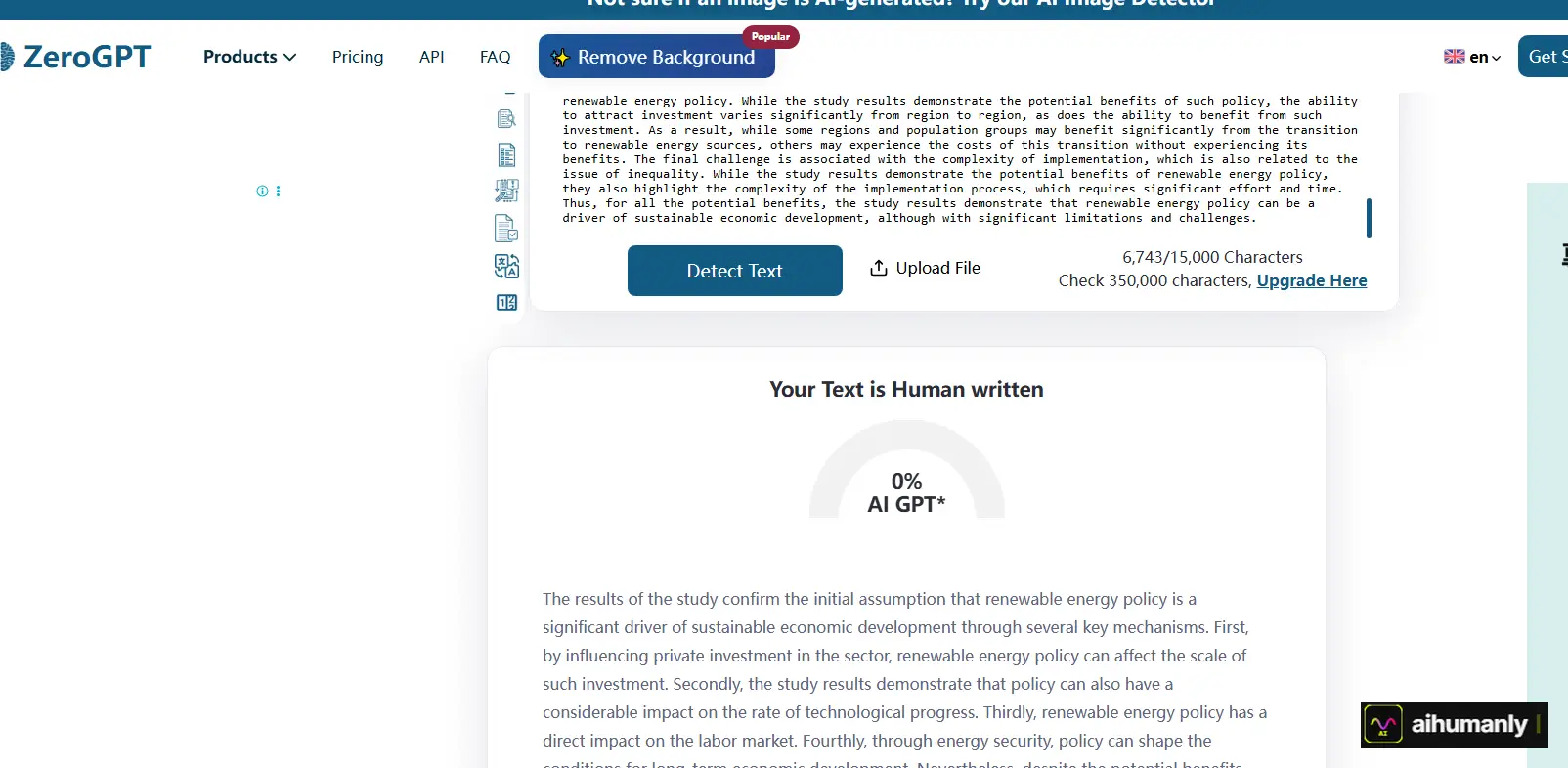
On the more challenging Essay 2, CleverHumanizer's performance dropped. It still passed ZeroGPT (0% AI) and Winston AI (18% AI), but GPTZero, Originality.ai, QuillBot, and Copyleaks all detected the text as AI-generated.
HumanizeAIText Results (Essay 2)
| Detector | Result | AI Score | Verdict |
|---|---|---|---|
| GPTZero | AI | 100% AI | ❌ Fail |
| ZeroGPT | Human | 0% AI | ✅ Pass |
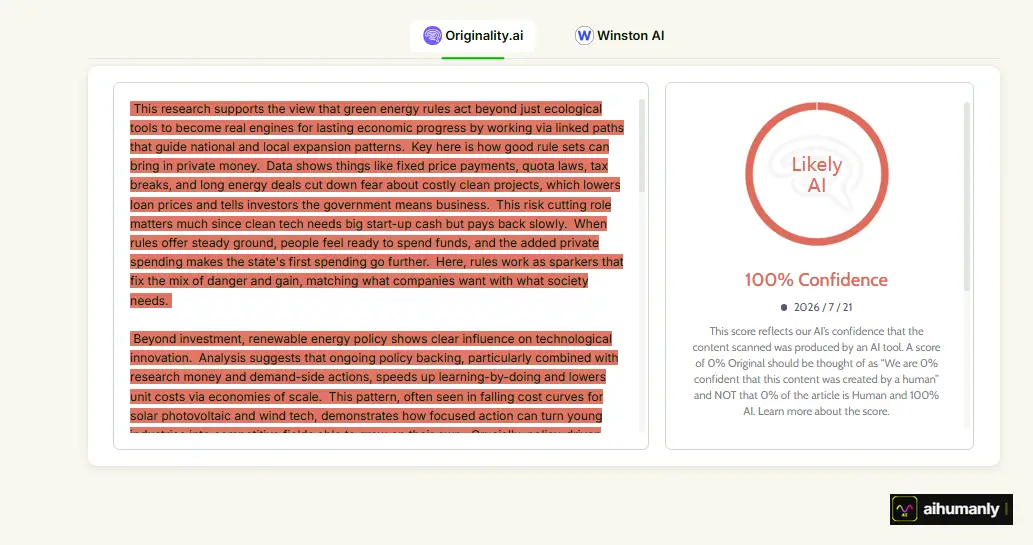
| Originality.ai | AI | 100% AI | ❌ Fail |
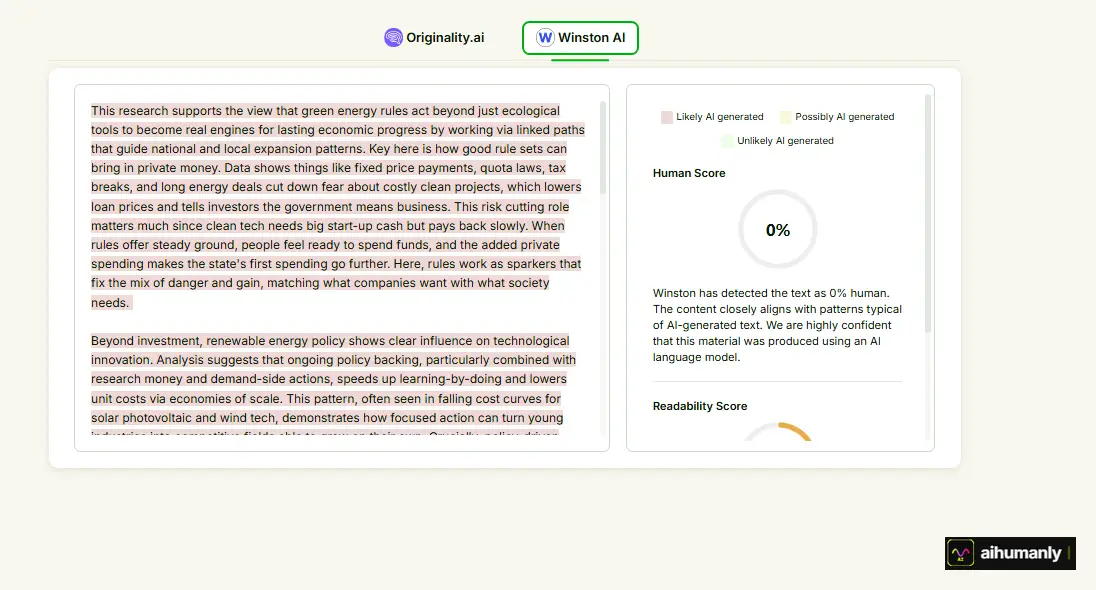
| Winston AI | AI | 100% AI | ❌ Fail |
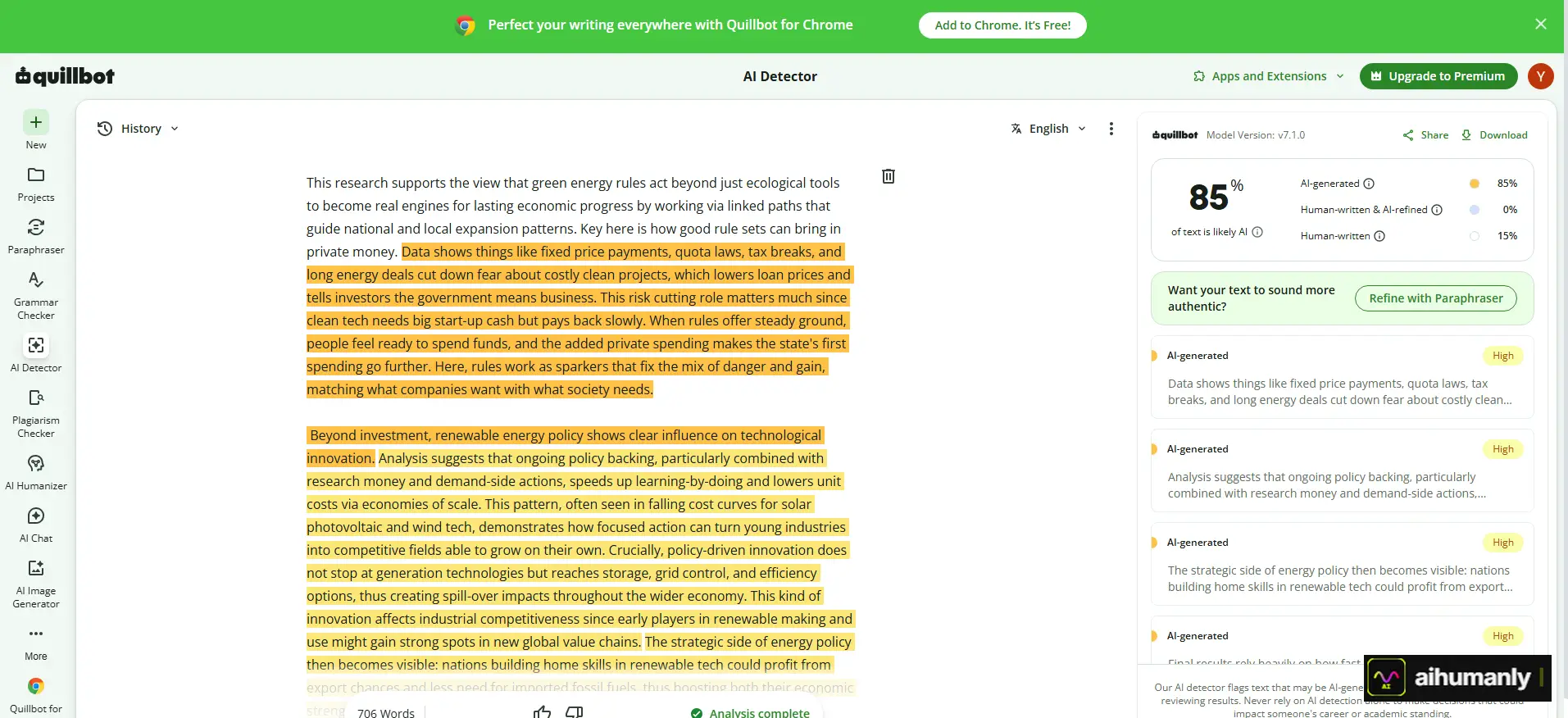
| QuillBot | AI | 85% AI | ❌ Fail |
| Copyleaks | AI | 100% AI | ❌ Fail |
Score: 1/6 passed (only ZeroGPT)
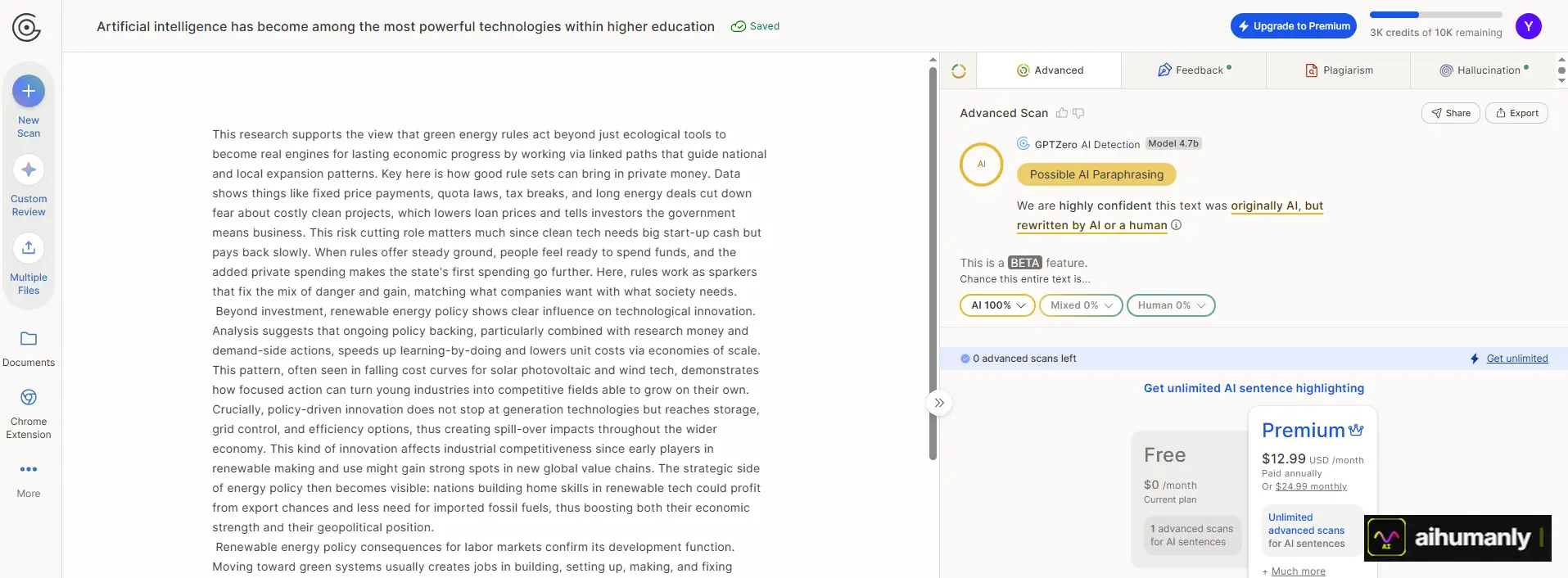
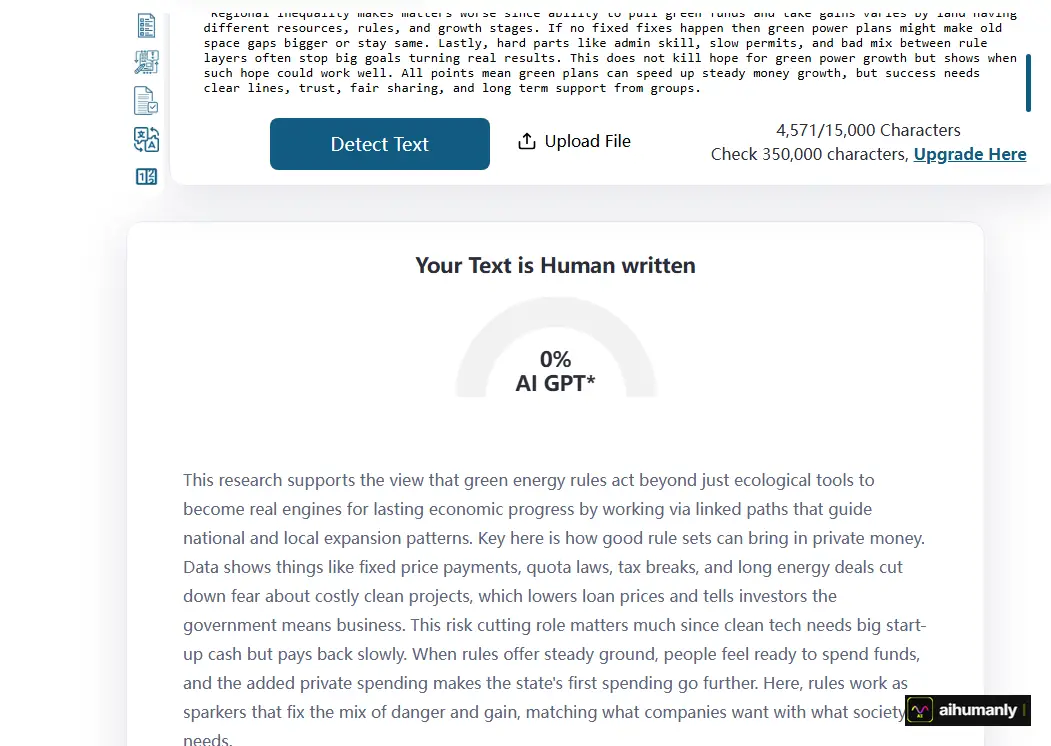
HumanizeAIText struggled even more on Essay 2. Only ZeroGPT classified the text as human. All other detectors — including GPTZero, which had given a borderline pass on Essay 1 — now flagged it as 100% AI.
Grammarly AI Humanizer Results (Essay 2)
| Detector | Result | AI Score | Verdict |
|---|---|---|---|
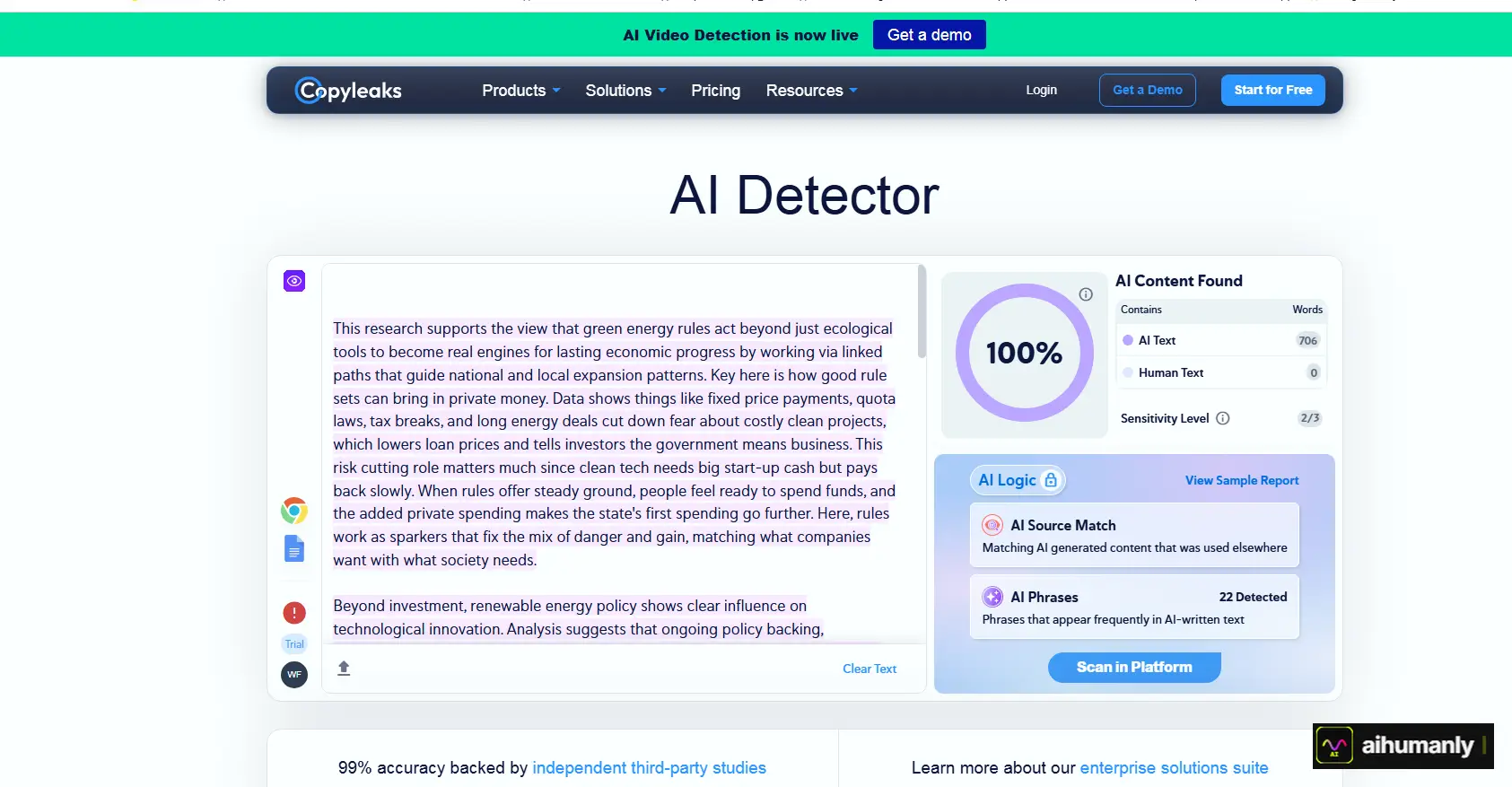
| GPTZero | AI | 100% AI | ❌ Fail |
| ZeroGPT | AI | 94.7% AI | ❌ Fail |
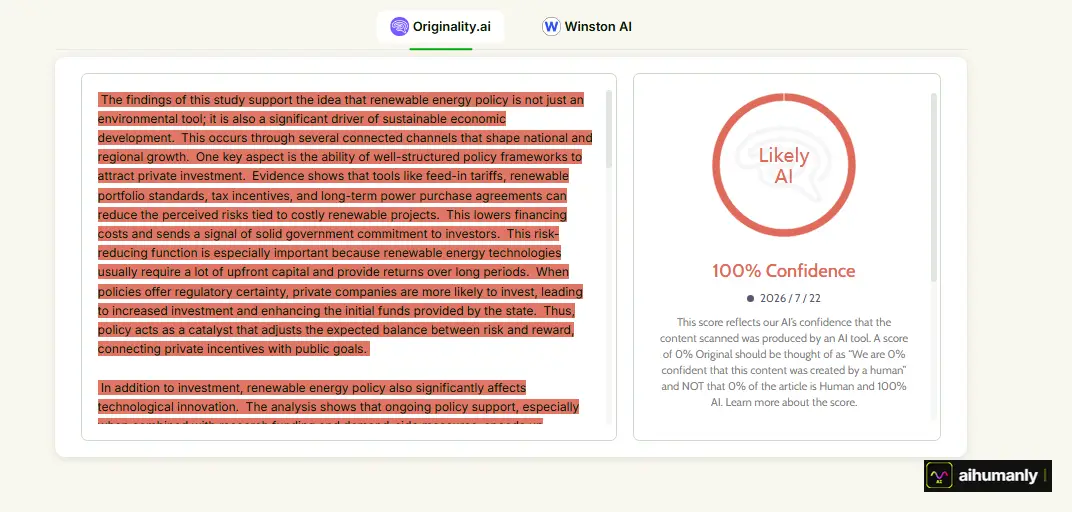
| Originality.ai | AI | 100% AI | ❌ Fail |
| Winston AI | AI | 100% AI | ❌ Fail |
| QuillBot | AI | 100% AI | ❌ Fail |
| Copyleaks | AI | 100% AI | ❌ Fail |
Score: 0/6 passed
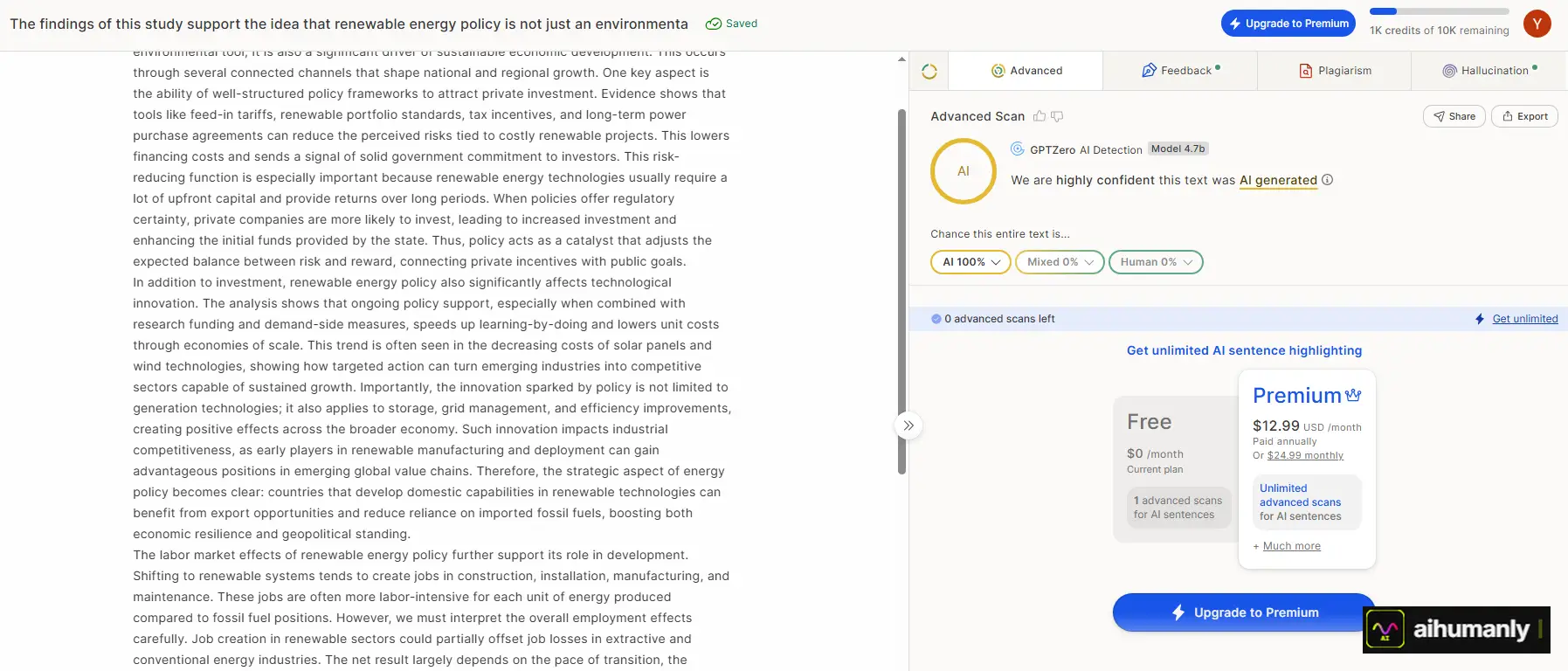
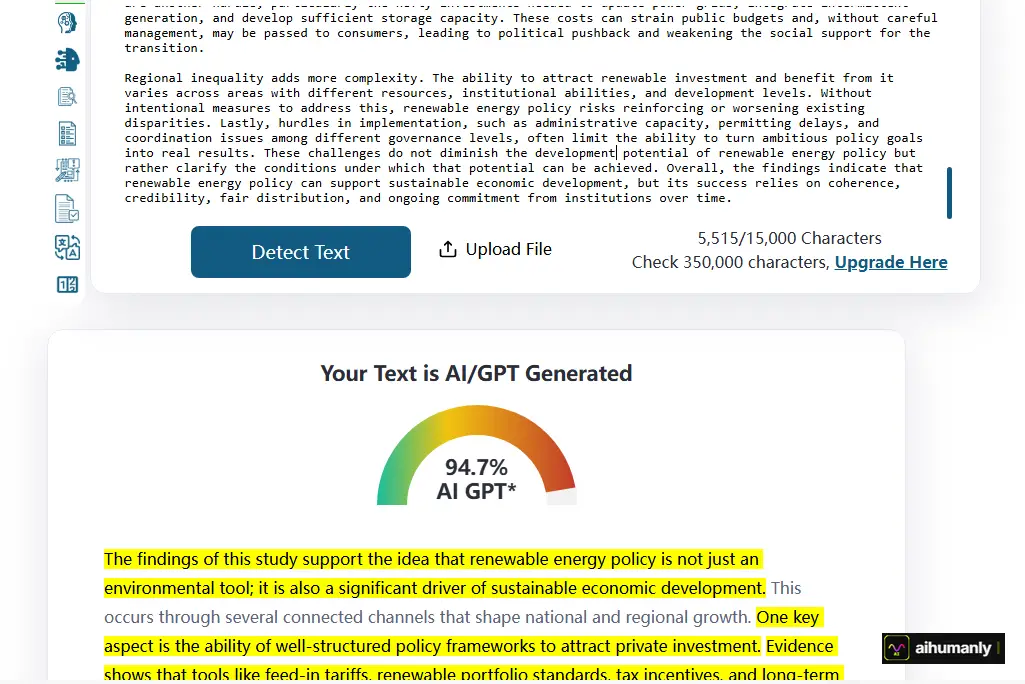
Grammarly completely failed on Essay 2. Every single detector identified the text as AI-generated, most with 100% confidence. Grammarly's humanizer made only superficial changes to the text — the underlying AI patterns remained fully intact.
Side-by-Side Comparison: All Detectors, Both Essays
Essay 1: "The Impact of AI on Higher Education" (GPT-5.5)
| Detector | Original AI | CleverHumanizer | HumanizeAIText | Grammarly |
|---|---|---|---|---|
| GPTZero | 100% AI | ✅ 0% | ✅ 45% | ❌ 100% |
| ZeroGPT | ~100% AI | ✅ 29% | ✅ 15.2% | ❌ 99.5% |
| Originality.ai | ~100% AI | ❌ 99% | ❌ 100% | ❌ 100% |
| Winston AI | ~100% AI | ✅ 0% | ❌ 100% | ❌ 100% |
| QuillBot | ~100% AI | ✅ 26% | ❌ 84% | ❌ 100% |
| Copyleaks | ~100% AI | ✅ 0% | ❌ 100% | ❌ 100% |
| Pass Rate | 0/6 | 5/6 | 2/6 | 0/6 |
Essay 2: "Renewable Energy Policy" (Claude Opus 4.8)
| Detector | Original AI | CleverHumanizer | HumanizeAIText | Grammarly |
|---|---|---|---|---|
| GPTZero | 100% AI | ❌ 100% | ❌ 100% | ❌ 100% |
| ZeroGPT | ~100% AI | ✅ 0% | ✅ 0% | ❌ 94.7% |
| Originality.ai | ~100% AI | ❌ 100% | ❌ 100% | ❌ 100% |
| Winston AI | ~100% AI | ✅ 18% | ❌ 100% | ❌ 100% |
| QuillBot | ~100% AI | ❌ 60% | ❌ 85% | ❌ 100% |
| Copyleaks | ~100% AI | ❌ 100% | ❌ 100% | ❌ 100% |
| Pass Rate | 0/6 | 2/6 | 1/6 | 0/6 |
Combined Results
| Tool | Essay 1 Pass | Essay 2 Pass | Total Pass | Pass Rate |
|---|---|---|---|---|
| CleverHumanizer | 5/6 | 2/6 | 7/12 | 58% |
| HumanizeAIText | 2/6 | 1/6 | 3/12 | 25% |
| Grammarly | 0/6 | 0/6 | 0/12 | 0% |
Analysis: Why Did the Tools Perform So Differently?
CleverHumanizer: The Clear Winner
CleverHumanizer achieved the best results across both essays. On Essay 1, it passed 5 out of 6 detectors — only Originality.ai still flagged it. On the more challenging Essay 2, it still managed to pass ZeroGPT and Winston AI.
Why it worked better:
- CleverHumanizer made substantial structural changes to the text, not just surface-level word swaps
- It reorganized sentence structures and varied the writing patterns
- The rewritten text reads more naturally, with more varied sentence lengths and transitions
Where it struggled:
- Originality.ai detected it on both essays (99% and 100%)
- On Essay 2, GPTZero and Copyleaks still flagged it as 100% AI
- The tool's Normal mode may not be aggressive enough for the most sophisticated detectors
HumanizeAIText: Inconsistent Results
HumanizeAIText showed mixed performance. It managed to pass GPTZero and ZeroGPT on Essay 1, but failed against the other four detectors. On Essay 2, only ZeroGPT gave it a pass.
Observations:
- The rewritten text uses somewhat awkward phrasing in places (e.g., "has become among the most powerful technologies")
- While vocabulary was changed, sentence structures remained fairly similar to the original
- The tool seems to focus more on synonym replacement than deep restructuring
Grammarly: A Surprising Failure
Grammarly's AI Humanizer was the biggest disappointment. Despite Grammarly's reputation as a leading writing tool, its humanizer barely modified the original AI text.
What we observed:
- Grammarly's output was almost identical to the original AI text
- Changes were limited to minor word substitutions and slight rephrasing
- Sentence structures, paragraph organization, and writing patterns remained virtually unchanged
- Every detector flagged it as 100% AI across both essays
Why it failed: Grammarly appears to treat "humanizing" as a light editing task rather than a deep rewrite. The tool is excellent at grammar and style corrections, but it doesn't fundamentally transform the statistical patterns that AI detectors look for. If you're hoping Grammarly will make your AI text undetectable, you'll be disappointed.
The Originality.ai Problem
One pattern that stood out across all tools: Originality.ai detected everything as AI.
Every single humanized output — from all three tools, on both essays — was flagged by Originality.ai with 99-100% AI confidence. This confirms what many users have reported: Originality.ai has the most sophisticated AI detection algorithms available, and it's significantly harder to fool than other detectors.
What this means for you:
- If your institution uses Originality.ai, even the best humanizer tools may not be enough
- Originality.ai should be your benchmark for testing — if a tool can pass Originality.ai, it's genuinely effective
- No tool in this test came close to bypassing Originality.ai
Writing Quality Evaluation
AI detection bypass is only half the story. The humanized text also needs to read well and maintain the original meaning. We used GPT-5.5 to evaluate each tool's output on four dimensions: Meaning Preservation, Academic Tone, Grammar and Fluency, and Formatting Consistency.
Writing Quality Scores
| Tool | Essay | Meaning | Tone | Grammar | Formatting | Average |
|---|---|---|---|---|---|---|
| CleverHumanizer | Essay 1 | 6 | 7 | 7 | 9 | 7.3 |
| CleverHumanizer | Essay 2 | 7 | 7 | 7 | 6 | 6.8 |
| HumanizeAIText | Essay 1 | 7 | 6 | 5 | 7 | 6.3 |
| HumanizeAIText | Essay 2 | 7 | 4 | 5 | 9 | 6.3 |
| Grammarly | Essay 1 | 9 | 8 | 9 | 10 | 9.0 |
| Grammarly | Essay 2 | 7 | 7 | 8 | 9 | 7.8 |
What the Scores Mean
Grammarly scored highest on writing quality (average 8.4/10) because it barely changed the original text. The meaning was preserved almost perfectly, and the grammar and formatting remained intact. But this is precisely why it failed every AI detector — it didn't rewrite enough.
CleverHumanizer achieved a middle ground (average 7.1/10). It made substantial changes to bypass AI detection, which inevitably introduced some meaning shifts and tone inconsistencies. The formatting remained mostly consistent, but the rewrites occasionally altered the original argument's nuance.
HumanizeAIText scored lowest on writing quality (average 6.3/10). The tool's synonym replacements often created awkward phrasing ("pupils studying another tongue," "has become among the most powerful technologies") and informal tone ("admin duties," "school duties"). The grammar and fluency suffered significantly.
The Trade-off
There's a clear trade-off between AI detection bypass and writing quality:
- High bypass + lower quality: CleverHumanizer and HumanizeAIText made aggressive changes that bypassed some detectors but introduced quality issues
- Low bypass + high quality: Grammarly preserved quality perfectly but failed to bypass any detectors
This suggests that current AI humanizer tools haven't solved the fundamental challenge: how to rewrite text enough to bypass AI detection while maintaining academic quality.
Key Takeaways
1. Dedicated AI humanizers outperform general writing tools
CleverHumanizer and HumanizeAIText both outperformed Grammarly's AI Humanizer. If your goal is to bypass AI detection, dedicated tools are the way to go.
2. No tool bypasses all detectors consistently
Even the best tool (CleverHumanizer) failed on Originality.ai for both essays and failed on several other detectors for Essay 2. There's no magic bullet.
3. Essay complexity matters
All tools performed worse on Essay 2 (the more complex, academic text) than on Essay 1. This suggests that simpler, more conversational AI text is easier to humanize effectively.
4. Grammarly's AI Humanizer is not worth it for detection bypass
If you're using Grammarly for grammar and style, great. But don't rely on its AI Humanizer to bypass detection — it barely changes the text.
5. Originality.ai is the hardest detector to bypass
Every tool failed against Originality.ai. If your target audience uses Originality.ai, you need to go beyond automated humanizers and do significant manual editing.
Limitations of This Test
- Two essays only: Results may vary with different content types, lengths, or subjects
- Normal mode only: We used default/Normal modes. Advanced or premium modes may produce different results
- Detector updates: AI detectors regularly update their algorithms. Results may change over time
- AI source variation: Essay 1 was from GPT-5.5, Essay 2 from Claude Opus 4.8. Different AI models produce different patterns
- Single run: We ran each text once. Multiple runs with different settings may yield different results
Final Verdict
Winner: CleverHumanizer
With a 58% overall pass rate (7/12 detector tests), CleverHumanizer is the clear winner. It's especially effective on less complex academic texts (Essay 1: 5/6 passed) and still manages to pass some detectors on more challenging content.
Runner-up: HumanizeAIText
With a 25% pass rate (3/12), HumanizeAIText showed some ability to reduce AI detection but was inconsistent across detectors.
Not recommended for AI bypass: Grammarly AI Humanizer
With essentially a 0-8% pass rate (0-1/12), Grammarly's AI Humanizer failed to meaningfully reduce AI detection scores. It's not designed for this purpose, and the results show it.
Appendix: Complete Test Data
For the complete original essays, all humanized versions, and detailed detector screenshots, refer to the test data files.
Related reading: For our earlier test comparing HumanizeAI.pro, MyDetector, and SuperHumanizer, see AI Humanizer Tools Tested: HumanizeAI.pro vs MyDetector vs SuperHumanizer for English Academic Writing.
This review is independent and not affiliated with CleverHumanizer, HumanizeAIText, Grammarly, or any AI detection tool. All test results are based on our own testing and are provided for informational purposes.